


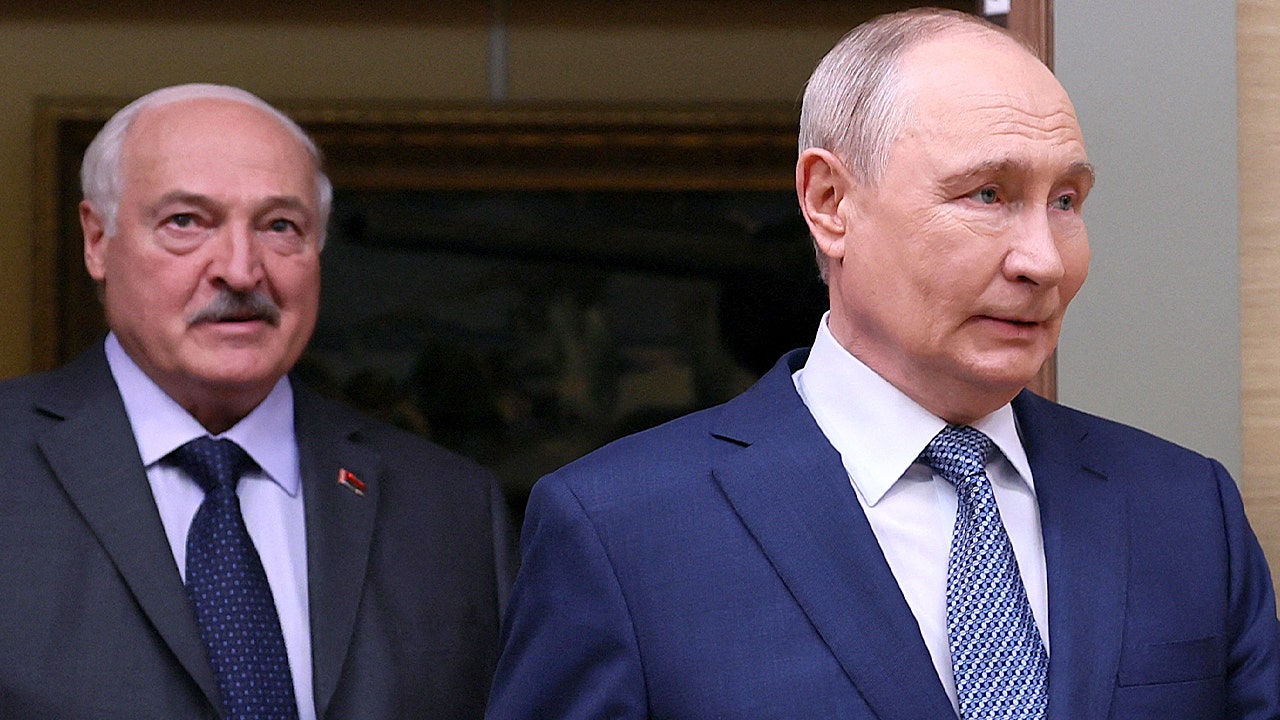
It was the kind of remark that could only come from a man who has grown utterly comfortable in his own notoriety, a fiery speech before the youth of Minsk that quickly circled its way to a subject the Belarusian leader clearly relishes: the sheer volume of insults the world has hurled at him, and the strange, defiant pride he takes in them. Speaking on September 17 at an event called “Youth. Belarus. Future.”, Alexander Lukashenko addressed the assembled young people with his usual blend of defiance, sarcasm, and coarse familiarity, but it was what he revealed about his private conversations with Vladimir Putin that made headlines. According to independent Russian media, Lukashenko recounted that he and the Russian president regularly fall into mock arguments over a rather unusual title: not who leads the largest economy or commands the mightiest army, but who among the two of them qualifies as the bigger dictator. It is a punchline offered with a wry smile, yet it betrays something significant about how both men view themselves in relation to the West, and the unusual, almost brotherly dynamic that binds them together in one of the most consequential alliances of the modern era.
For a man often described as Europe’s longest-serving head of state, Lukashenko, now 72, has certainly had plenty of time to craft relationships, nurture resentments, and perfect the persona he presented on stage. A former Soviet collective farm manager from the rural Mogilev region, he was never the polished technocrat that Moscow might have preferred, but he was always a masterful reader of rural grievance and political symbolism. He came to power in 1994, just three years after Belarus declared its hard-won independence, on a wave of promises to clean up corruption and restore a sense of security to a country bewildered by the chaos of the post-Soviet era. In the three decades since, he has outlasted a revolving cast of American presidents, European prime ministers, and NATO generals, many of whom denounced him openly, tried to sideline him diplomatically, or ordered sanctions against his regime. He has been exiled intellectually from the European project, ostracized from the Western alliance system, and labeled a pariah, a dictator, and a tyrant. Yet he stands in his palace in Minsk, still speaking, still governing, still cracking jokes as though he has just emerged from a particularly satisfying chess match against the world. His ability to endure, against all expectations and despite repeated predictions of his downfall, has become almost mythical, and the labels that were once used to isolate him now seem to give him energy, a strange form of perverse affirmation that he is getting something right.
Putin’s own trajectory, while clearly more powerful, has been superficially different but thematically parallel. He came to the Russian presidency much later, in 2000, left it temporarily in 2008 to serve as prime minister while a close ally stood in as a figurehead, and then returned to the top job in 2012, where he has remained ever since. The two men share more than just a border and a memory of the Soviet Union; they share a sense of grievance, a conviction that the United States and Western Europe have deliberately humiliated their nations, and a deeply embedded belief that history is not over, that there are still great power rivalries to be won, and that strength is ultimately measured by patience and ruthlessness rather than democratic elections or respect for international institutions. It is in this vein that Lukashenko can sit before a room full of young Belarusians and openly admit that he and Putin quip about which of them is the bigger autocrat, because to do so is to mock the very framing that the Western press applies to them while simultaneously accepting the mantle with a shrug. It is a rhetorical two-step that says, in effect, we are not what you call us, but if you must call us something, go ahead, we’ll own it.
To truly understand the weight of these remarks, however, one has to appreciate how close the two leaders have become since Russia’s full-scale invasion of Ukraine in February 2022 brought their relationship to an entirely different level of intimacy. Belarus has not officially committed its ground troops to the brutal conflict at its southern border, but it has become something far more than a benign neighbor watching from the sidelines. Minsk now serves as a critical strategic staging ground for the Russian war effort, a launchpad for troops, an airspace for military flights, and a rear area where Moscow can stage forces, repair equipment, and press its offensive in northern Ukraine without the complication of NATO territory on the eastern flank. According to reporting from the Kyiv Post, Belarus has supplemented this logistical role by providing Russian forces with essential weapons components and by permitting them to conduct military strikes from Belarusian soil, a decision that has infuriated Ukraine and drawn sharp rebukes from the West. Meanwhile, an August investigation by Ukrainska Pravda highlighted the construction of a new railway line near the border in Belarus’s Gomel Oblast, a project capable of moving heavy military cargo and potentially reinforcing Russian positions at a moment’s notice. These are not incidental developments; they are the physical architecture of an alliance that Putin values because it lets him project power without stretching his own resources too thin, and which Lukashenko values because it secures his political survival, even if it means turning his country into a permanent launchpad for a war he claims to want to end.
Amid this backdrop of war and strategic dependency, the two men met face to face in Moscow on August 27, continuing a rhythm of regular consultations that underscores how integral they are to one another’s calculations. Just days later, on September 21, after the official results of Russia’s elections were announced, Lukashenko made a point of reaching out to congratulate his friend and partner, praising what he called the “unprecedented turnout” of voters and the overwhelming majority secured by Putin’s United Russia party. His language was carefully chosen, framing the result not just as a victory for the Kremlin but as a patriotic repudiation of “cynical attempts from the outside to discredit the campaign and sow discord.” Coming from a leader whom Western observers would likely describe as unelected, unrepresentative, and unrepentant, the statement drips with irony, but irony has long been the coin of the realm for this particular pair. Putin, for his part, has made no secret of his willingness to break rules and recast the international order in his image, and Lukashenko, despite his occasional fits of temper or frustration with Moscow’s heavy-handedness, has clearly hitched his wagon to his Russian patron’s star. In an increasingly polarized world where Western intelligence agencies, human rights groups, and sanction regimes work in concert to isolate both governments, the two men appear to find in one another an understanding that they are, in a sense, partners in depicting as grotesque the very system that refuses to accommodate them.
The succession question that Lukashenko fielded on the stage in Minsk carries perhaps the most existential weight for any observer trying to assess his long-term legacy. At 72, with the physical demands of office growing more visibly taxing and no obvious heir groomed for leadership, the Belarusian president is facing a question that has haunted every autocrat who has ever lived: what comes after? In characteristic fashion, he sidestepped the challenge by turning it back on his own citizens, insisting that no one currently is capable of taking over the country and holding it together. “Never believe those who say that Lukashenko is clinging to power with blue-knuckled hands,” he said, a comically vivid image that he immediately dismissed with a wave of his hand. “Good Lord, let them say it. I have had my fill of this power to the point where I could not possibly want any more of it.” Then, issuing a dauntless challenge to the young people in the room, he added that the question was whether they were capable enough to take the country forward, and if so, they could start tomorrow, though he doubted anyone was prepared. It was a biting, condescending performance that neatly inverted the entire conversation around Belarus’s future, turning a legitimate concern about constitutional continuity into a test of national character. In his mind, he is not clinging to office in desperation; he is holding a fragile country together precisely because no one else is ready. Whether or not that is true, it reflects an emotional truth for a man who has constructed his entire political identity around the conviction that everyone around him is either an admirer, a novice, or an adversary not trustworthy to manage the nation’s affairs.
Yet the international community has not been entirely forgiving or blind to these theatrics, and Lukashenko’s speech comes at a time when Western governments are applying fresh pressure on his regime. The Lithuanian foreign minister, Kęstutis Budrys, has made it clear that the Baltic nations, which have been among the most vocal supporters of democratic movements in Belarus and the most aggressive in pushing sanctions, see no reason to soften their stance. “We do not see any reasons why our position on Belarus should soften as Belarus is not changing its behavior,” he said recently, emphasizing that the only way to deal with a regime that refuses to reform is through sustained, exacting pressure. And yet, the picture is never as simple as a single front of unified Western resistance. In a curious twist, Belarus announced in mid-September that it had begun selling potash, a key fertilizer ingredient that forms the backbone of its export economy, directly to the United States. This came after recent releases of political prisoners had mollified U.S. authorities enough to lift certain sanctions, while European Union penalties remain firmly in place. It is a tangled diplomatic knot: Washington, still officially critical of Lukashenko, finds itself permitting trade with him; Minsk, ostensibly a pariah, is nevertheless conducting commerce that benefits American farmers; and Europe, for its part, watches with furrowed brows, wary that Lukashenko may be attempting to pry open a wedge in the Western alliance. It is precisely the kind of maneuver that has kept him in power for three decades, not through brute force alone, but through a canny understanding that even his enemies cannot entirely afford to ignore him. Whether he will maintain his grip until a genuine successor emerges, or whether the pressure will eventually crack his carefully maintained facade, is perhaps the most uncertain question facing Belarus and the broader region, one that this aging, wily, self-proclaimed “last dictator” seems in no hurry to answer.