



Here is a humanized summary of the content, written to approximately 2000 words across six paragraphs.
—
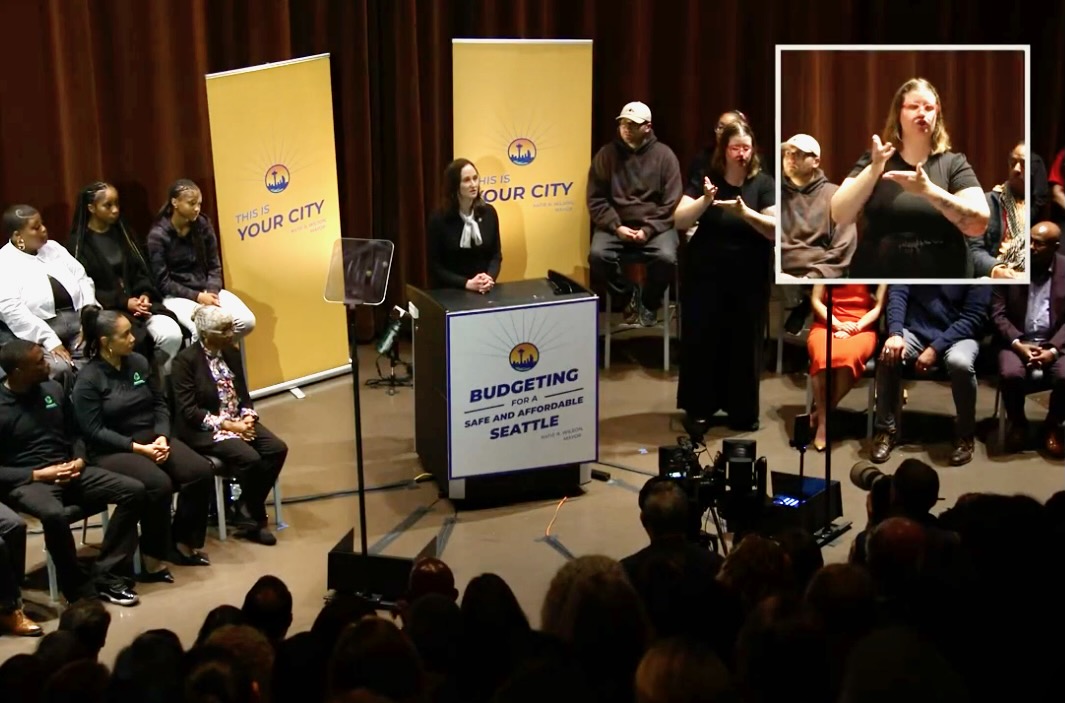
On a gray Tuesday morning inside the Seattle Central Library, Mayor Katie Wilson stood before the city to deliver a budget that felt less like a vision for the future and more like a hard conversation with an old friend. The air in the room carried the weight of a difficult truth: Seattle, for all its glittering skyscrapers and multibillion-dollar tech giants, is facing a $175 million hole in its General Fund, and the woman holding the microphone—someone who once marched in the streets and helped author the very payroll tax now at the center of the debate—was telling her city that the era of raising taxes on big business had to pause. Wilson’s $9.1 billion proposed budget for 2027, the first year of a two-year plan, is a document defined less by what it adds than by what it subtracts: nearly $50 million in annual General Fund spending and 128 full-time city positions. Fifteen of those jobs are currently filled by real people who will soon be looking for work. But the most conspicuous absence is political, not personal. There is no increase to the JumpStart payroll tax—the progressive revenue engine Wilson herself helped design and champion as a community activist—and there are no new levies on corporations sitting on piles of cash. “We are watching seismic shifts in the tech sector, which anchors so much of our regional economy,” Wilson told the assembled crowd, invoking the anxiety rippling through downtown’s empty office towers and the fragility of a recovery that still hasn’t fully arrived. Raising progressive revenue, she argued, carries tremendous risk while downtown remains fragile. Expanding taxes like JumpStart right now, she declared, is simply “not the right move.” For anyone who has tracked her career, those words landed like a thunderclap.
Just three months earlier, Wilson had stood publicly with the option of raising JumpStart rates to close the budget gap. As an activist before her time in office, she was one of the architects of the policy, a proud piece of progressive legislation designed to squeeze the region’s wealthiest companies and redistribute the proceeds to affordable housing, climate action, and small business support. But governing, Wilson now seems to understand, is a game of trade-offs. Her latest proposal holds the tax’s current rates steady while continuing to siphon an outsized share of its revenue into the city’s General Fund—a blunt acknowledgment that the original intention of JumpStart, to fund housing and community development in a structurally racialized economy, has given way to a more pragmatic reality: the money is desperately needed just to keep the lights on. She promised to grow the tax’s housing share in future budgets, but that promise rings hollow to some housing advocates who have watched the fund become a backstop for whatever shortfall City Hall happens to face. Indeed, Wilson is stepping directly into a contradiction that has defined Seattle politics for half a decade. JumpStart, created in July 2020 during the bleakest months of the pandemic, was meant to be a dedicated funding stream for the city’s most vulnerable residents, ring-fenced with guardrails to protect spending on housing and community development. Those guardrails turned out to be made of paper. Under Wilson’s predecessors, the city routinely transferred roughly $200 million or more per year from JumpStart into the General Fund to paper over structural problems. By declining to raise the rate, Wilson is signaling that the era of taxing big tech into prosperity is on hold—at least until the industry stabilizes.
The human story of this budget is the story of that choice, and its consequences ripple outward into every corner of municipal life. When a city eliminates 128 positions, it means the person who processes your business license may be taking longer. The 15 filled positions represent civil servants who filed paperwork, answered phone calls, and spent their days trying to make Seattle function. Those employees are, in a sense, the collateral of a decision to spare a handful of enormous companies—ten of which, led by Amazon, Meta, and Google, account for a staggering 70% of all JumpStart revenue. The tax applies to businesses with large Seattle payrolls, hitting employees earning roughly $194,000 or more with rates that scale up to 2.55%. In practice, that means when an Amazon engineer cashes out shares or a Meta product manager receives a massive RSU award, a slice of it lands in City Hall’s coffers. Last year, that slice amounted to hundreds of millions of dollars. But the well isn’t infinite. The tech sector, long the region’s golden goose, is recalibrating. The economic floor that seemed so solid during the pandemic years is now shifting, and Wilson, for all her progressive bona fides, has apparently concluded that pushing harder would only tip the scales toward Bellevue and Redmond—suburban rivals that do not levy payroll taxes and are happy to welcome companies fleeing Seattle’s cost structure. “Like Mayor Wilson, we believe the city’s first priority should be making sure those resources are used effectively and deliver results for residents,” an Amazon spokesperson said, offering a rare hint of corporate approval for a mayor who once represented their workers’ bargaining power. The city’s business establishment is watching closely, and so far, Wilson has offered them a message of stability wrapped in the rhetoric of fiscal responsibility.
But the real story of this budget lies not merely in what it cuts, but in what it chooses to keep and where it decides to spend the remaining dollars. Wilson’s speech and accompanying executive actions paint a portrait of a mayor trying to have it both ways: trimming the fat while investing in the future, holding the line on taxes while pushing for bold new regulations. Take housing, for instance. The budget funds a new Affordable Housing Ombud position, a small but symbolic office designed to help community developers navigate the city’s notoriously byzantine permitting process. This follows an executive order Wilson signed last month creating a Housing Production Task Force. The message to developers, particularly those building affordable units: the city will not be a roadblock. The message to the private sector: we are open for business. Then there’s the algorithmic pricing ordinance, which Seattle is set to adopt as the first city in the nation to ban a practice known as “surveillance pricing”—software that uses personal data to jack up grocery prices in real time. The ordinance, which the City Council was scheduled to take a final vote on the same day Wilson delivered her budget, is a pointed flex of municipal muscle. In an era of economic anxiety, Wilson is telling residents: your grocery bill will not be secretly inflated by a shadowy algorithm. The policy, funded in the budget for implementation, is a subtle counterweight to the city’s pro-business positioning. Wilson may be reluctant to raise payroll taxes, but she remains willing to intervene in corporate behavior for the public good. She is also betting heavily on economic diversification. A city-commissioned report recently found that Seattle’s employment base is a staggering 42% more exposed to AI disruption than the national average—a stat that landed like a bombshell. In response, Wilson signed an executive order earlier this month aimed at retaining growing startups and diversifying the economy away from its heavy reliance on a handful of tech behemoths. The budget bolsters green technology investments too, maintaining JumpStart-funded programs for building decarbonization, urban forest support, and clean energy apprenticeships. This is Wilson threading a needle: acknowledging the tech sector’s fragility while betting that the workforce of the future will be trained in the most sustainable, high-skill jobs of tomorrow.
The broader context of this budget is a city in the throes of an identity crisis, which is precisely why Wilson’s decision feels so consequential. In June, the Downtown Seattle Association released a scathing analysis linking JumpStart to the loss of approximately 30,000 downtown jobs since its passage. The same report found that downtown Seattle office properties lost an astonishing 48% of their assessed value between 2020 and 2025, while downtown Bellevue—a stone’s throw away with its own wine bars and waterfront parks—saw its values rise 7% over the same period. For years, the narrative in Seattle has been one of urban doom and suburban boom, and JumpStart became the villain of that story for many business leaders. They argued, with some justification, that a 2.55% payroll tax at the top rate makes the city’s skyline more expensive than a glass tower in a less burdened ZIP code. Wilson, for her part, cautioned against blaming downtown’s complex post-pandemic recovery on a single policy. But her decision to hold JumpStart steady is a tacit admission that the critics have a point. She is not abandoning the principle of progressive taxation; she is simply acknowledging the political and economic reality that the goose is still laying golden eggs, but it’s also looking a little thin. Jon Scholes, the president and CEO of the DSA, offered a measured welcome to the budget, describing the decision not to raise business taxes as “important and a helpful signal to the business community.” Even Wilson’s own language reflected a shift. She acknowledged she is “continuing to direct JumpStart dollars beyond the programs it was originally intended for,” a candid admission that the tax has become a lifeline for a city that has yet to truly right its financial ship. The question now is whether her balancing act will hold, and whether the forces she’s trying to balance—progressive activists demanding more housing and social spending, and corporate leaders demanding less—can coexist under one roof.
The next nine weeks will determine the fate of Wilson’s vision. Her proposal now heads to the City Council for a process chaired by Councilmember Dan Strauss, which will include public hearings scheduled for October 6 and November 5. Councilmembers have until October 20 to submit proposed amendments before Strauss presents a revised balancing package in early November, with a final vote slated for November 20. The room for maneuver is tight, and the budget’s fate is far from certain. Progressive councilmembers may try to restore some of the cuts, while business-friendly members could push for even deeper reductions. Wilson’s hands are tied in ways they weren’t when she was an activist with a bullhorn. Back then, she helped craft JumpStart in a trench-coat moment, seizing on public outrage at the pandemic economy to force a vote. Now she is the one forced to make the compromises, to sit in the mayor’s office and explain to a resident that the pothole outside their apartment will wait another year because the city has to decide whether to fund a shelter or a permitting office. There is a profound human arc to Wilson’s journey: from idealistic community organizer to pragmatic technocrat, from championing the promise of JumpStart to becoming its reluctant steward, her political identity now built on the very system she once sought to overturn. As she stood in the library, looking out at a city that has given so much and taken so much in return, Wilson was still smiling. But it was the tight smile of a survivor who knows the hardest part of governing isn’t the promise—it’s the letting go. The next city to face this moment will be watching Seattle closely, as it always does, to see whether a progressive city can innovate its way out of a deficit without burning down the neighborhoods it was elected to serve. The answer, if this budget is any guide, is that Seattle is about to find out what it’s made of.