

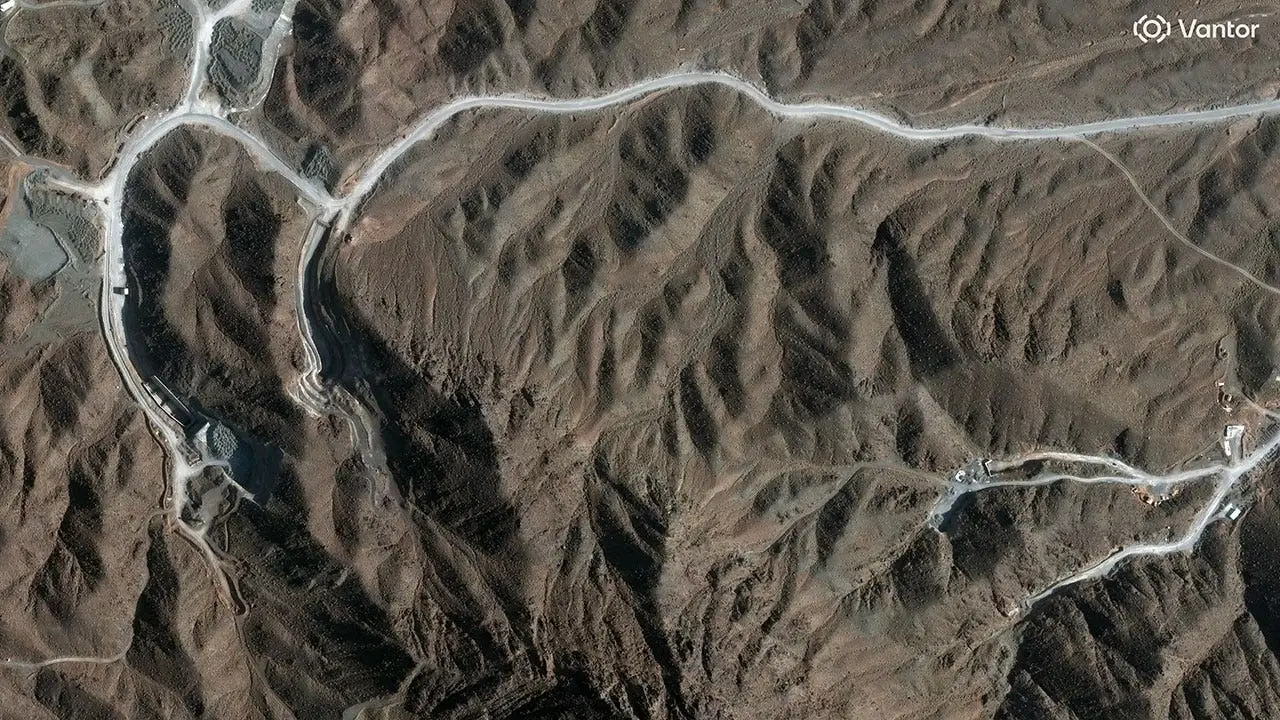
It’s one of those quiet, unsettling developments that only becomes visible from space. New satellite images of a mountain in Iran, known as Pickaxe Mountain, reveal that Tehran has been busily stacking earth and soil around the entrances to its underground tunnels, adding another layer of protection to a site that President Donald Trump has repeatedly threatened to strike. The mountain sits near the Natanz nuclear complex, and for years it has been a source of intense concern for Western intelligence agencies and nuclear analysts. The latest imagery, captured on September 11 and analyzed by the Institute for Science and International Security, shows earthen roadblocks still blocking the roads that lead to the western tunnel portals, a sign that the facility is not being used for normal operations. But the more striking detail is the fresh soil piled over one tunnel entrance and over a nearby cluster of entrances that were first built back in 2007. That extra earth might not sound like much, but in the world of hardened underground facilities, every additional layer of dirt and rock matters. It makes the entrances tougher to destroy, harder to reach, and more resistant to the kind of aerial bombardment that would come with any military strike. The report’s authors believe valuable equipment or materials are likely still inside, and Iran appears determined to keep them safe from anything Trump might send their way.
The timing is no accident. Just one week before the satellite images were made public, Trump issued another stark warning about the site. “We notice there’s a little activity at Pickaxe,” he told reporters. “I would advise Iran not to get cute because we will have to hit them very hard.” It wasn’t the first time he had raised the possibility of an attack. In a late July interview on “Fox & Friends,” Trump said the U.S. was watching Pickaxe closely and knew “exactly what’s going on,” adding that Washington could “take out Pickaxe” if diplomacy failed. The president’s words carry weight, especially given the broader standoff over Iran’s nuclear program and the sanctions pressure campaign his administration has been running. But the satellite imagery suggests Iran is listening and responding in its own way, not by backing down but by digging in. Pickaxe Mountain is located roughly two kilometers from Natanz, the sprawling nuclear site that has been at the heart of international tensions for decades. The underground complex at Pickaxe features multiple tunnel entrances leading into a deeply buried facility, and construction reportedly began in 2020, shortly after sabotage damaged an advanced centrifuge assembly building at Natanz. Iranian officials later confirmed that a replacement underground facility was being built for advanced centrifuge production, though they have insisted there is no nuclear activity at the site. Analysts estimate that portions of the facility may be buried at least one hundred meters beneath the mountain, making it a formidable target for even the most powerful conventional weapons.
The question of whether a strike could actually work is a matter of serious debate among defense experts. Behnam Ben Taleblu, senior director of the Iran program at the Foundation for Defense of Democracies, told Fox News Digital that some analysts believe the window for a straightforward attack on Pickaxe Mountain may have already passed. “The window to strike Pickaxe Mountain, according to some, has already expired because the regime has dug an underground nuclear facility several times deeper than Fordow,” he said. Fordow is another Iranian nuclear site, one that was hidden inside a mountain and later revealed to international inspectors. If Pickaxe is indeed far deeper, then the challenge of destroying it from the air becomes enormous. But Ben Taleblu argued that Washington still has military options even if destroying the entire underground complex is not feasible. “Washington can do what it’s traditionally been able to do with sites that are underground, hardened and fortified, and that’s to bury their entrances and raise the political cost to the Islamic Republic of being able to dig out,” he explained. In other words, the U.S. might not need to vaporize the whole mountain. It could instead collapse the entrances, trap whatever is inside, and force Iran to spend months or years digging its way back in, all while suffering the international embarrassment and strategic setback. “While there may not be the perfect munition just yet, Uncle Sam always has a bigger bomb,” Ben Taleblu added. “And in the meantime, what they can do is show that they mean business by burying the entrances.” That kind of approach would send a clear message, even if it doesn’t achieve the kind of dramatic destruction that military planners might prefer.
Pickaxe Mountain wasn’t the only site drawing attention this week. The same institute released a separate report about reconstruction at another sensitive Iranian facility, this time at Parchin, a military complex southeast of Tehran. There, Iran is “rapidly moving forward” with rebuilding Taleghan 2, a hardened facility that was destroyed by Israeli strikes in October 2024 and then hit again in March 2026 after Iran had already rebuilt and hardened it. Satellite imagery from September 13 shows that Iran has erected a large tarp over the destroyed facility, hiding the work underneath from the eyes of satellites and aerial surveillance. Around the site, dump trucks, bulldozers, concrete equipment, and cranes were all active, a clear sign that reconstruction is in full swing. The institute also noted that Iran has built new concrete reinforcement, which could provide additional protection against future attacks. The fact that Iran is so quickly rebuilding a facility that has already been struck twice suggests a pattern of determined defiance. Each time Israel or the United States destroys something, Iran seems to rebuild it, often with even more protection than before. The questions about what exactly Iran plans to do at Taleghan 2 remain unanswered, but the pace of work and the effort to conceal it from outside view speak to the regime’s priorities. It is a cat-and-mouse game played out in the shadows, with satellite imagery as the only window into what is happening behind those walls and tarps.
While all of this was unfolding on the ground, a separate confrontation was taking place at the United Nations. Russia and China on Thursday vetoed a U.S.-drafted Security Council resolution that would have extended for another year, until September 2027, the mandate of the Panel of Experts that supports the 1737 Iran Sanctions Committee. That panel is responsible for investigating alleged sanctions violations and reporting on how the sanctions are being implemented. The vote was lopsided, with eleven members in favor, but Russia and China, both permanent members with veto power, blocked it. Pakistan and Somalia abstained. The dispute is about more than just a technical extension. It reflects a deep and growing split over whether UN sanctions that were suspended under the 2015 nuclear agreement were legally restored through the so-called “snapback” mechanism. Most Security Council members maintain that the sanctions and related monitoring structures were revived, but Russia and China reject the legal and procedural validity of that position entirely. For the United States, the panel is a crucial tool in the fight against Iranian evasion. The day before the vote, U.S. Ambassador to the U.N. Mike Waltz told reporters in New York that Washington considers the sanctions legally restored. “The snapback sanctions… occurred, the United States and this U.N. Security Council followed appropriate procedures for that to occur,” Waltz said. “Those sanctions are in place and we expect those who are a party to fully enforce those sanctions.” He also stressed why the expert panel matters so much, noting that sanctioned companies and individuals often try to evade restrictions by changing names and corporate structures. Without the panel, that kind of evasion becomes much harder to track. “The president has been clear, and the world community has been clear with resolution after resolution, that the Iranian regime cannot have a nuclear weapon,” Waltz added.
Thursday also brought fresh United Nations scrutiny of both Washington and Tehran, adding yet another layer of complexity to an already tense situation. An independent U.N. fact-finding mission said it had reasonable grounds to believe that two U.S. strikes on civilian sites in Iran in February constituted war crimes. At the same time, the mission concluded that Iranian authorities had committed crimes against humanity during their crackdown on anti-government protests. The mission is investigative rather than judicial, and its findings do not themselves constitute criminal judgments, but they carry moral and political weight. For the United States, the accusation of war crimes is deeply serious, even if it comes from a body without prosecutorial power. For Iran, the finding of crimes against humanity reinforces the international community’s longstanding concerns about the regime’s treatment of its own people. Fox News Digital reached out to Iran’s U.N. mission for comment but did not receive a response in time for publication. In many ways, this report captures the tangled, dangerous nature of the current moment. There are military tensions over underground nuclear facilities, diplomatic battles over sanctions and international monitoring, and now a U.N. fact-finding mission pointing fingers in multiple directions. The world is watching Iran’s every move from above, and Iran is responding by burrowing deeper and building stronger. Whether that will ultimately lead to negotiation, confrontation, or something in between remains unclear. What is clear is that the stakes could hardly be higher, and the quiet work of piling dirt over a mountain tunnel may turn out to be one of the most telling signs of where things are headed.