







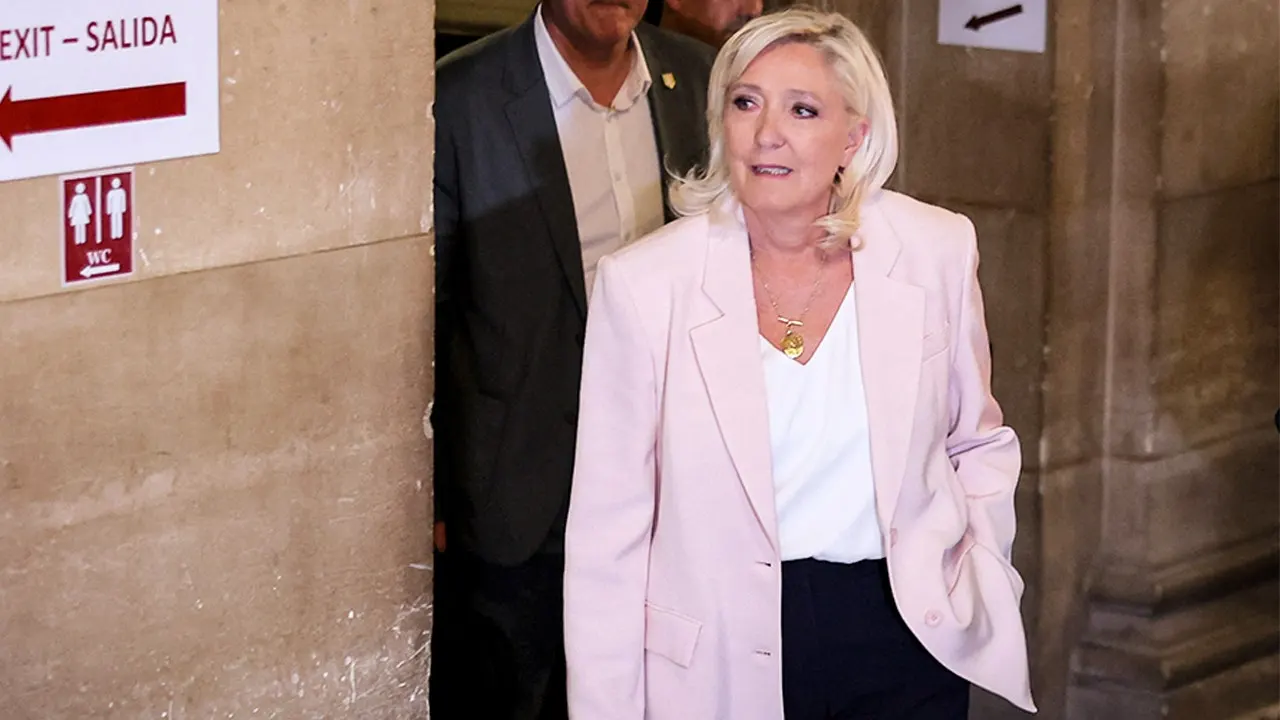
The French political landscape was sent into a tailspin this week following a Parisian appeals court ruling that has both burdened and liberated Marine Le Pen, the prominent leader of the right-wing National Rally party. In a dramatic twist of legal fate, the court upheld her conviction for embezzling European Parliament funds but slashed her punishment, crucially preserving her high-stakes ambitions to run for the French presidency in 2027. While she has officially escaped a career-ending five-year ban from public office, the compromise is a bittersweet victory: Le Pen must now navigate her imminent political future while serving a year of house arrest, complete with an ankle monitor.
At the heart of the scandal is a complex and long-running “lawfare” battle dating back to 2025, when a lower criminal court originally found Le Pen and nearly a dozen of her party associates guilty of systemic financial misconduct. Prosecutors argued that the National Rally—formerly known as the National Front—had orchestrated a sophisticated scheme to exploit millions of dollars in European Union funds. According to the court, these resources, which were strictly earmarked to pay the salaries of parliamentary assistants in Brussels, were instead diverted to fund domestic party operations and pay employees working exclusively on French political campaigns.
The initial judicial hammer fell incredibly hard on the conservative firebrand. Le Pen was originally sentenced to a daunting five-year prison term—with two years suspended and three years slated for house arrest—coupled with a devastating five-year ban on running for political office. This automatic restriction threatened to disqualify her from the upcoming 2027 presidential race, a contest in which she is widely expected to be a frontrunner. However, the appeals court significantly modified this sentence, reducing her active house arrest to just one year and shrinking her disqualification period to a mere 45 months, most of which are suspended. Because the court backdated the suspension to her original sentencing in March 2025, she is technically clear to run for office immediately.
Despite the legal relief, the logistical reality of Le Pen’s situation remains incredibly awkward. While she is legally permitted to launch a presidential bid, she must do so under the restrictive custody of an ankle monitor. This physical limitation presents an unprecedented obstacle for a populist politician who relies heavily on energetic, ground-level campaigning across the country. Addressing the media on Wednesday, Le Pen expressed deep skepticism about the viability of such an arrangement, questioning how she could genuinely run for the nation’s highest office if she is physically prevented from traveling and campaigning freely among the French electorate.
Throughout the trial and subsequent appeal, Le Pen has fiercely maintained her innocence, dismissing the allegations of systemic fraud. She conceded that some parliamentary assistants paid by the EU did indeed end up performing domestic chores for her party, but she steadfastly characterized these instances as minor, administrative errors rather than a calculated conspiracy to defraud European taxpayers. Nevertheless, the appeals court was unmoved by these explanations, ordering the defendants to pay back a staggering €2.8 million in restitution to cover the misappropriated funds that were funneled into the National Rally’s apparatus over the years.
Faced with this mixed judicial bag, Le Pen’s defense team expressed a sense of guarded relief, stating they were “partially satisfied” with the verdict but would take time to fully review the court’s complex decision. Demonstrating her trademark resilience, Le Pen bypassed any public displays of despair, heading straight from the Parisian courthouse to her party’s headquarters to immediately huddle with strategists and chart her next moves. As her legal team weighs their final options, the French public is left watching a highly unusual political drama unfold, where the country’s most prominent opposition figure must balance the pursuit of the presidency with the restrictive realities of a criminal sentence.