


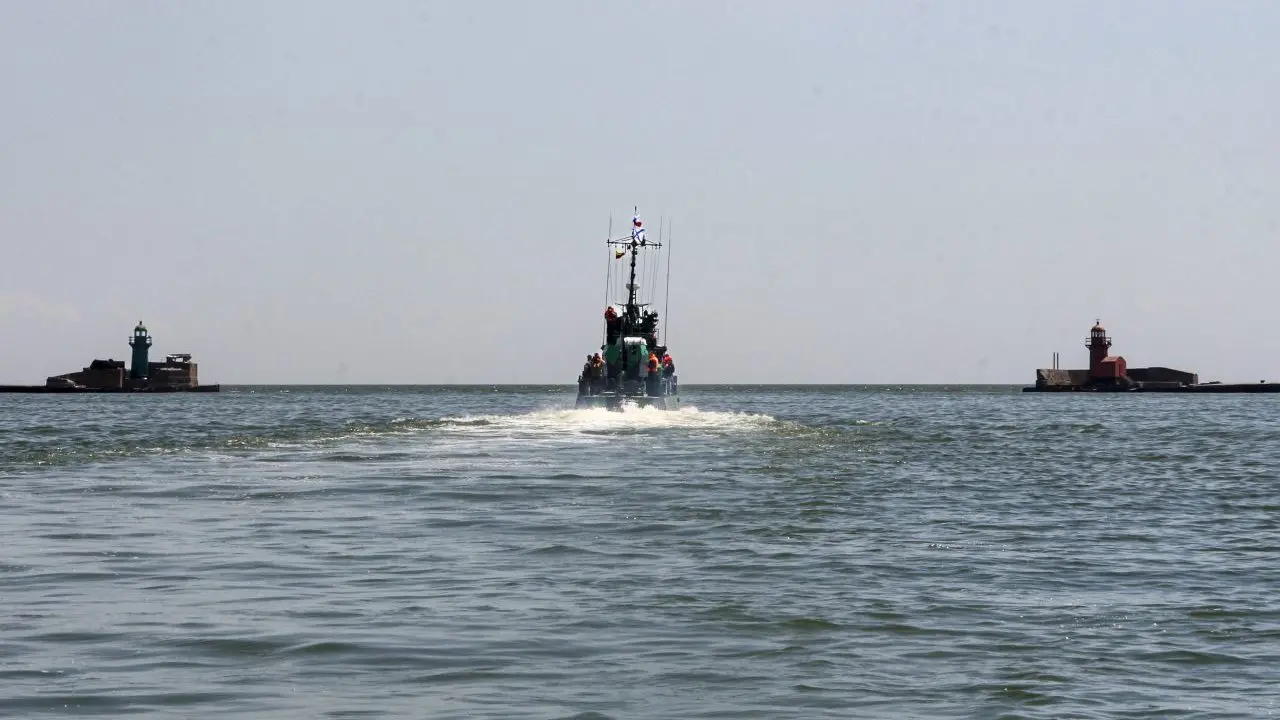
In the dark waters of the Black Sea, not far from the quiet Bulgarian coastline, what should have been an ordinary journey for commercial sailors became a sudden scene of catastrophe. A cargo ship, later identified as the Alfa Watan, vanished beneath the waves after a devastating strike on Tuesday, and its crew have not been found. The attack took place roughly 70 nautical miles off the eastern Bulgarian town of Byala, inside waters that belong to the exclusive economic zone of a NATO member. Bulgarian authorities scrambled to make sense of the scene: a wrecked vessel, an overturned lifeboat, life rafts bobbing in the debris, and life jackets floating where men and women had likely been just minutes before. As rescue teams searched the gray waters, a second ship, the ABLE, was also struck and set ablaze while carrying grain. The crew of the ABLE managed to evacuate, but the Alfa Watan’s sailors remain missing, their families left in limbo, waiting for news that may never come. The scale of the tragedy was amplified by the nature of the attack itself: Ukrainian President Volodymyr Zelenskyy immediately blamed Russia, saying this was a coordinated assault using both maritime and aerial drones. It was a chilling reminder that the war in Ukraine is no longer confined to the front lines of the Donbas or the streets of Kyiv; it is reaching into the shipping lanes and economic waters of Europe, where ordinary workers now find themselves caught in the crossfire of a conflict they did not choose.
The way the ships were attacked reveals something even more unsettling: this was not a random act of war or a stray missile, but a carefully planned, precision-driven operation that combined two types of drones in a way that military analysts say signals a dangerous escalation. Cameron Chell, the founder of the drone manufacturer Draganfly, told Fox News Digital that the sinking of the Alfa Watan likely involved both an aerial drone, possibly the Geran-4, and a marine surface vehicle, perhaps the Maran. The distinction matters because each type of weapon has different strengths and limitations. Chell explained that Geran drones usually come in at a steep angle when they are on a final attack, and they are not precision weapons that can skim just above the surface of the water to hit a ship at the waterline. To sink a vessel quickly and with such devastating effect, the attackers needed a surface drone that could strike low against the hull, or at least a combination of weapons that could overwhelm the ship’s defenses and create catastrophic structural damage. The fact that both vessels were struck at nearly the same time, even though they were sailing in opposite directions and one had only recently left Ukraine, points to an impressive level of coordination. “These things coordinated and were struck relatively at the same time,” Chell said. “So another level of coordination has unfolded here.” That coordination is not just a military detail; it is a sign that Russia is willing to use its most sophisticated tools in the Black Sea, close to NATO’s doorstep, in ways that blur the line between traditional warfare and acts of intimidation against civilian commerce. The attack is a stark reminder that modern warfare is no longer about soldiers facing soldiers on a battlefield; it is increasingly about drones, algorithms, and remote operators who can sink a ship from miles away, while the people on board are left with only seconds to react.
For the sailors who survived, the rescue was nothing short of miraculous. The Bulgarian ferry Dioscuria, which was nearby, diverted toward the scene after witnesses heard an explosion and picked up distress signals. The ferry crew arrived to find a scene of chaos and heartbreak: oil-streaked water, debris scattered across the surface, and, most painfully, an overturned lifeboat and life jackets that told the story of a desperate struggle to escape. The ABLE, the second vessel struck, was carrying grain when it caught fire, and its crew of 18 men — 11 Turkish nationals and 7 Indian nationals — were evacuated by the ferry. Two of those men suffered severe injuries and had to be airlifted by helicopter to a medical facility in Varna, the Bulgarian port city that became the center of the emergency response. The remaining 16 were brought safely to shore, but their relief must be mixed with grief and fear for the missing sailors from the Alfa Watan, whose number remains unknown. Bulgarian authorities launched an extensive search-and-rescue operation involving the Navy, the Air Force, and the Border Police, but as darkness fell and the sea refused to give up its secrets, hope began to fade. The ocean is a merciless place, and for families waiting at home in Turkey, India, and wherever the Alfa Watan’s crew called home, the silence from the Black Sea must feel unbearable. Every life jacket found in the debris is a reminder of a human being, someone who probably woke up that morning thinking only of the cargo to be delivered and the wages to be earned, not that they would become a casualty in someone else’s geopolitical calculation.
The political fallout was immediate and intense. Ukrainian President Zelenskyy said that Ukrainian intelligence and security services were working to determine the full circumstances of the attack, but he had no doubt about who was responsible. “This was a combined Russian attack using maritime and aerial drones,” he wrote on X, adding that Ukraine’s Navy had contacted its Bulgarian counterparts to share information. In Sofia, Bulgarian Prime Minister Rumen Radev convened an emergency government session and condemned the attack in the strongest possible terms, calling it a “gross, flagrant violation of international law.” He acknowledged that it was not yet clear whether the drones had originated from Russia or Ukraine, but he warned that the war was expanding in a way that threatened the entire region. “Such an attack within the Bulgarian exclusive economic zone is absolutely unacceptable,” he said. “If this war is not ended in time, it will continue to expand its spatial scope and increase the risk of even a global conflict.” For NATO, the attack inside the economic waters of a member state is a nightmare scenario: a conflict with Russia that has already brought war to Ukraine, threatened Moldova, and tested the Baltic states now appears to be creeping toward the alliance’s southern flank. The alliance has repeatedly said it will defend every inch of its territory, but an exclusive economic zone is a gray area, not quite territorial waters, and this ambiguity gives Russia room to probe and provoke without triggering a full Article 5 response. The fact that commercial ships were targeted, not naval vessels, makes the episode even more insidious, because it threatens the very basis of global trade and energy security. Every shipping company, insurance underwriter, and captain now has to ask a terrifying question: if drones can strike a cargo ship off the coast of Bulgaria, how safe is any ship in the Black Sea?
The strategic logic behind the attack, according to experts, may be even darker than the immediate tragedy. Cameron Chell suggested that the hybrid nature of the assault — combining aerial and maritime drones — is designed to create chaos and uncertainty across the region. “We can see the amount of geopolitical chaos that’s involved, and this is exactly the type of thing that would benefit Russia in the region,” he said. “The hybrid element here is really blurring the lines between traditional military actions.” By striking inside Bulgaria’s exclusive economic zone, Russia is not just attacking two ships; it is signaling that no part of the Black Sea is safe, and that any vessel, regardless of flag or cargo, could become a target. Chell drew a direct comparison to Iran’s strategy in the Strait of Hormuz, where the threat of attacks has made insurance rates so high and the risk so great that many commercial operators no longer want to send their ships through those waters. “The Russians are really taking a playbook out of the Iranians who have basically created enough chaos in the Strait of Hormuz where the operators can’t take the chance to put their ships through there,” he said. The goal is not necessarily to sink every ship, but to make the risk of operating in the Black Sea so intolerable that commerce collapses, Ukraine’s trade lifeline is strangled, and the world grows weary of the disruption. Chell called the attack “indicative of this larger invasion posture that seems to be unfolding for Russia” and said it appears to reflect “a real desire, what appears to be, for Russia to take things up a notch.” That is a terrifying prospect for everyone, because it means the war is entering a more volatile phase, one in which the rules of engagement are no longer shaped by the front lines but by the dark calculus of economic warfare and psychological terror.
Zelenskyy’s warnings did not end with the attack itself. Late Tuesday, he said that Ukrainian intelligence had obtained information indicating Russia was preparing a major new assault, a “massive strike” that could target Ukrainian cities and infrastructure. His words to his own people were stark and parental, urging them to take missile threat alerts seriously and to protect themselves. “I ask you, please, to take care of yourselves and respond to missile threat alerts,” he wrote. He also appealed directly to Ukraine’s partners, especially the United States and Europe, saying that Ukrainian air defenses were ready but that their ability to respond depended entirely on the weapons and support that allies were willing to provide. “A lot depends on our partners — every country in the world that has the defensive capabilities we need and can provide them to us,” he said. This plea came against a backdrop of growing concern across the region. The attack on the Alfa Watan and the ABLE was not an isolated incident; it was part of a surge of violence in the Black Sea that has already claimed lives. Just a day earlier, off the coast of Romania, two people died in a ship fire. A British firm that monitors maritime risk, Ambrey, recorded more than 210 strikes on commercial ships between July and the end of September. Each strike is a story of fear, damage, and, too often, loss of life. The Black Sea has become a haunted body of water, filled with mines, drones, and shadowy ships, where a sailor can no longer look at the horizon with peace but must watch the skies and the waves for the low hum of an approaching drone. For the families of the Alfa Watan’s missing crew, the wait is already unbearable. For the rest of us, the attack is a warning that the war in Ukraine does not stay in Ukraine, and that the price of indifference may be paid by people we will never know, in places we have never seen, in waters that belong to all of us.