







In a world continuously shrinking under the influence of global digital connectivity, a young couple in the conservative Indonesian province of Aceh recently discovered the terrifying point where virtual expression collides with ancient, rigid physical laws. The young man, aged twenty-two, and his partner, a twenty-five-year-old woman, were simply seeking a private moment of connection within the temporary sanctuary of a parked car one evening in March. In an act typical of a generation that documents its lives online, they decided to broadcast their interaction on a TikTok livestream, unaware that their digital display of affection—a simple, fleeting kiss—would set off a chain of events culminating in profound public humiliation and physical violence. Within hours of their stream going viral, the warmth of online engagement evaporated, replaced by the cold reality of handcuffs and state detention. The couple was swiftly arrested by the local Sharia police, beginning a grueling four-month journey through the penal system where they were locked away in a cell, left to contemplate the agonizing physical punishment that awaited them. This pre-trial confinement was a period of intense psychological torment, though it ultimately served a clinical legal purpose: under local judicial guidelines, their months behind bars shaved four strokes off their final sentence, reducing their ultimate punishment from twenty-five lashes to twenty-one.
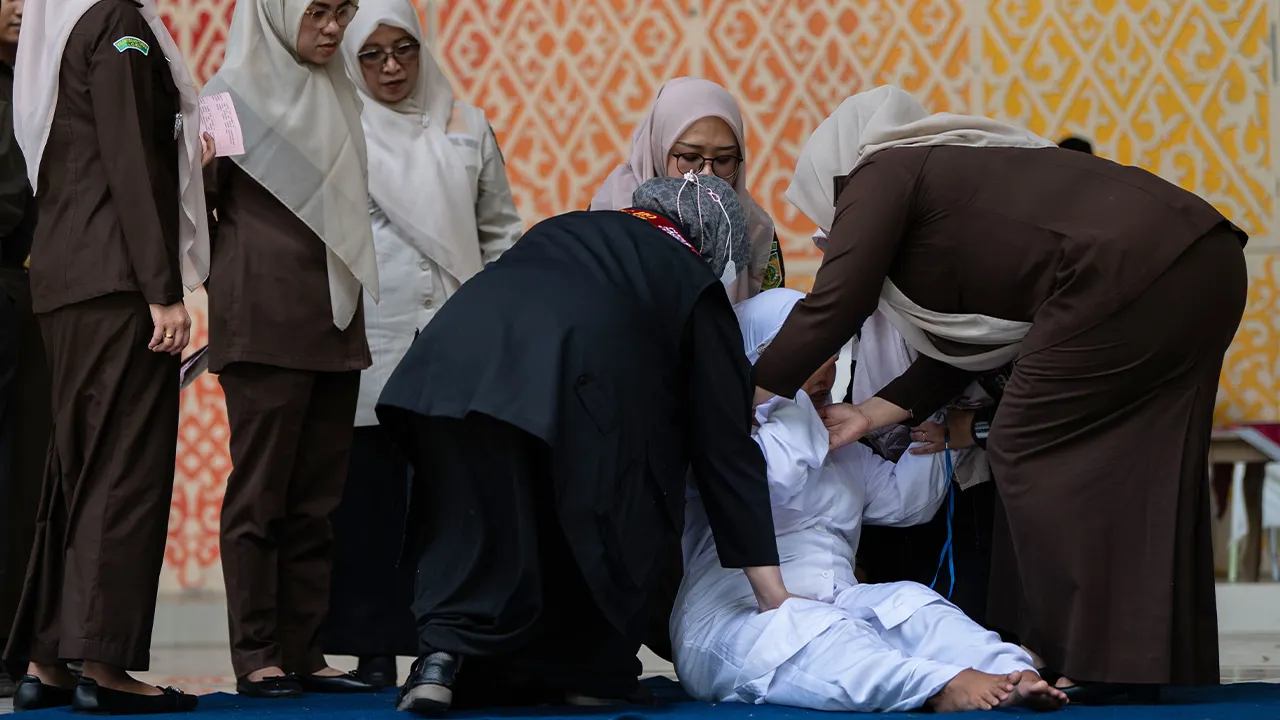
The physical execution of that sentence on a recent Thursday in Banda Aceh was a stark, agonizing spectacle designed to exert total state authority over the human body. Standing on an elevated public wooden stage, under the unwavering glare of the tropical sun and the watchful eyes of a gathered crowd, the young man and woman were forced to endure twenty-one successive strikes of a flexible rattan cane across their backs. Each blow landed with a sharp, echoing crack, designed by the authorities to inflict modern-day discipline through medieval levels of physical pain and public degradation. Public canings in Aceh are meticulously orchestrated events, drawing crowds of onlookers who witness the literal breaking of their neighbors’ spirits for transgressions against local moral codes. For the young couple, the sheer vulnerability of standing exposed before their community, knowing that their private intimacy had been transformed into a physical warning for all to see, inflicted psychological wounds that will far outlast the physical bruising on their skin. The scene illustrated a devastating paradox of the digital age: a modern smartphone had enabled their connection, but it had also facilitated a highly public, physically brutal stripping of their human dignity.
This tragic turn of events was not initiated by an active police dragnet, but by a highly efficient, crowdsourced system of community surveillance that has flourished in the internet era. The couple’s TikTok livestream, which they likely imagined would be lost in the infinite sea of social media content, was quickly intercepted by local “netizens” who viewed their affectionate display as a direct threat to the moral fabric of their society. In a chilling demonstration of digital vigilantism, residents took it upon themselves to document the stream, compile the evidence, and report the young lovers to the religious authorities. Sharia Police Head Muhammad Rizal later explained to the public that the swift arrest of the couple was a direct response to these community complaints, highlighting how local citizens have been successfully deputized as moral guardians of both physical and digital spaces. To ensure the complete sanitization of this perceived moral transgression, the Sharia court did not just punish the physical bodies of the couple; they also ordered the confiscation of the offending mobile devices and a USB drive containing the video. The authorities publicly promised to incinerate these physical artifacts, as if burning the hardware could somehow erase the digital memory of a stolen kiss and re-establish the rigid boundaries of their conservative sanctuary.
While global onlookers might view such physical castigation with profound horror, the viewpoint of many local residents reveals a complex, deeply internalized defense of these harsh measures. Standing among the spectators at the public caning was Aini Nadhirah, a twenty-two-year-old resident of Banda Aceh who is a direct peer of the punished couple. Her reaction to the whipping represents a common mindset within the province; she described the flogging as “entirely justified,” explaining that it serves as a critical warning and an educational tool for the younger generation. In the eyes of Nadhirah and many others who share her conservative worldview, the rapid spread of borderless social media represents a dangerous gateway to Western decadence and moral decay that threatens to erode their cultural and religious identity. To this segment of the population, the cane is not seen as an instrument of state-sponsored cruelty, but rather as a necessary, protective boundary that maintains social harmony and spiritual purity. This perspective humanizes a worldview that outsiders often dismiss as merely archaic, showing how a community’s deep-seated fear of losing its cultural soul can lead ordinary, peaceful citizens to embrace physical violence as a legitimate act of collective self-defense and moral education.
To comprehend how such a legal system can legally operate within Indonesia—the world’s most populous Muslim-majority country, which is otherwise governed by a secular central constitution—one must examine the painful, bloody history of Aceh province. The region serves as a unique political anomaly, holding the exclusive right to enforce its own strict interpretation of Islamic Sharia law. This legal autonomy was not grant-funded overnight, but was instead the result of a highly delicate peace agreement forged in 2005 between the secular Indonesian national government in Jakarta and the Free Aceh Movement, designed to bring an end to a brutal, decades-long separatist insurgency that had claimed over fifteen thousand lives. In the years following the peace deal, the local government gradually expanded the scope of its Islamic Criminal Code, codifying strict laws that criminalize a wide matrix of personal behaviors, including gambling, drinking alcohol, adultery, same-sex relationships, and premarital intimacy. What began as a highly specific political concession to preserve national unity and stop a civil war has slowly evolved into a comprehensive system of moral regulation that now even applies to non-Muslim residents, creating a society where the private behaviors of individuals are completely subordinated to the state’s pursuit of collective religious conformity.
This reliance on public physical violence has consistently placed Aceh at the center of an intense, unresolved global human rights debate. International watchdog organizations, including Amnesty International Indonesia, have repeatedly condemned the practice of public caning, classifying it as a cruel, inhuman, and completely degrading form of punishment that directly violates international treaties against torture, many of which the central government of Indonesia has formally ratified. Despite this persistent international pressure, local authorities in Aceh remain entirely unmoved, fiercely defending their legal sovereignty and arguing that the caning does not meet the definition of torture, but is rather a spiritual and corrective discipline rooted in cultural self-determination. This unyielding division leaves vulnerable individuals, like the young TikTok couple, trapped in a tragic, high-stakes geographical and ideological crossfire. As the immediate media attention surrounding their arrest begins to fade, the young man and woman are left to pick up the shattered pieces of their lives in a small community where they have been physically marked and socially exiled, serving as a sobering, deeply human reminder of the devastating personal cost when the boundaries of human affection are policed by the uncompromising power of the state.