




The Night Wisconsin’s Democratic Soul Hung in the Balance
The air in Madison was thick with the smell of cheap coffee, nervous sweat, and the electric crackle of a political night that refused to end. As the clock crept past midnight, two rival campaign headquarters were locked in a tense, silent embrace with uncertainty. In one corner, the progressive insurgents supporting Francesca Hong, a democratic socialist with fire in her belly and a movement at her back, watched the numbers trickle in with a mix of hope and dread. In the other, the more polished, well-funded operation of David Crowley, the establishment’s anointed heir, tried to maintain a calm veneer while their advisors nervously refreshed their spreadsheets. The primary for the Democratic gubernatorial nomination had come down to a knife’s edge, with Crowley clinging to a slim lead of roughly 4,000 votes. But of course, with over 97% of precincts reporting, nothing was certain. The final verdict wasn’t lost on the ballots cast in the rural north or the bustling suburbs, but rather in the massive, multi-ethnic, deeply Democratic city of Milwaukee, where a blunder—a simple human error in the data upload process—had left 28,000 absentee ballots in a digital limbo, their fate unknown until the morning.
To understand the gravity of this moment, one had to understand the two figures at the center of this ideological tug-of-war. Francesca Hong, a state representative who burst onto the scene with a platform of Medicare for All, rent control, and a Green New Deal, was not your typical politician. She was a former chef, a daughter of immigrants, and a relentless organizer who viewed politics not as a career, but as a moral imperative. Her supporters were the young, the disenfranchised, and the working poor who felt the system had left them behind. They chanted her name with the fervor of a revival meeting, convinced that she represented a fundamental break from the status quo. On the other side, David Crowley, the Milwaukee County Executive, was the steady hand that party elders believed could actually win in November. He spoke the language of fiscal responsibility, pragmatic reform, and coalition-building. He had the endorsements of mayors, unions, and national Democratic donors who saw him as the safe choice to reclaim the governor’s mansion. The primary was thus not just a local contest, but a microcosm of the national battle raging within the Democratic Party—the passionate, sometimes unpredictable left versus the cautious, experienced centrists who feared losing the crucial independent voters.
As the night dragged on, the drama shifted away from the speeches and the exit polls to the mechanics of the vote itself. The delay in Milwaukee was a bitter pill to swallow. City election officials, usually meticulous, had made a fateful mistake—the digitization of the absentee ballots had stalled due to a technical glitch, leaving the largest cache of votes in the state unreported. For the Hong campaign, these 28,000 votes were their lifeline. Milwaukee was her territory, the heart of the progressive base, and the melting pot of diverse communities that resonated with her message of economic justice. Every minute that passed without those numbers felt like an eternity, a slow, agonizing torture. For Crowley, the delay was a strategic nightmare. He was ahead, but he hadn’t broken away, and he knew that a late surge from Milwaukee could easily wipe out his lead. The candidates themselves remained in insulated rooms, trading whispers with their campaign managers, while the supporters outside engaged in a nervous dance of speculation. The city’s election chief had promised the results would be posted by early morning, but in the world of high-stakes politics, an hour felt like a lifetime.
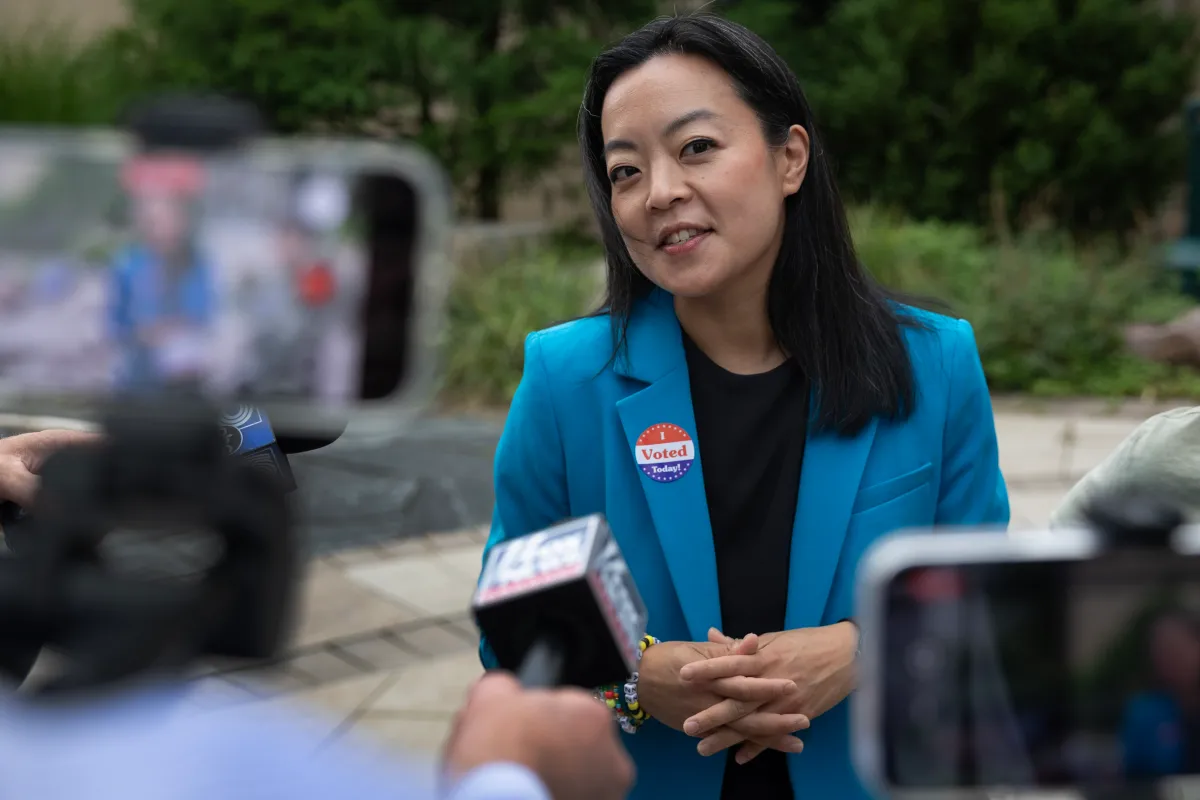
When Francesca Hong finally emerged to address her throng of weary but defiant supporters, the emotion was raw. She didn’t concede, and she didn’t declare victory. Instead, she gave a speech that was less about the election and more about the permanent revolution she believed she had ignited. “We have built something that will change politics forever,” she declared, her voice hoarse but unwavering. “The work we have done will be remembered forever. I know we don’t have the final results right now, but what I do know is we are ready to keep fighting.” It was a masterclass in political messaging—transforming a tense setback into a rallying cry. She framed the night not as a loss or a win, but as a continuation of a struggle for the very soul of the state. Across town, Crowley’s campaign issued a more cautious, prepared statement. “We’re still waiting for all the results to come in,” his spokesperson read, careful not to gloat. “We feel optimistic, but it’s not over until the votes are counted.” The contrast in tone was stark: one spoke of a movement, the other of a process; one promised a fight, the other promised a competent administration.
Yet, whoever emerged victorious from this primary would face a battle far more intense than the one they had just fought. The Republican nominee, U.S. Representative Tom Tiffany, was a staunch ally of former President Donald Trump, and he was already sharpening his attack lines. Wisconsin, a state that had gone for Trump in 2016 and remained a fiercely contested battleground, stood as a critical piece of the national electoral puzzle. The Republicans had controlled the entire state apparatus for years, riding a wave of gerrymandered district lines that had made it nearly impossible for Democrats to capture the Legislature, regardless of the statewide vote. This election was the Democrats’ best shot in a decade to break that stranglehold. They believed that Trump’s sagging approval ratings, coupled with a national Republican brand tarnished by extremism, would finally tip the scales. If Hong won the primary, her progressive energy could ignite the young voters who often stayed home. If Crowley won, his moderate appeal might sway the suburbanites who had grown tired of GOP chaos. The path to a Democratic victory in November was narrow, but it ran directly through this primary decision.
The implications of this race stretched far beyond the shores of Lake Michigan. For the first time since 2010, a Democratic governor, coupled with a favorable wave, could potentially flip both chambers of the Wisconsin Legislature. It would mark the end of a decade of one-party rule that had eroded unions, restricted voting rights, and slashed funding for public education. It would give the state’s government a fully unified Democratic control—a rare trifecta that could transform Wisconsin into a laboratory for progressive policy. But that destiny rested on the 28,000 uncounted ballots currently sitting in a Milwaukee warehouse. As the first hints of dawn began to break over the state, the campaigns could do nothing but await the final numbers. The night had been a testament to the democratic process—messy, flawed, and agonizingly slow. Yet, it was also a reminder of the high stakes involved, where every vote truly does carry weight. The story was still developing, but for the passionate souls who had spent months knocking on doors and making phone calls, the wait was not just a count of paper; it was the weighing of their dreams. In a few hours, the sun would rise, the numbers would come in, and the next chapter of Wisconsin’s political history would finally be written.