





On a quiet Monday night in the Kinnaird Avenue area of north Belfast, the fragility of human life and the delicate social fabric of a community were shattered in a single, devastating moment of violence. The victim of this horrific knife attack, whose identity remains protected as he clings to stability in a hospital bed, has had his life permanently and unimaginably altered. Beyond the immediate terror of the assault, the physical toll of his injuries is staggering; medical officials confirmed that the victim tragically lost his left eye as a direct result of the violence, and he remains in a serious, unstable condition. Such an injury is not merely a clinical statistic; it represents a profound, life-long trauma that will require years of physical rehabilitation and psychological healing. In the immediate aftermath, as sirens echoed through the dark Belfast streets and paramedics rushed to stabilize a man fighting for his life, the local neighborhood was left in a state of profound shock. The quiet residential area, usually a sanctuary of domestic routine, became an active crime scene, leaving neighbors to grapple with the realization that such extreme, life-altering brutality had occurred right on their doorsteps. This intimate tragedy, born in the shadows of a Belfast evening, would quickly cascade into a much larger, collective nightmare, demonstrating how rapidly a localized act of violence can ripple outward to tear at the seams of an entire society.
The human face of the accused was revealed on Wednesday morning when thirty-year-old Hadi Alodid appeared before the Belfast Magistrates’ Court, marking the formal beginning of a legal reckoning that has caught the attention of the entire nation. Flanked by security and facing the gravity of his situation, Alodid was formally charged with attempted murder, the possession of an offensive weapon—specifically a knife—in a public place, and making explicit threats to kill. The court proceedings offered a chilling look into the mechanics of the justice system as details of the attack were read aloud, leading the magistrate to remand Alodid in custody for a period of four weeks while prosecutors compile their evidence. Beyond the cold lexicon of criminal charges, Alodid’s presence in the dock represents a deeply complex human trajectory; he is a Sudanese national who navigated a perilous global journey to arrive in Northern Ireland in 2023. Having fled the systemic instability of his homeland, he sought asylum under the United Kingdom’s humanitarian provisions and was subsequently granted refugee status, securing “leave to remain” until 2028. This legal designation was intended to provide him with a path toward safety and integration, a chance to rebuild a shattered life in a peaceful society. Instead, within just a year of finding harbor in Belfast, his life has become inextricably linked to a catastrophic act of violence that has not only ruined his victim’s life but has also dismantled his own hard-won sanctuary, leaving him facing decades behind bars and igniting a fierce debate about the systems designed to monitor and integrate foreign nationals.
Before the legal system could even begin to process the events of Monday night, a digital wildfire was already raging across social media platforms, transforming a localized criminal act into a catalyst for widespread civil unrest. Within minutes of the incident, graphic video footage of the attack began circulating online, bypassing traditional journalistic filters and delivering raw, unedited horror directly to the smartphones of thousands of citizens. This digital evidence was swiftly co-opted and weaponized by anti-immigration activists and far-right influencers, who stripped the tragedy of its human nuance and used it to validate pre-existing political grievances and xenophobic narratives. On these digital platforms, the complex reality of a single individual’s criminal action was generalized into a broader indictment of all refugees and immigrants, turning a profound human tragedy into ideological ammunition. This rapid dissemination highlights the volatile intersection of modern technology and social anxiety, where algorithms designed to maximize engagement instead maximize outrage, transforming grief and fear into a potent fuel for real-world hostility. The speed with which the footage spread left little room for official facts, police clarifications, or appeals for calm, demonstrating how easily digital spaces can bypass the rule of law to incite mob justice and collective punishment.
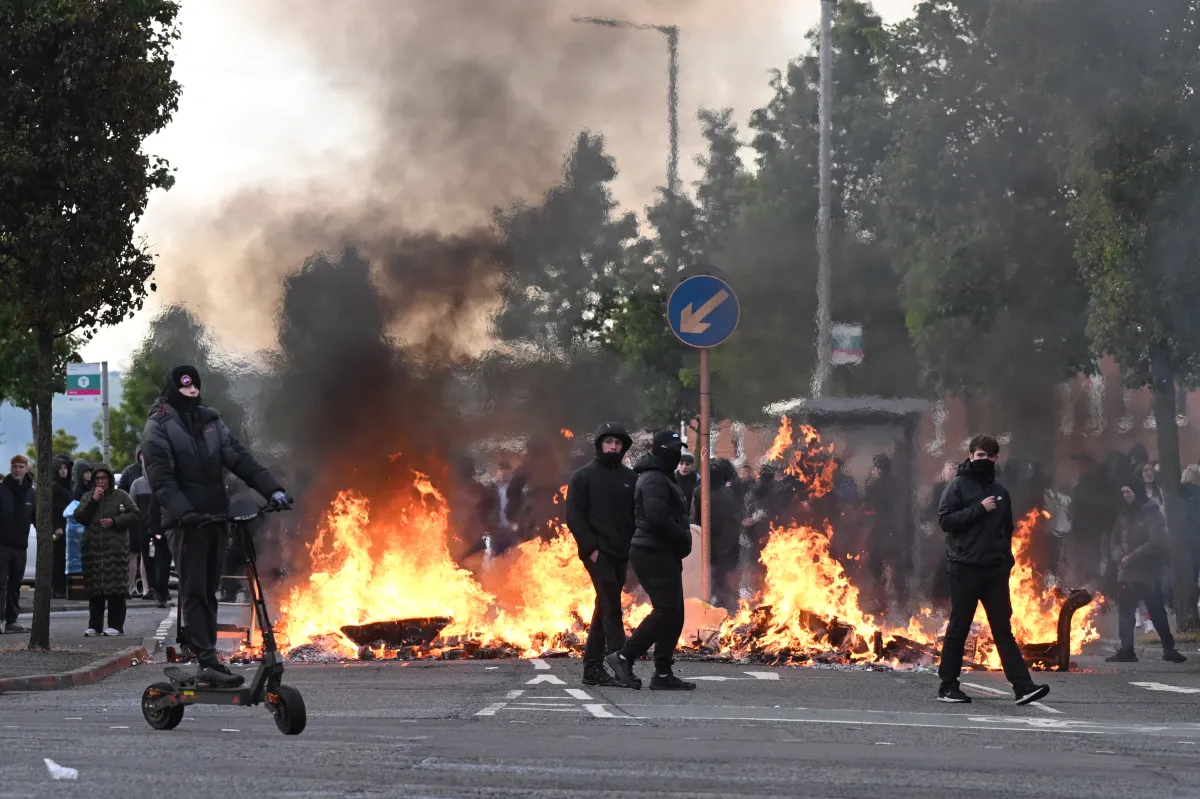
The real-world consequences of this online polarization manifested on Tuesday night as communities across Northern Ireland erupted into organized, terrifying violence. Under the cover of darkness, groups of masked men rode a wave of digital anger into the streets, transforming neighborhood corners into battlegrounds of fire, smoke, and debris. In several districts, these rioters set fire to trash bins, erected burning barricades, and pelted responding police officers with a barrage of bricks, fireworks, and petrol bombs. In one of the most visual symbols of the night’s chaos, a double-decker Belfast transit bus was hijacked and set ablaze, casting a grim, flickering orange glow over the asphalt. Most harrowing of all was the targeted targeting of residential properties, as several homes were set alight, forcing terrified residents to flee for their lives. Firefighters, operating under incredibly hazardous conditions while being targeted by rioters, had to perform several emergency rescues to pull innocent families from their burning houses. This collective rage, ostensibly sparked by a desire to defend the community, instead terrorized the very people living within it, proving once again that riots are an indiscriminate force that destroys innocent lives, businesses, and the sense of safety that communities require to survive and thrive.
At the heart of the resulting political and social debate lies the bureaucratic path that brought Hadi Alodid to Belfast, a journey that has renewed scrutiny of the UK’s immigration policies and border integrity. Confirming the details of his immigration status, a Home Office spokesperson revealed that Alodid had entered the United Kingdom in 2023 via the Common Travel Area, a long-standing border-free zone encompassing the UK, Ireland, and the Channel Islands. Assistant Chief Constable Ryan Henderson of the Police Service of Northern Ireland (PSNI) clarified during a press conference that Alodid is believed to have crossed the open land border from the Republic of Ireland, traveling from Dublin up to Belfast, where he settled in a residence close to the site of the attack. Under the provisions of the Common Travel Area, which is designed to facilitate seamless travel and economic cooperation between the British and Irish states, formal border checks are non-existent, a reality that critics argue creates vulnerabilities within the asylum system. For many residents, the realization that an individual could travel across jurisdictions, secure refugee status within the same year, and subsequently commit a violent crime has intensified anxieties about the government’s ability to vet and integrate newcomers. This systemic complexity highlights the delicate balance that democratic societies must strike between fulfilling their moral and legal obligations to protect fleeing refugees and ensuring the safety, surveillance, and cohesion of their domestic communities.
As the smoke clears from the streets of Belfast and the legal process grinds slowly forward, the community is left to contemplate the difficult path toward healing, reconciliation, and the restoration of order. In an effort to dispel rumors and de-escalate tension, the Police Service of Northern Ireland has firmly stated that there is no evidence to suggest the stabbing was an act of terrorism, nor are they searching for any other suspects, emphasizing that this was an isolated, criminal act of violence rather than a coordinated plot. This distinction is critical in preventing the further demonization of marginalized immigrant communities who have themselves expressed fear of retaliatory violence and displacement. The true victim in this tragedy remains the man recovering in the hospital, whose life has been forever altered, and the communities whose neighborhoods have been scarred by fire and hate. If Belfast is to heal, it must reject the toxic cycle of collective punishment and digital manipulation, recognizing that the criminal actions of one individual must not be used to justify the terrorization of many. The coming weeks will test the resilience of Northern Ireland’s peace, demanding that community leaders, law enforcement, and ordinary citizens stand together to demand justice through the courts rather than through the lawless violence of the streets.