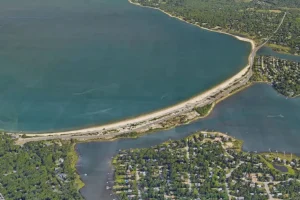





On what started as a quiet, ordinary Monday morning in coastal New Jersey, the peaceful routine of Stafford Township was suddenly shattered by a violent confrontation that underscored the high-stakes reality of federal immigration enforcement. On Route 72, near the quiet intersection of Mermaid Drive—a corridor typical of suburban Jersey transit—the mundane sounds of commuter traffic were abruptly replaced by the roaring of an engine, the sickening impact of metal against human flesh, and the sharp crack of a gunshot. At approximately 9:30 a.m., an Immigration and Customs Enforcement (ICE) agent was severely injured during a targeted vehicle stop that went catastrophically wrong. What was supposed to be a closely coordinated, routine arrest quickly dissolved into a scene of panic and survival, leaving a federal officer hospitalized, a suspect fleeing into the wind, and a local community grappling with the sudden eruption of violence on their local roads. The incident serves as a stark, visceral reminder of the unpredictable dangers inherent in the daily work of those on the front lines of law enforcement, where a split-second decision can mean the difference between life and death.
The central figure in the escalating drama was identified by federal officials as Friedrich Castillo-Ormeno, a Peruvian national whose presence in the United States had already been marked by the rigid bureaucracy of the federal immigration system. Castillo-Ormeno was a man living under the heavy, ticking clock of a final order of removal, which had been handed down by an immigration judge and slated for realization on January 30, 2026. For undocumented individuals, such legal mandates often represent a looming, terrifying precipice—the absolute end of the lives they have meticulously built in America and a forced return to the countries they left behind. When the ICE agents initiated their targeted vehicle stop on Monday morning, this abstract legal pressure collided violently with the physical reality of the highway shoulder. For Castillo-Ormeno, the flashing lights represented the arrival of his worst fear, triggering a desperate, desperate instinct to flee at any cost, transforming a routine regulatory arrest into a high-octane escape.
According to statements released by ICE spokespeople, the encounter escalated almost instantly when Castillo-Ormeno allegedly chose to “weaponize his vehicle” rather than surrender to the officers. Confronted by the agents, the driver revved his engine and lunged forward, striking one of the ICE officers with the heavy frame of his car. In that terrifying moment of impact, facing the immediate threat of being crushed or dragged under the vehicle, the struck officer drew his service weapon and fired, discharging rounds in an attempt to stop the threat as the car sped away. The sheer physics of the encounter—the vulnerability of a human being standing on the asphalt against thousands of pounds of accelerating steel—highlights the terrifying vulnerability of law enforcement officers in the line of duty. The suspect managed to maneuver his vehicle around the agents and sped away from Route 72, leaving behind a chaotic scene of blue smoke, spent shell casings, and a wounded officer lying on the pavement.
Within minutes of the gunfire, the local apparatus of emergency response sprang into action, demonstrating the profound camaraderie and seamless coordination that often defines first responders in times of crisis. Officers from the Stafford Township Police Department, though entirely uninvolved in the planning or execution of the federal ICE operation, rushed to the scene after receiving frantic calls reporting shots fired and an officer down. Upon arrival, local police immediately pivoted to saving lives, administering crucial first aid to the bleeding ICE agent before paramedics could arrive to transport him to a nearby hospital. The severity of the agent’s injuries remained closely guarded by officials, but the psychological and physical trauma of being struck by a fleeing vehicle hung heavily over the cordoned-off highway. Local officers quickly established a secure perimeter, shutting down lanes of traffic and turning Route 72 from a busy commercial artery into a sprawling, meticulously preserved crime scene.
As the dust settled, the administrative division of labor between local and federal authorities became clear, highlighting the complex jurisdictional lines that govern modern law enforcement. The Stafford Township Police Department quickly clarified to the public that their role was strictly supportive, limited to traffic management, local security, and life-saving measures, while the Federal Bureau of Investigation (FBI) stepped in to take complete control of the investigation. The involvement of the FBI shifts the weight of the incident into the highest tiers of federal criminal justice, as assaulting a federal officer carrying out their official duties is a major crime carrying severe penal consequences. A massive manhunt was launched across the region, with local, state, and federal agencies sharing intelligence, analyzing tire tracks, and scouring traffic cameras to locate Castillo-Ormeno, who managed to vanish into the surrounding area and remains at large, leaving a community on edge.
Ultimately, this violent incident on a New Jersey highway reflects the deep, painful human complexities that define the broader national debate surrounding immigration and law enforcement. On one hand, it highlights the immense, daily physical dangers faced by federal agents who are tasked with enforcing the law under increasingly volatile and politically charged circumstances. On the other hand, it reveals the sheer, desperate panic of individuals facing deportation, a panic that can drive people to make catastrophic decisions that endanger lives and ruin their own futures forever. As the wounded ICE agent begins his recovery in a local hospital and the FBI continues its pursuit of the fugitive Castillo-Ormeno, the sirens have faded, but the deep systemic anxieties, the fear, and the search for answers continue to ripple through the quiet communities of Stafford Township and beyond.