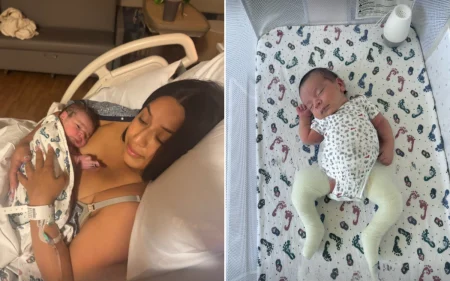






An Alaskan nurse and single mother of two, McKenna West, finds herself at the center of a deeply emotional and legally complex battle that spans multiple states. West, who became a surrogate through the Worldwide Surrogacy Specialists agency to supplement her income without sacrificing precious time with her children, is now fighting for the life of the unborn baby she carries. The child, affectionately referred to as “Baby Gabriel,” was conceived for a Californian couple, Nausheen Gilkar and Omar Ahmed. However, what began as an act of generosity and financial necessity has spiraled into a contentious legal war. The conflict erupted after a routine anatomy scan in April, during West’s twentieth week of pregnancy, revealed that the baby had a serious congenital heart defect known as hypoplastic left heart syndrome (HLHS). This diagnosis set off a chain of events that would pit West against the biological parents, who demanded she terminate the pregnancy, leading West to flee to Texas in search of legal protection and a chance for the baby to receive life-saving medical care.
Hypoplastic left heart syndrome is a rare and severe birth defect that affects the normal flow of blood through the heart. In this condition, the left side of the heart, including the mitral valve, left ventricle, aortic valve, and aorta, is underdeveloped, rendering it incapable of pumping oxygen-rich blood to the body. Without intervention, the condition is fatal, as the left ventricle cannot effectively support systemic circulation. However, HLHS is treatable, though not curable, through a series of complex, staged surgeries performed in early childhood. The first of these, the Norwood procedure, is typically performed within the first two weeks of life and involves reconstructing the aorta and connecting it to the right ventricle, which will then serve as the main pumping chamber for both the lungs and the rest of the body. This is an extraordinarily challenging operation, and the infant often appears bluish due to an incomplete separation of oxygen-rich and oxygen-poor blood. The second surgery, the bi-directional Glenn shunt procedure, occurs when the child is around four to six months old, creating a direct connection between the pulmonary artery and the superior vena cava. Finally, the Fontan procedure, performed between eighteen months and three years of age, connects the pulmonary artery and the inferior vena cava, allowing the body’s blood to flow passively to the lungs.
While these surgeries are designed to maximize the heart’s efficiency and improve the child’s quality of life, they are not a permanent fix. Children with HLHS face lifelong complications and require regular checkups with a cardiologist to monitor their condition. In some cases, the heart may weaken over time, necessitating a heart transplant, which would require the child to take immunosuppressive medications for the rest of their life. The causes of HLHS remain largely unknown, though a combination of genetic factors and other risk elements may increase the likelihood of its occurrence. According to the Centers for Disease Control and Prevention, approximately 925 babies are born with HLHS in the United States each year. Despite the severity of the condition, many children do survive and lead fulfilling lives with the appropriate medical care. For West, this prognosis was a beacon of hope, and she believed that Baby Gabriel deserved a chance at life, even if the biological parents did not share that belief.
The legal imbroglio began when the Californian couple, upon receiving the prenatal diagnosis, invoked the “abortion-upon-demand clause” in their surrogacy agreement and requested that West terminate the pregnancy. However, doctors in Alaska refused to perform the high-risk, late-term abortion, and the couple then asked West to travel to Seattle for the procedure. West refused, citing the treatable nature of the heart condition and her moral objection to ending the pregnancy. In her legal filings, West proposed a compassionate solution: she suggested that the biological parents “simply cut ties” with her and the baby, offering that her own brother had stepped forward to adopt the child once born. The couple, however, responded with threats, warning West that they would sue her for $250,000 if she did not comply with their demand to abort. They also escalated the conflict by filing a petition for parentage in California, attempting to establish their parental rights over the unborn child. West argued that this action breached the terms of the surrogacy contract, which explicitly stated that any legal proceedings should take place in Alaska.
The dispute has now spawned a convoluted legal battle involving multiple jurisdictions, including the Alaska Superior Court, the California Second District Court of Appeal, and a Dallas District Court in Texas. The Alaska Superior Court has ruled that California holds jurisdiction over the case, despite West’s objections. In a bid to secure medical care for the baby and to ensure that surgery would be performed once born, West relocated to Texas, a state where she sought legal custody of the child. Under Texas family law, the woman who gives birth in the state is automatically recognized as the legal mother, a provision West hopes will strengthen her position. The biological parents have filed a lawsuit demanding that West deliver the baby in California, but they have not provided any indication of whether they will consent to the necessary HLHS treatment for the child. The couple maintains that the case has been unfairly characterized as being solely about abortion and bodily autonomy, arguing that their parental rights are being disregarded in the process. This legal tug-of-war has created significant uncertainty about the baby’s future, with West’s attorney emphasizing that the priority is ensuring Baby Gabriel receives the medical attention he will need immediately after birth.
As the due date approaches in early September, the situation remains tense and unresolved. West has garnered significant public support, with a crowdfunding campaign launched on GiveSendGo by a friend of hers exceeding its initial goal of $40,000 to help cover her mounting legal expenses. The case has also drawn the attention of Texas Attorney General Ken Paxton, a staunch ally of former President Donald Trump, who has publicly thrown his weight behind West. Paxton announced on Tuesday that he had secured an emergency order to support West, preventing anyone from refusing necessary treatment for the baby and forbidding the child from being removed from Texas while the lawsuit is pending. In a statement, Paxton declared, “Baby Gabriel deserves a chance at life, and I will not allow anyone to unlawfully deny him medically necessary care. My office will use every tool available to protect innocent lives and ensure that every child receives the care required under Texas law.” He has also requested that UT Southwestern and Children’s Medical Center Dallas provide care for the baby upon its arrival. This high-stakes case now sits at the intersection of surrogacy law, abortion rights, parental rights, and medical ethics, with West adamant that she is doing what is best for the child she has carried for nine months.
The emotional and moral dimensions of this story are profound, as West is not just a surrogate but a mother who has formed an attachment to the baby she carries. She has publicly stated that she cannot, in good conscience, terminate a pregnancy for a child that can be treated and given a fighting chance at life. Her decision to relocate to Texas, leaving her own children and her home in Alaska, underscores her commitment to Baby Gabriel’s well-being. The case raises difficult questions about the autonomy of surrogates, the enforceability of contractual clauses that mandate abortion, and the rights of intended parents versus the gestational carrier. While West and the biological parents have not communicated amicably since the initial diagnosis, the outcome of this legal battle will have lasting implications for surrogacy agreements across the country. For now, all eyes remain on the Dallas courts and the upcoming birth, as both sides prepare for the next chapter in this harrowing saga. At the core of it all is a baby, due in just days, whose future hangs in the balance, waiting for a decision that will determine whether he receives the medical care he needs to survive.