





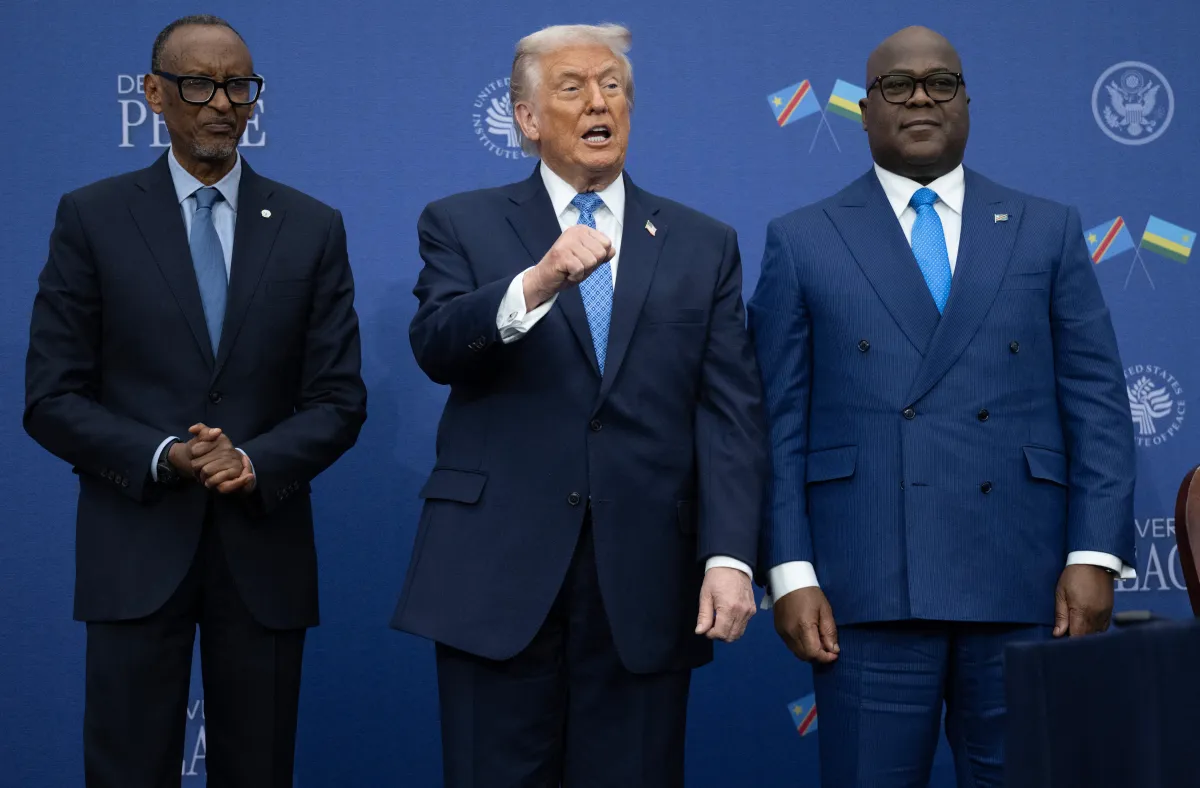
For nearly three decades, the breathtakingly beautiful, mineral-rich hills and valleys of the African Great Lakes region have been haunted by an agonizingly repetitive cycle of conflict, characterized by massive human displacement, shattered communities, and the sorrowful echoing of gunfire. When the United States stepped in to sponsor and host the historic Washington Peace Accords last year, a rare, flickering beacon of hope finally emerged for the millions of ordinary people in the Democratic Republic of the Congo and Rwanda who have known nothing but the horrors of war. This ambitious peace framework, heavily championed by the Trump administration, was designed not just as a dry diplomatic document, but as a living, breathing bridge toward sustainable regional stability, promising to unlock billions of dollars in American development investments that could transform a war-ravaged landscape into a prosperous economic powerhouse. Yet, nearly a year after the initials were signed on the parchment, that historic promise of peace has stalled in a frustrating, highly dangerous state of geopolitical limbo. On the ground, the peace process is rapidly crumbling because the international community, in its desperate rush to find a single villain to blame, has adopted an dangerously one-sided approach. To rescue this crucial diplomatic achievement and bring real comfort to a suffering population, the United States must recognize that a lasting peace cannot be built on selective memory, partial truths, or biased enforcement. Washington must shake off its current policy myopia and hold its new Congolese allies strictly accountable to the commitments they made, rather than allowing them to hide behind American favors while quietly fueling the flames of war in their own backyard.
This uneven playing field is painfully evident in the aggressive manner in which the United States has recently cracked down on Rwanda and its allied rebel group, the M23. Late last year, while President Donald Trump went to great lengths to host Congolese President Félix Tshisekedi and Rwandan President Paul Kagame to finalize the Washington Accords, the Rwandan-backed M23 launched a massive, aggressively timed offensive to capture Uvira, the second-largest city in Congo’s South Kivu province. This aggressive military push was a direct, public embarrassment to the administration’s high-stakes mediation efforts, prompting a furious, swift, and highly punitive retaliation from policymakers in Washington. In a series of the most drastic diplomatic and economic strikes witnessed in over a decade, the U.S. Treasury and State Departments slapped heavy sanctions and visa restrictions on elite Rwandan officials, while taking the unprecedented step of blacklisting the Rwandan Defense Forces—a proud national army that forms the core of the country’s economic and institutional identity, making it only the second national military in Africa to share this infamous distinction. Furthermore, Washington turned its sights on former Congolese President Joseph Kabila, penalizing him for providing financial resources to the rebels, while rumors circulated that President Kagame himself was denied an American visa to attend a prestigious event at Harvard University. These heavy-handed tactics sent a clear, unyielding message to Kigali that defying American peace initiatives would carry devastating consequences, but they also created a dangerous imbalance by leaving the other side of the conflict entirely unchecked.
While Kigali was being systematically starved of diplomatic oxygen and subjected to international isolation, President Tshisekedi and his administration in Kinshasa were enjoying unprecedented favor, positioning themselves as Washington’s darling new strategic allies. By playing a highly sophisticated game of geopolitical chess, the Congolese government signed a massive, comprehensive strategic partnership with the United States that essentially gave American technology and energy firms direct, highly lucrative access to the world-renowned Copperbelt region. This partnership is anchored by the ambitious, American-funded Lobito Atlantic Railway project, a massive infrastructure corridor designed to transport Congo’s vital critical minerals, such as cobalt and copper, westward directly to the Atlantic coast, securing supply chains for Western nations while bypassing competing routes dominated by Chinese interests. To sweeten the deal and cement this relationship with the Trump administration, Kinshasa even aligned its domestic policies with Washington’s sensitive immigration agenda, agreeing to accept deported migrants from Latin America and potentially parts of the Middle East. To external observers, the Congolese government appeared to be the ultimate model partner, trading valuable mining concessions and migration cooperation for powerful political cover. However, this cozy relationship has successfully blinded U.S. policymakers to Congo’s highly destructive actions on the ground, creating a dangerous moral hazard where Kinshasa feels entirely insulated from the consequences of its own military aggression.
The tragic irony of the current situation is that while the M23 rebels have largely taken a defensive stance and even yielded significant territory in compliance with intense American demands, the Congolese military and its violent local proxies have used this breathing room to actively escalate the conflict. Emboldened by American political shield, the Congolese army has deployed sophisticated military drones and launched aggressive ground offenses that have repeatedly devastated civilian neighborhoods and claimed innocent lives in eastern Congo’s urban centers. Even worse, during separate, Qatari-mediated negotiations aimed at de-escalating the crisis, Congolese officials have continuously stalled, using minor technicalities to block critical confidence-building measures. Most alarmingly, Kinshasa has utterly failed to honor its core pledge to stop funding and collaborating with ruthless nonstate armed groups. Instead, top Congolese army generals have actively sabotaged peace efforts, channeling millions of dollars every month to unruly local militias to wage a brutal proxy war against the M23. Chief among these state-sponsored proxies is the notorious Democratic Forces for the Liberation of Rwanda (FDLR), an extremist Hutu armed group founded by the perpetrators of the horrific 1994 Rwandan genocide. For Rwanda, the presence of an active, well-funded genocidal militia right on its border is a terrifying, existential threat. By continuing to arm and shield the FDLR, the Congolese government is not only violating the Washington Accords but is actively perpetuating the very cycle of trauma and violence that has kept the Great Lakes region in agony for generations.
This unconditional American backing has had disastrous domestic consequences within Congo itself, enabling a deeply troubling power grab that threatens the long-term viability of the U.S.-Congo alliance. Feeling completely untouchable, President Tshisekedi has weaponized the ongoing border conflict to justify dismantling democratic norms at home. He has actively used the continuous state of war to push for rewriting the national constitution, aiming to delay scheduled elections and clear a path for an unconstitutional third presidential term. Furthermore, his administration has strategically used the threat of U.S. sanctions and the specter of the M23 rebellion to launch a brutal crackdown on domestic political rivals, human rights occupiers, and independent journalists, labeling any dissenting voice as a traitor or a Rwandan sympathizer. This severe suppression has deeply alienated the democratic opposition in Congo, who now view the U.S. partnership not as a beacon of liberty, but as a financial and political lifeline for an authoritarian regime. This represents a massive strategic blunder for Washington; by tying its geopolitical fate so tightly to a corrupt and increasingly dictatorial leader, the United States is setting itself up for a devastating loss of influence. In a nation as historically volatile and fragile as Congo, regimes can collapse overnight, and when Tshisekedi is eventually ousted, the highly valuable critical mineral agreements and security partnerships could be permanently torn up by a vengeful successor government that remembers Washington’s complicity in their oppression.
To save the Washington Accords from total ruin, the Trump administration must urgently shift to a foreign policy of radical transparency and balanced accountability that holds both friend and foe to the same rigorous standards. The U.S. must immediately pressure the Congolese government to halt all logistical, financial, and military collaboration with the genocidal FDLR and initiate credible joint operations to neutralize the group once and for all. If Kinshasa continues to drag its feet, Washington should swiftly deploy targeted financial sanctions against the specific Congolese generals and politicians orchestrating this complicity, while threatening to suspend bilateral military assistance programs. Simultaneously, American diplomats must privately instruct President Tshisekedi to engage in the Qatari-led peace talks with genuine humility, urging him to accept crucial compromises, such as allowing a temporary, localized transitional administration for M23 in their historical strongholds. To offset the political danger Tshisekedi might face at home for making these concessions, the United States can use its critical minerals partnership to deliver highly visible economic victories—such as modern roads, clean energy projects, and stable jobs—that show the Congolese people the tangible benefits of making peace. A truly humanized, sustainable foreign policy understands that lasting stability in the Great Lakes region cannot be achieved through one-sided bullying; it requires the courage to demand integrity from our allies, ensuring that the heavy weight of justice falls equally on all who choose to feed the fires of war.