




In a modern world often dominated by loud spectacles, fast-paced blockbusters, and larger-than-life fictional heroes, there is something deeply comforting about the realization that quiet kindness still holds the ultimate power to capture our collective hearts. This truth was beautifully demonstrated when the United States Postal Service announced the winner of its historic “Stamp Encore” voting campaign, a ten-week-long public poll designed to mark the organization’s upcoming 250th anniversary. Among twenty-five beloved historical stamp panes, which included culturally massive contenders like the Star Wars droids, DC Comic superheroes, the Peanuts gang, and the iconic Bugs Bunny, it was a humble, soft-spoken man from Pennsylvania who emerged victorious. More than half a million votes were cast during the competition, and the 2018 commemorative stamp featuring Fred Rogers—the beloved creator and host of Mister Rogers’ Neighborhood—secured a landslide victory, outpacing its closest competitor by more than forty thousand votes. When the original stamp was first issued in 2018, its run of twelve million copies sold out almost immediately, taking postal officials completely by surprise. The resurgence of this stamp is not merely a nostalgic triumph; it is a profound testament to the enduring impact of a man who spent his life teaching children, and the adults they would become, that they are loved exactly as they are.
To understand why Fred Rogers continues to resonate so deeply across generations, one must look at how he viewed his relationship with his audience. Isaac Cronkhite, the Postal Service’s chief processing and distribution officer, eloquently observed that the Mister Rogers stamp touches the child residing within each of us—recalling Rogers’ own belief that we are not just the age we are today, but rather a composite of all the ages we have ever been. Fred Rogers did not speak at children from a distance; instead, he communicated with an intentional, direct intimacy that made every viewer feel uniquely seen and valued, addressing complex emotional landmarks with unmatched tenderness and respect. Emma Lee, the Director of the Fred Rogers Institute, noted that Rogers famously regarded the physical space between a television set and a young viewer as “holy ground,” a sacred emotional bridge that extended far beyond the broadcast itself. Historically, the thousands of letters written by children to Mister Rogers, and the deeply personal, hand-written replies he sent back, served as a physical extension of this sacred bond. It is incredibly poetic, then, that a man who was a passionately loyal postal customer and a tireless champion of the written word should be honored once again through the very medium he used to heal, comfort, and connect with millions of families during his lifetime.
Born in Latrobe, Pennsylvania, in 1928, Fred McFeely Rogers dedicated his entire adult life to the revolutionary idea that television could be used as a tool for nurturing the human spirit. In 1953, he co-founded the pioneering educational station WQED in Pittsburgh, where he worked behind the scenes as a composer, organist, and puppeteer on The Children’s Corner before launching Mister Rogers’ Neighborhood, which ran from 1968 to 2001. Every afternoon, millions of children watched him walk through his television doorway, sing “Won’t You Be My Neighbor?”, hang up his suit jacket to slip into a cozy, hand-knitted cardigan, and swap his dress shoes for comfortable blue sneakers. It was a comforting ritual of transition that prepared young minds for gentle explorations of emotional literacy, accompanied by educational visits to the fanciful “Neighborhood of Make-Believe” where puppets like King Friday XIII helped unpack real-world issues. Decades after the show’s final episode, that sense of community remains intensely alive, especially in Pittsburgh, where local citizens mounted a passionate grassroots campaign to secure the stamp’s victory, driving tens of thousands of interactions across social media to ensure their native son was honored. This legacy of teaching empathy continues to thrive today through the beloved PBS KIDS animated spin-off Daniel Tiger’s Neighborhood, proving that Fred Rogers’ philosophy is as essential to modern childhood as it was to previous generations.
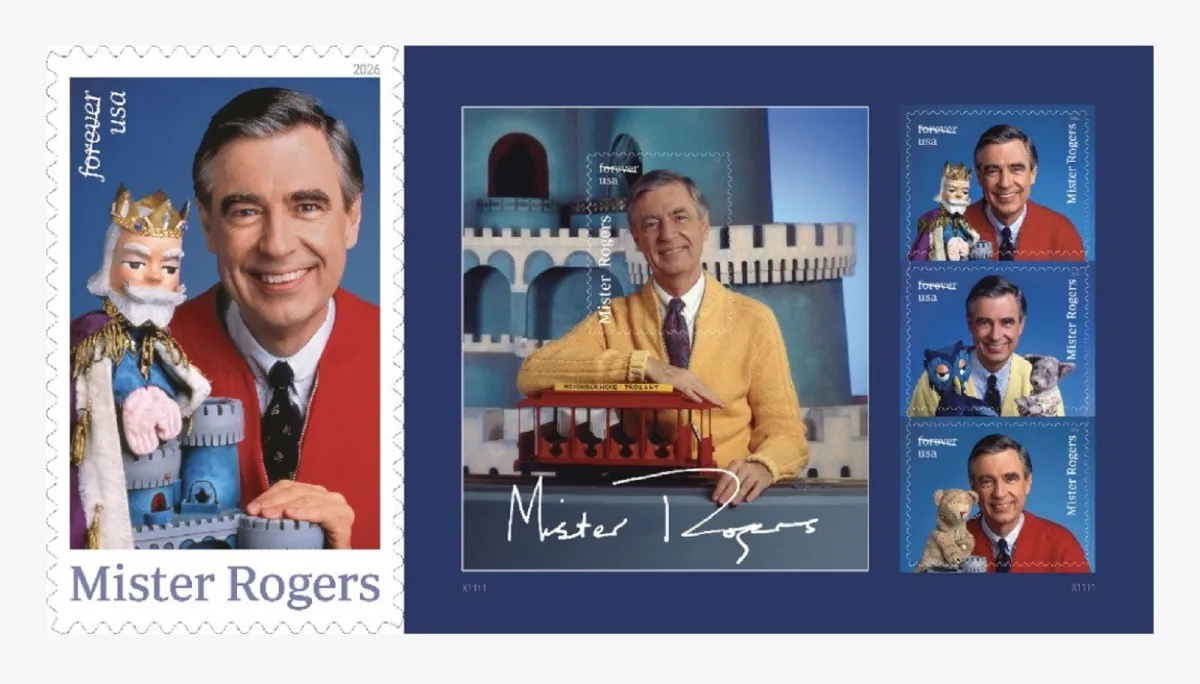
The physical design of the stamp itself mirrors the straightforward, unpretentious nature of the man it honors. Crafted by USPS art director Derry Noyes, the design deliberately eschews flashy, modern graphic gimmicks, focusing entirely on Rogers’ universally inviting presence. The core image features a warm, timeless photograph captured by Walt Seng, showcasing a smiling Fred Rogers clad in his signature red cardigan, sitting alongside the puppet King Friday XIII. To celebrate this grand encore victory, the Postal Service has released the original design alongside an exclusive new four-image souvenir sheet that depicts Fred interacting with several other beloved characters from the program. Unveiled during a ceremony at the Boston 2026 World Exposition, these Forever stamps—which remain perpetually valid for first-class mailing—were sold exclusively at the Boston Expo before becoming available to the wider public at local post offices and online starting June 1st. As Paul Siefken, President and CEO of Fred Rogers Productions, expressed, the hope is that every time a person affixes this stamp to an envelope, it serves as a gentle, daily reminder of Fred’s unwavering belief in the inherent, unconditional worth of every human being.
This celebratory reissue comes at a momentous time for the nation and the postal service, as both prepare to commemorate America’s upcoming 250th anniversary, or Semiquincentennial. In a parallel gesture of cultural celebration, the USPS has partnered with another iconic standard-bearer of American heritage: legendary fashion designer Ralph Lauren. For the first time in its long history, the Postal Service has invited a single creative individual to curate an entire official stamp issuance, resulting in the groundbreaking “American Icons” collection. Announced in mid-May, this historic collaboration draws inspiration directly from Lauren’s vast personal archives, aiming to visually capture the diverse, hopeful, and resilient identity of the United States. Designed as a unified pane of thirteen stamps, the collection features twelve evoking symbolic objects of American life arranged around a central design: a beautifully knit American flag bearing the historic dates “1776 to 2026,” all set against a rich, tactile denim background that visually represents the shared, rugged cultural fabric of the nation.
Each of the twelve outer stamps in the “American Icons” collection tells a quiet story of the human values that have shaped the American experiment over two and a half centuries. Among these carefully curated symbols are a baseball glove used by the barrier-breaking Jackie Robinson, representing equality and perseverance; a faithful dog, reflecting unconditional loyalty and trust; and a Diné (Navajo) blanket crafted by weaver Naiomi Glasses, celebrating the rich heritage of Indigenous artistry. Other stamps feature a sturdy pickup truck, a historic barn, a guiding lighthouse, a classic teddy bear, a racing sailboat, a simple hamburger, the Empire State Building, and wild horses running free across open landscapes—each representing ideals of hard work, community, optimism, compassion, and untamed independence. Together, these symbols, much like the timeless face of Fred Rogers, remind us that the story of America is ultimately written in the small, everyday moments of connection, empathy, and creativity. Whether through a hand-knit sweater worn on a television soundstage or a hand-woven blanket honoring ancestral earth, these stamps invite us to look at our history through a lens of warmth, reminding us that we are all deeply stitched into the same beautiful, enduring neighborhood.