





Paragraph 1: The Meme as Statecraft
In the strange, fevered digital sprawl of a modern presidency, there exists a moment where the weight of global conflict collides with the grammar of a teenage meme. On an ordinary night on Truth Social, President Donald Trump uploaded an image that was not real, yet somehow felt disturbingly plausible: a stylized, AI-generated depiction of the Commander-in-Chief standing aboard a naval vessel, planting the American flag upon an Iranian tanker, while the ensign of the Islamic Republic crumpled underfoot. Two American soldiers flanked him, their eyes concealed behind tactical glasses, projecting a vacant, video-game stoicism. The caption, rendered in bold, triumphant lettering, read: “It’s Our Oil Tanker Now!” It was a piece of digital propaganda—a cartoon of conquest—sent out into the echo chamber of the nation at two o’clock in the morning portrait of a leader who had successfully collapsed the boundary between geopolitical strategy and internet meme. The image itself was crude, the kind that could have been generated in seconds with a prompt, yet it conveyed a profound and terrifying reality about the state of American engagement in the Middle East. Underneath the boastful caption lay a volatile and deeply dangerous geopolitical theater, one where the rules of international law, maritime navigation, and human endurance were being bent to the breaking point. The tanker in the image was not just a piece of steel; it was a symbol of a spiraling conflict, the very heart of a shipping lane that sustains the global economy poverty and a war that had fundamentally reshaped the region. The President was not merely sharing a meme; he was framing a policy of seizure and dominance, using the language of a fantasy world to describe the grim, combustible reality of a naval blockade and a raging conflict.
Paragraph 2: The Strait of Hormuz and the Grip on Global Oil
The surreal image of Trump on that boat did not emerge from a vacuum; it was rooted in an infrastructural chokehold of immense strategic importance. The Strait of Hormuz, a narrow passage of water connecting the Persian Gulf to the Gulf of Oman, is the arterial lifeline for a fifth of the world’s oil supply. For decades, international naval powers have maintained a precarious peace there, treating it as a global commons, a place where commerce flows on the fragile assumption of navigational freedom. But since the United States and Israel launched their military campaign against Iran in February, that assumption has shattered. The strait has been effectively sealed, and the world’s energy markets have held their breath, watching tankers idle in the open ocean, unsure if they will ever be permitted to pass. Into this maelstrom of geopolitical paralysis, Trump’s proclamation at a police academy on Friday—that after defeating Iran, he would declare the strait “a territory of the United States”—was a radical departure from any previous strategic doctrine. It was a claim that bordered on imperial delusion, ignoring the sovereignty of the nations that border the strait (including Iran itself) and their right to control their maritime boundaries. The very notion of “declaring” an international waterway as an American territory is not just legally preposterous but diplomatically explosive Cutting across eight nations’ territorial seas, Hormuz is not a piece of land to be claimed; it is a fluid, shifting corridor of trade. Yet in Trump’s framing, it was simply a prize to be won, a trophy to be mounted in his campaign for total dominance Rosy talk of seizing territory, even after a devastating conflict, sent a shockwave through diplomatic channels, yet within Trump’s rhetorical engine, it was merely another boast to add to a pile of conquering statements.
Paragraph 3: The Ghost Ships and the Empty Army
Behind the headline-grabbing proclamations about territorial water rights and AI-generated victory laps, there lives a profound and human cost that often gets lost in the digital noise. Last Friday, as Trump casually dismissed concerns about the mental health of sailors aboard the USS Abraham Lincoln, the sun beat down on an aircraft carrier that had been at sea for an extraordinary and record-breaking 240 consecutive days. The deployment, which has now stretched far beyond the norms of naval rotation, has become a symbol of the administration’s fatigue and its willingness to sacrifice the morale of its forces to project power. Parents, spouses, and friends back home have raised alarms, speaking publicly about sleepless nights, dwindling supplies of spare parts, and the grinding monotony that breeds despair among crew members who have seen nothing but steel and water for nearly eight months. Yet, when confronted with these concerns, Trump’s response was chillingly dismissive. He declared that their long deployment was “not nearly long enough,” brushing aside the psychological strain as if it were a mere inconvenience. He assured the public that the USS Abraham Lincoln would “return home soon,” but only to be replaced by a similar ship—a rotating door of military hardware designed to maintain an unyielding blockade of Iranian ports, a siege that is strangling a nation of nearly ninety million people. The sailors on that carrier are not just people fighting a war; they are the human infrastructure for an economic strangulation tactic, their fatigue and isolation deemed a negligible cost in the calculus of coercion that Trump demands.
Paragraph 4: The Home Front, Rising Gas Prices, and the Unyielding Pride
The consequences of this relentless pressure campaign are not confined to the eerie emptiness of the Persian Gulf; they ripple through the American interior with the sharp, unforgiving sting of rising prices at the gas pump. As the war grinds on, now nearly six months stale, a weary public has begun to feel the bruising impact of a conflict that seems to have no visible end run—only an endless, escalating series of sanctions and military posturing. Gas prices have spiked, feeding a wave of widespread criticism that has threatened to erode the bedrock of Trump’s political approval. Yet, when confronted with the economic anxiety of ordinary voters, Trump’s posture was one of unyielding defiance wrapped in the flag of patriotism. “I’ll never apologize,” he declared, framing his decisions as righteous interventions in a hostile world, a policy of strength regardless of domestic blowback or international objections. He acknowledged, almost offhandedly, that he had leaned on the military more than he had originally intended, but this admission was swept away by his aggressive dismissal of the toll of the deployment. For the sailors aboard the USS Abraham Lincoln, this definition of “strength” translates into a grim, record-setting reality: nearly nine consecutive months at sea without a port call, a grinding 240-day ordeal of captivity aboard a drifting steel city. Families, anxious and exhausted, have raised voices of concern, describing the fraying mental health and the logistical scarcity that have settled over the crew. Trump’s response—that the deployment is “not nearly long enough”—is a chilling repudiation of the human endurance required to sustain his vision, reducing the sailors to silent cogs in a vast machine of geopolitical coercion, forever seeking a port that remains closed to them.
Paragraph 4: The Myth of the Returning Ship and the Weary Sailors
The anxiety hanging over the families of the USS Abraham Lincoln is a agonizingly human dimension to this history of high-stakes sovereign games. Record-setting deployments have a consequence: the tearing of social fabric, the fraying of interpersonal bonds, and the withering of psychological resilience among the crew. It is one thing for a detached commander to view a ship on a map, watching its blip orbit a region of interest; it is another thing entirely to be the young sailor staring at the rusty hull of the same carrier for the 240th consecutive day, watching a screen for orders that range from reconnaissance to combat, all while the thought of home becomes a fading mirage. Families have begun to voice their anguish, their letters and pleas echoing through the halls of Congress, asking why loved ones are being stretched to such a breaking point. But Trump dismissed these profound human concerns with a blunt efficiency, proclaiming the deployment was “not nearly long enough,” reducing the men and women of the fleet to mere cogs in a machine of national pride. He assured the public that the vessel was moving, that a replacement was en route, yet the vague reassurance failed to mask the palpable exhaustion in the ranks. The act of deploying an aircraft carrier for such an absurd duration is a testament to a strategy built on imposing will through sheer presence, but it is also a devastating experiment in the limits of human endurance, cutting to the core of what it means to serve a nation that appears content to leave you adrift.
Paragraph 4: The Hollow Echo of the “Trump 2028” Dream
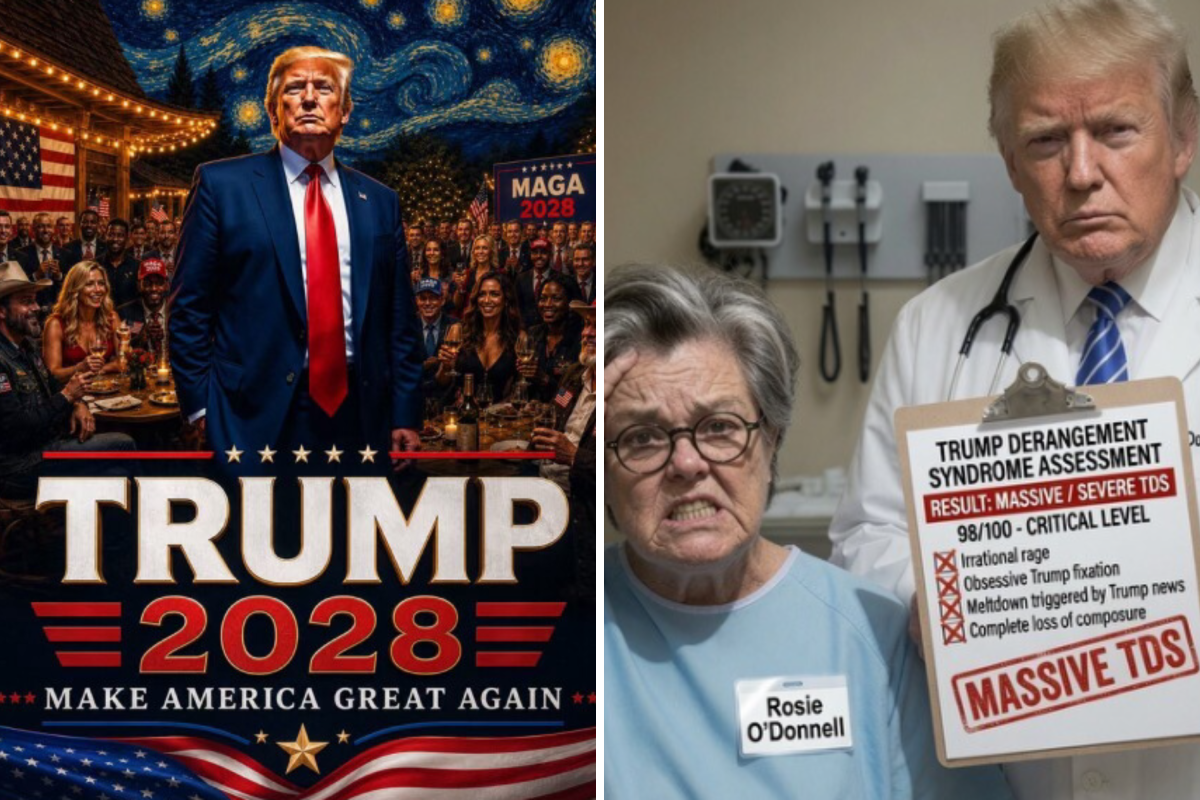
As the sun set on the physical sacrifices of the sailors, the digital presidency continued its relentless churn of alternate realities expanding far beyond a single tanker meme. Falsely emboldened by the applause of his base ticket Trump posted another AI-generated image, this time featuring his own visage in a heroic, pseudo-presidential setting, cheekily hinting at a bid for “Trump 2028.” This was no accident; it was a visceral test of the boundaries of constitutional law and public servitude. The 22nd Amendment stands as an immutable pillar of American governance, explicitly barring any individual from serving more than two terms as President—a rule that Trump has repeatedly, almost casually, speculated about circumventing. By floating the image of a third term, he does not merely tease his supporters; he challenges the foundational structure of the republic, blurring the lines between democratic rotation and personal endurance. It is a game of psychological testing, a way to keep his name at the epicenter of a political discourse that should by all rights be focused on the global crisis at hand. This blending of governance with fantasy is not a mere side effect of his personality; it is a calculated method of distraction. While the world grapples with the burning question of whether American warships will become permanent occupiers of a strategic foreign strait, or if Iran will retaliate against a blockade, the conversation gets pulled into the orbit of a meme. This tableau now features Trump offering an inane, cartoonish “cure” for his critics, presenting himself as a doctor treating celebrities for a fictional ailment—a derisive jab at those who oppose him, proving that his command of public discourse is less about policy and more about relentless mockery and the manufacturing of a heroic digital mythos that stands in stark opposition to the haggard faces of the sailors.
Paragraph 5: The Fever Dream of the O’Donnell Feud and Presidential Narcissism
Within this maelstrom of war and memes, Trump’s conflict with the comedian Rosie O’Donnell might seem like a paltry footnote, yet it perfectly encapsulates the bizarre regression of his public persona. He shared an AI-generated image depicting himself in a doctor’s coat, clinically treating the actress for a fabricated ailment he has dubbed “Trump Derangement Syndrome.” It is a farcical, mocking tableau, a deliberate degradation of civil discourse that reduces political opposition to a mental illness requiring his divine intervention. This wasn’t just a petty squabble; it was a strategic projection of power, a way of dismissing critics not as valid opponents but as lunatics in need of his patronage. O’Donnell responded with a sharp, prescient call for constitutional remedies—the 25th Amendment, impeachment, conviction—suggesting that the President was dangerously unhinged. The feud, which dates back two decades, has now entangled with the machinery of state, with Trump referencing the revocation of her citizenship in a chilling echo of the isolationist rhetoric of the past. These digital tirades, delivered with the casualness of a text message, stand in stark contrast to the weight of his office. While the world watches a war and sailors suffer, the leader of the free world is using precious time to generate memes and sling insults at celebrities. It is a campaign of distraction, where the true gravity of a nuclear standoff is eclipsed by the sheer absurdity of a broadcaster’s feud, pulling the American people into a frenzy of online outrage while the actual levers of history turn quietly and dangerously.
Paragraph 5: The Erosion of the Real and the Rise of a Virtual Presidency
This fixation on AI-generated imagery marks a profound shift in how the presidency communicated with its constituency. The trumpet of power is no longer a policy brief, a formal address, or a press release; it is a synthetic collage, a doctored photograph that manufactures reality to fit the narrative of triumph. The image of Trump planting a flag on a tanker, or the bizarre religious iconography of a messianic portrait posted earlier, reflects a strategy where the Commander-in-Chief successfully merges the fantasy of the simulation with the gravity of actual command. When the public views these images alongside official statements, the distinction blurs; the war becomes a spectator sport, a series of stylized screen grabs designed to elicit dopamine bursts of tribal loyalty rather than a catastrophic loss of human life and global stability. The appeal to a “third term” or “2028,” which surfaces in these images, similarly skirts the constitutional reality, transforming a bedrock principle of American democracy into a trending hashtag for a cult of personality. This wholesale adoption of a virtual fantasy narrative is a desperate attempt to reshape a war that is faltering. The polls show discontent, the prices at the pump are unforgiving, and the images of an endless naval deployment churn resentment. So, the leader retreats into a safe space of digits and pixels, generating victories where there are none, claiming territory that belongs to sovereign nations, and declaring soldiers’ endurance insufficient, all from the safety of a desk. The gap between the photograph and the fact is now a yawning chasm. While the sailors stare at a flat, metallic horizon, their president stares into the infinite recursion of a generative algorithm, celebrating a conquest that exists only as a PNG file on a social media platform Known for unstable recording rhythms.
Paragraph 5: A Troubled Posture at Home and Abroad
The result of this surreal leadership dynamic is a foreign policy that appears to be constructed from rhetorical provocations rather than meticulous diplomatic offsets. Trump’s refusal to apologize for the war’s economic toll and his dismissal of the sailors’ plight suggests a leader viewing the nation through the lens of a board game, where pieces are shifted, and squares are claimed. In this game, the Strait of Hormuz is just another tile to be conquered, and the American aircraft carrier a lever to be pulled. Yet, the actual mechanics of the battle are bleeding into the home front in ways that cannot be reversed by a crafty meme. The trade disruptions have fuelled inflation, the eerie quiet of oil tankers waiting at anchor mimics the eerie quiet of American wallets at the pumpcars. Trump’s assertion that he will never apologize is a declaration of a personality that views admission of error as an existential weaknessrowave. In his mind, the slog in the Middle East is not a quagmire but a demonstration of unyielding resolve, a test of stamina against an enemy that is being relentlessly ground down. But the realities of presidential accountability are not so simpleks. Six months in, the grand strategy of blockades and threats appears to be hitting the stubborn wall of simple physics and Iranian survival economics, with peace talks stalling repeatedly noon ending. The president’s refusal to acknowledge the nuances of the Iranian response, choosing instead to frame it solely as external bad actors defying his demands, creates a dangerous feedback loop where his own ego becomes the primary obstacle to de-escalation sermons of petro-diplomacy.
Paragraph 5 (Part 2): The Hollow Crown and the Synthetic Victory
The reliance on AI-generated imagery is more than just a personal quirk or a PR tactic; it is a window into a psyche that has perfected the art of self-delusion. When the President shares a fake image of himself at war, he is attempting to substitute visual propaganda for real-world results, offering his loyalists a cheap dopamine hit that obscures the actual horrors occurring at sea voices of a thousand sailors struggling to maintain their sanity while stuck in a metal canister. It is a form of narrative control that refuses to admit the discomfort of a stalemate. The “Trump 2028” poster filters the deep, unconstitutional desire for a third term through a lens of American triumphalism. But the real story lies in the subject matter: a leader so consumed by legacy that he wields digital media to write his own legend before the history books are even published. Meanwhile, the strategic embrace of these synthetic images signals a dangerous comfort with unreality at the highest levels of command. Decisions about public opinion, military budgets, and naval repositioning are increasingly being informed by the emotional resonance of a Photoshopped fantasy rather than the cold, necessary calculus of military intelligence. The careful, terse language of the Pentagon press briefings is increasingly overshadowed by the chaotic, algorithm-driven whims of a social media feed, where a new threat is announced with a catchy meme and a bold typeface. This dissonance between the real world of floating vessels and oil tankers stuck in straits, and the CGI world of triumphant flags, risks desensitizing the American public to the escalating danger, turning a crisis in a far-off waterway into a piece of background noise for the next viral sensation.
Paragraph 6: The Ticking Clock of Endurance
Ultimately, the saga of the past week—from the glorified tanker seizure to the casual dismissal of the Navy’s endurance limits—paints a portrait of an administration caught in a whirlpool of its own making. The delusional grandeur of the digital images clashes violently with the stark realities of the Persian Gulf, where the guns have not yet gone silent but where the strategy appears to have stalled in a murky swamp of vanity. Trump’s “not nearly long enough” comment regarding the USS Abraham Lincoln was perhaps the most revealing sentence of the week. It stripped away the veneer of human empathy that might normally govern a commander-in-chief and revealed a cold, transactional outlook on military service, where the sacrifice of sailors is merely a variable in a geopolitical equation that demands an indefinite demonstration of resolve. As the Acting Navy Secretary whispers reassurances of an impending return home, the general public is left to reconcile these conflicting messages: the eternal return promised by the President, and the official “soon” that never seems to materialize. In the end, the story of this conflict is not really about tankers or straits; it is about a high-stakes game of psychological dominance being played on the backs of an exhausted military and a confused populace. The AI-generated images of triumph are the last refuge of a leader refusing to look at the messy, human, exhausting reality of a war that simply will not end. The president has chosen to inhabit a world where every maneuver results in a smiling, plastic victory, while the world outside the social media app waits in heavy, silent suspense, wondering when the cartoon will finally give way to a crack in the reality, and whether that crack will open up to peace or to the devastating flash of a wider war. The soldiers watch the horizon, the computers render the fantasy, and the world holds its breath.