


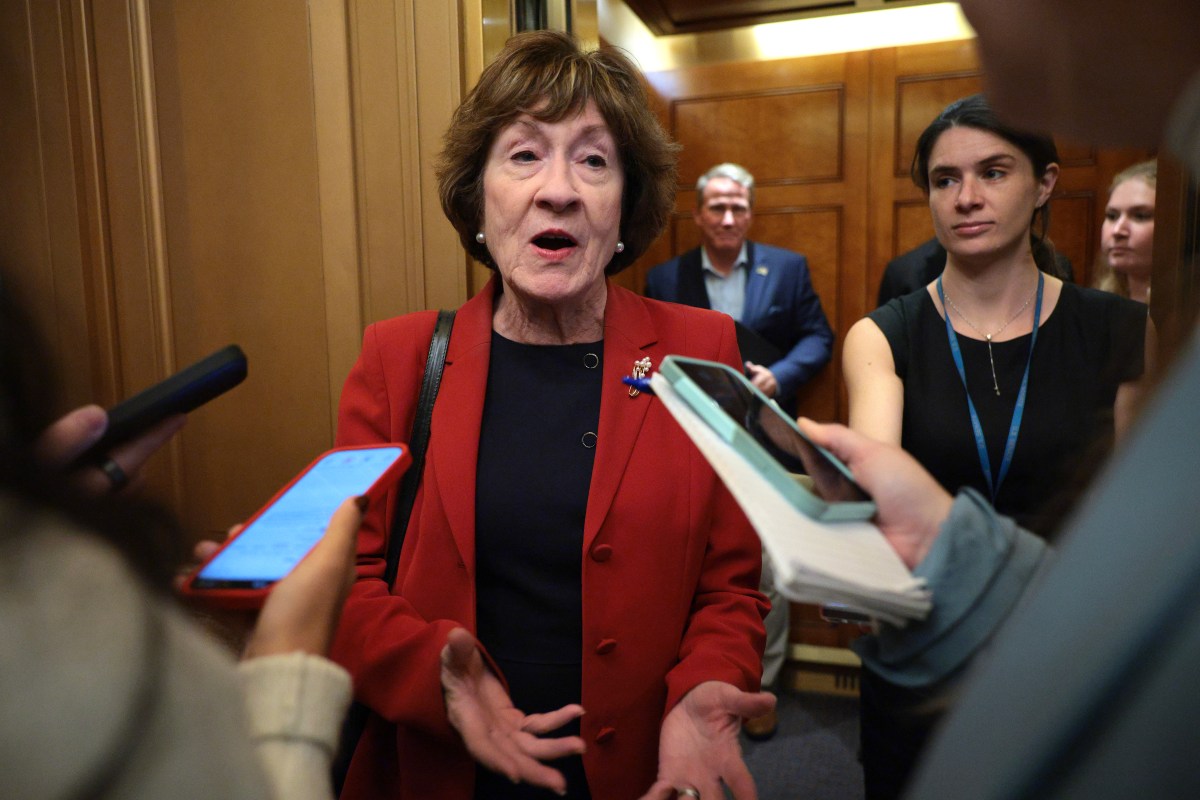
In the small, fiercely independent state of Maine, the race for U.S. Senate has settled into a pattern as familiar as the autumn leaves: a neck-and-neck fight, a new poll, and, just beneath the surface, a swirling set of questions that neither candidate can fully ignore. Republican Senator Susan Collins has once again emerged with a narrow edge in the latest survey, this time from the data analytics firm co/efficient, which sampled 1,240 likely voters between September 28 and 30 and found 48 percent supporting her against 46 percent for Democrat Troy Jackson. The two-point advantage sits comfortably within the poll’s margin of error, meaning the contest remains essentially tied, with a meaningful six percent still undecided. It is also the second piece of good news in a row for Collins; last week, a New York Times/Portland Press Herald/Siena survey gave her her first lead in a race where Jackson had previously edged her in nearly every public poll. For Collins, the five-term incumbent who has built a career on moderation and constituent service, it is a welcome change after months of trailing. For Jackson, a logger and former president of the Maine Senate, it is a reminder that the race is still close enough that a single misstep, or a single piece of news, could change everything. Jackson entered the contest as a replacement for Graham Platner, who dropped out in July after a sexual assault allegation that he denies. Since then, the challenger has cast himself as a working-class advocate taking on a powerful incumbent. But the campaign’s backdrop has been complicated by a ProPublica report alleging Collins helped steer federal funding toward a defense contractor with ties to her political donors—what critics describe as a kickback scheme—and by related questions about an FBI inquiry that was ultimately shelved. Collins has denied any wrongdoing, her office says she cooperated fully, and the FBI has said the probe found nothing implicating her. Still, the story lingers, and in a race this tight, trust is everything.
The stakes of this race extend far beyond Maine’s rocky coastline. With Democrats holding only a slight structural advantage in the battle for the Senate, forecasters like RacetotheWH show a virtual toss-up for control of the chamber in the 2026 midterms. Maine’s seat, alongside closely watched races in Ohio, Texas and elsewhere, has become a critical piece of the national puzzle. The state itself has voted Democratic in recent presidential elections, rejecting Donald Trump in 2016, 2020 and 2024, and it has not been reliably red in any modern sense. Yet Collins has managed to hold her seat since 1996 by carefully constructing a persona as a moderate Republican willing to cross the aisle, protect local interests, and distance herself from the more combative wings of her party. That brand is being tested in ways it never has before. Voter frustration with the Trump administration and the economy is running high, and Jackson’s campaign has relentlessly tied Collins to that frustration, arguing that her votes and her alliances have drifted far from the independent, commonsense image she projects. The result is an election that feels less like a typical Maine showdown and more like a referendum on the direction of the country, filtered through the particular lens of a state that prizes individualism, decency, and a healthy skepticism of concentrated power. Collins’s longevity is itself a testament to her political skill, but skill may not be enough if the national mood sweeps her out with the tide. At the same time, Jackson’s challenge is to convince voters that he is not simply a Democratic place-holder but a genuine alternative with his own vision for Maine’s future, from the woods and mills he grew up around to the fishing villages and small cities that depend on federal support. The race matters not only because it could determine control of the Senate, but because it tests whether a moderate Republican can survive in a volatile era when loyalty to party, or to some version of the party’s agenda, often outweighs individual reputation.
Beyond the top-line numbers, the co/efficient poll paints a portrait of a deeply divided electorate. Collins is viewed favorably by 44 percent, unfavorably by 47 percent; Jackson is viewed favorably by 36, unfavorably by 47, with 16 percent holding no opinion. That gap in name recognition is both an opportunity and a weakness. Jackson’s numbers suggest many voters don’t know him yet, but also that the ones who do are almost evenly divided. Collins, by contrast, has nearly universal familiarity, and her unfavorable rating is higher than her favorable rating—a warning sign for an incumbent who once seemed untouchable. The poll, which was conducted by co/efficient and identified as conservative-leaning, also found that 53 percent of respondents dislike Trump and his policies, while 32 percent support both Trump and his policies. Twelve percent said they dislike Trump personally but support his policies, and three percent were unsure. That last group is fascinating; it suggests a slice of voters may hold their noses and vote for the party, not the personality. For Collins, the challenge is to persuade enough of those Trump-skeptical Republicans and independents that she remains an independent force. For Jackson, the challenge is to convert anti-Trump sentiment into votes for him personally, not just against the president. Prediction markets have favored Jackson as the eventual winner for much of the race, but his odds have slipped from over 70 percent to under 60 percent in the past week, reflecting the new polling reality. If the election were held today, it would likely come down to the six percent undecided—voters who are tired of politics, wary of both parties, and looking for a reason to believe in someone. In Maine, where independent candidates have historically played a spoiler or a savior role, those undecided voters are not an afterthought; they are the whole ballgame.
Perhaps the heaviest cloud hanging over Collins’s campaign has nothing to do with her voting record or her party loyalty; it is the lingering echo of a federal investigation that, officially, came to nothing. In September, the investigative outlet ProPublica published a report alleging that Collins had helped steer federal funding toward a defense contractor that had contributed to her political campaigns. The report suggested a troubling overlap between her official power as a senior appropriator and the money flowing into her campaign coffers—an allegation that, if true, would cut to the heart of public trust in government. The FBI investigated at the time, but according to ProPublica, the investigation was shelved after Trump returned to office. An FBI spokesperson later told ProPublica that the investigation had concluded years earlier and “ultimately found nothing implicating Senator Collins.” Collins’s office, meanwhile, told Newsweek that she “cooperated fully” with the investigation and called the allegations “categorically false.” For many voters, that should be the end of the matter: the FBI looked into it, found nothing, and moved on. But in the world of a close election, an accusation doesn’t need to be proven to leave a mark. It lingers in the form of a headline, a question at a town hall, a passing glance at a campaign flyer. And it gives Jackson and the Maine Democratic Party an opening to frame Collins not as a corrupt politician, but as someone whose long tenure in Washington has blurred the line between public service and private influence. “You’re not supposed to be the chair of Appropriations and steer money toward people who fill your campaign coffers,” Jackson said this week, as reported by Portland’s WMTW. The quote captures the essence of the attack: not that Collins is a criminal, but that she has been in power so long that the rules no longer seem to apply. Whether the story cuts through the noise depends, as Maine-based Democratic strategist Toby J. McGrath put it, on whether voters believe anything nefarious actually occurred. In a polarized environment, many will dismiss it as politics; others may see it as confirmation of what they already suspected about Washington. For the small number of genuinely persuadable voters in Maine, it might be the factor that tilts their decision.
The Collins campaign has responded with characteristic poise, pointing to her record, her cooperation with the FBI, and the absence of any finding against her. But Jackson and his allies have not let the issue fade. To them, the ProPublica report is not a footnote but a rallying cry. In the weeks since it appeared, Jackson has continued to hammer Collins over what he calls “corruption of the highest order.” His campaign has tried to make the case that the incumbent’s power—particularly her role as chair of the Appropriations Committee—has been bought and paid for by a network of special interests. The language is blunt, but it resonates with a broader public mood that is deeply suspicious of money in politics. On Tuesday, the Maine Democratic Party released a series of interviews with veterans in Bangor who said they were “galvanized” to speak out after reading the ProPublica report. One veteran, speaking on behalf of the group, said: “Senator Collins chairs the Appropriations Committee, the committee that controls enormous federal spending. That power comes with a responsibility to taxpayers and service members who depend on those dollars.” The message is carefully calibrated: it isn’t about partisan politics, but about accountability. Veterans are among the most respected voices in Maine politics, and their entrance into the controversy gives the Jackson campaign a moral weight it might otherwise lack. It also shifts the conversation from Collins’s long record of bringing federal money home to Maine—a record she often boasts about—to the question of where that money actually goes and who benefits. For Collins, this is a dangerous framing. Her political identity is built on the idea that she is above the fray, a consensus builder who puts Maine first. If voters begin to see that identity as a facade, even the most impressive legislative record may not save her. The Jackson campaign’s strategy, therefore, is not to defeat Collins in a battle of policy details, but to challenge her character. In a state where people take measure of a person’s word above all else, that may be the most potent weapon of all.
As the campaign moves into its final weeks, what remains most striking about Maine’s Senate race is how unsettled it still feels. The polling is close enough that either candidate could honestly claim momentum. The political terrain favors Democrats nationally, but Collins has survived difficult cycles before by being, in some ways, a party of one. The economy remains a source of anxiety for many families; the cost of heating oil, groceries, and health care are not abstract issues in a rural state where winters are long and paychecks are often tight. Jackson, with his logger’s background and union roots, speaks to that anxiety in a way that Collins, for all her experience, sometimes cannot. Yet Collins has a record of tending to Maine’s specific needs—from shipbuilding to fishing rights to broadband access—that has earned her a reservoir of goodwill that may still be deep enough to carry her across the finish line. The unresolved questions around the ProPublica report and the investigation only add to the unpredictability. Voters are left to sort out competing narratives: one of a dedicated public servant who has spent thirty years serving her state, and another of an entrenched politician whose closeness to power has made her forget who she works for. The truth, as is often the case, probably lies somewhere in between, but elections are not decided by nuanced truths. They are decided by the impressions people carry into the voting booth. In Maine, those impressions are shaped by personal encounters, by the stories told at diners and fish markets, by the sound of a candidate’s voice on the radio, and by a deep-seated conviction that the person asking for your vote is someone you could trust with your own affairs. Susan Collins and Troy Jackson offer very different answers to that question. In the coming weeks, Maine’s voters will decide which answer is more convincing. And in a year when the fate of the Senate may hang on a single seat, the rest of the country will be watching the Pine Tree State with an intensity that its famously modest citizens may find a little uncomfortable. But that’s Maine: a place that has always marched to its own rhythm, where the final verdict is never quite certain until the last leaves have fallen.