


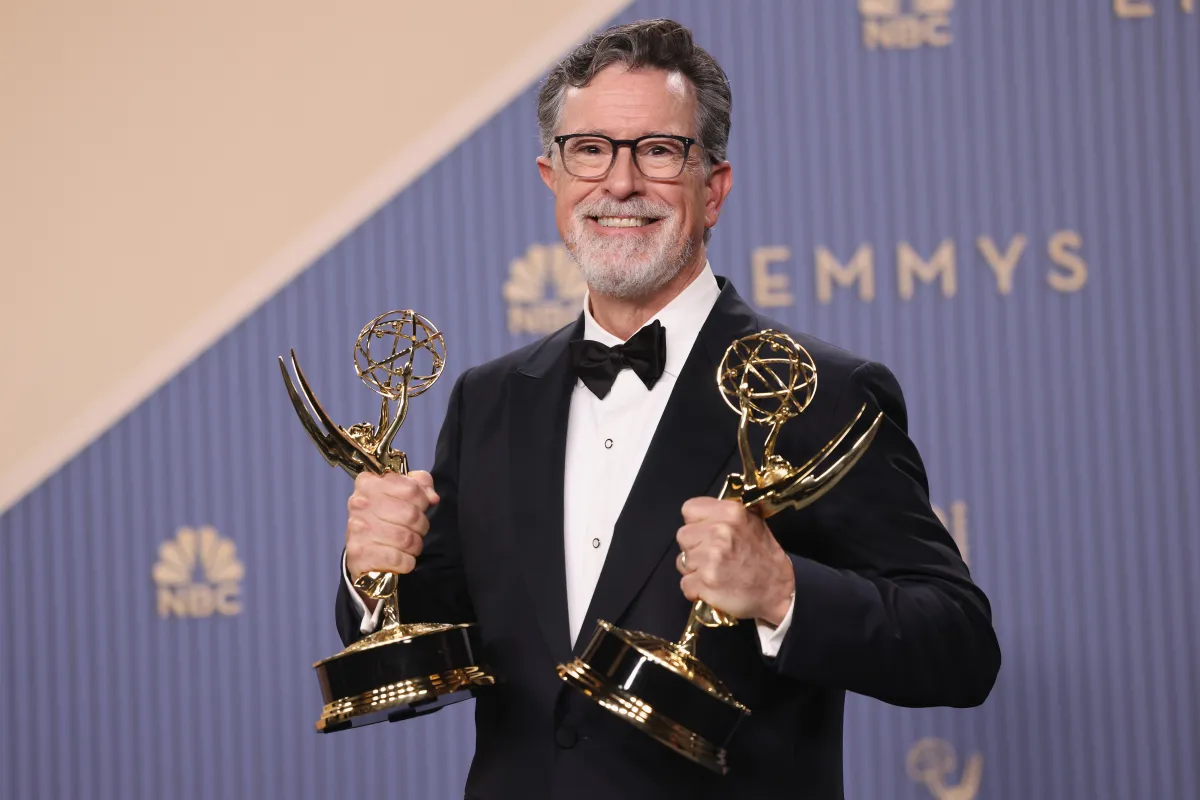
1. The lights of the Emmy stage felt different that night. For eleven years, Stephen Colbert had walked out onto the set of The Late Show with a specific kind of energy—sharp, playful, sometimes righteous, always aware that he was speaking into the living rooms of millions of Americans. But on Monday night, as the Television Academy handed him the Emmy for Outstanding Variety Series, the moment wasn’t about politics or punchlines or the nightly battle for attention in late-night television. It was about something far more personal: gratitude. The award arrived after the show had already ended its long run, a bittersweet coda to a season that had been building toward a farewell for months. The room knew it. Colbert knew it. And when he stepped to the microphone, he didn’t use the platform to deliver a final political statement or to fire one last shot at the president who had so often been the subject of his comedic ire. Instead, he looked out at the audience—his peers, his colleagues, the people who had watched him for over a decade—and he simply said thank you. “I want to say to the audience, thank you so much for watching,” he said, wrapping up a nearly two-minute speech that felt less like an acceptance and more like a gentle closing of a very long, very meaningful chapter. “We hope you enjoyed the show. We had a great time doing it for you.” There was no mention of Donald Trump. There was no final jab at the political chaos that had defined so many of his monologues. There was only warmth, relief, and the kind of emotional honesty that often emerges when someone realizes that a huge part of their life is officially over.
2. The absence of any mention of Trump was striking, and not just because Colbert had spent years making him a recurring character in his comedy. Trump had repeatedly attacked Colbert, sometimes by name and often with the kind of crude personal insults that defined his relationship with the late-night host. When CBS announced in 2025 that The Late Show would come to an end, Trump celebrated the news on Truth Social with characteristic glee, writing, “I hear Jimmy Kimmel is next. Has even less talent than Colbert!” It would have been easy—maybe even expected—for Colbert to use his final Emmy moment to respond, to point out that he had just won the biggest award in television while Trump was watching from a distance. But Colbert chose the opposite path. He didn’t take the bait. He didn’t turn the moment into a victory lap or a political manifesto. Instead, he seemed intent on leaving the public stage with the same grace that had defined his best moments as a host: by focusing on the people who helped him get there, rather than the people who tried to tear him down. In doing so, he turned what could have been a controversial and divisive speech into something more enduring. It was a reminder that late-night comedy, at its core, isn’t really about winning arguments or scoring points. It’s about connection. It’s about making people laugh, making them think, and making them feel less alone in a complicated world. And in that final Emmy moment, Colbert was determined to celebrate that connection rather than the political battles that had consumed so much of the past decade.
3. The speech itself was a masterclass in humility and gratitude, directed almost entirely at the people who worked behind the scenes. Colbert dedicated a significant portion of his time to the more than 200 staff members who had made the show possible night after night, describing late-night television as a “fantastic incubator” for young people learning how to work under pressure, think on their feet, and collaborate with a large and diverse team. He spoke about the apprenticeship of late-night with genuine reverence, acknowledging that the skills his staff had developed—writing jokes on deadline, managing chaotic production schedules, staying creative through exhaustion—would serve them well wherever they went next. Then came the joke that captured his affection and his faith in his team: “They are all tech-avail,” he said, urging the industry to hire his former colleagues. “Hire them, they will make your show better, and they will make your day easier.” It was a classic Colbert move—equal parts praise and humor, with a layer of practical advice buried inside. He also made a point to credit his writing team, which had won the show’s first Emmy for variety series writing just the weekend before, for writing the very jokes he was delivering on the Emmy stage. It was a generous acknowledgment, a way of saying that even in his final moment in the spotlight, he wasn’t standing there alone. He thanked the countless guests who had sat in the chair across from him, sharing their stories, their art, their struggles, and their triumphs. But the most emotional moment came when he turned to his wife, Evelyn “Evie” McGee Colbert, whom he called his favorite guest. After years of public life, after all the headlines and the political firestorms, the person he wanted to honor most was the one who had been beside him quietly, away from the cameras. And then he closed the way he had opened—with gratitude to the audience, the people who had chosen to spend their evenings with him. “That’s it. Thank you. We’ll catch you all on the flip,” he said, with a smile that suggested he was at peace with the ending.
4. Colbert’s Emmy win was notable not just for the emotional weight of the moment, but for the unusual circumstances surrounding the award itself. This year, the Television Academy did something different: instead of keeping the traditional categories for talk shows and scripted variety shows separate, it combined them into a single Outstanding Variety Series award and reclassified it as an “area award.” The change meant that voters weren’t asked to pick one winner over the others. Instead, they evaluated each nominee individually with a simple yes-or-no vote. Any show that received at least 90 percent “yes” votes could win, which meant that multiple shows could take home the Emmy in the same year. It was a thoughtful and somewhat egalitarian approach, acknowledging that different shows in the variety space do different things and that greatness doesn’t always have to be a zero-sum game. Colbert’s win came in a field that included heavyweights like The Daily Show, Jimmy Kimmel Live!, Last Week Tonight with John Oliver, and Saturday Night Live—shows that had defined the genre for years and had earned their place in the conversation. But what made the moment even more meaningful was the goodwill Colbert had shown toward his fellow nominees. Two weeks before the ceremony, he had posted an Instagram video endorsing Jimmy Kimmel, saying, “I think we can all agree that Jimmy Kimmel deserves an Emmy.” Kimmel, who was sitting in the audience, applauded warmly as Colbert delivered his speech. In a television landscape often defined by rivalries and competition, the moment stood out as a rare display of mutual respect and genuine friendship. Colbert didn’t need to tear anyone down to build himself up. He had spent his career proving that comedy could be smart, compassionate, and inclusive—and his final awards-season behavior reflected those same values.
5. The end of The Late Show marked the conclusion of an extraordinary television legacy. Colbert hosted the show for eleven seasons, stepping into the role after David Letterman’s monumental twenty-two-year run. Together, the two hosts brought the Late Show franchise on CBS to a total of thirty-three years, a remarkable stretch that spanned multiple eras of American culture and politics. The final episode aired in May 2026 and drew 6.74 million viewers, making it the most-watched weeknight episode in the show’s history, according to CBS data. The audience clearly wanted to be there for the goodbye, to see Colbert close the book on a show that had become a comforting nightly ritual for so many. But the show’s cancellation was not entirely without controversy. Just days before CBS announced the end of the program, Colbert had criticized the network’s parent company, Paramount, for its $16 million settlement of a lawsuit brought by President Donald Trump over a 60 Minutes interview with then-Vice President Kamala Harris. Colbert denounced the deal as a “big fat bribe,” a sharp and uncharacteristically harsh public rebuke of his own employer, at a time when Paramount was seeking approval for its merger with Skydance Media. CBS responded by saying the decision to end the show was “purely a financial decision against a challenging backdrop in late night,” and insisted that it was not “related in any way to the show’s performance, content or other matters happening at Paramount.” Whether or not the controversy played a role in the timing, the network’s explanation highlighted the difficult reality of late-night television in an era of changing viewing habits, rising costs, and corporate consolidation. Even a show as successful as Colbert’s wasn’t immune to the broader pressures reshaping the entertainment industry.
6. But Colbert isn’t disappearing. According to IMDbPro, he is currently working on The Lord of the Rings: Shadow of the Past with his son, Peter McGee—a project that suggests he’s ready to explore new creative territory, and to do it with family by his side. He’s also listed as an executive producer on The Chronicles of Amber and Hello, Nancy, indicating that he plans to remain active behind the scenes, helping to shape stories rather than simply performing them. The transition from nightly host to producer and storyteller feels like a natural evolution for someone who has always been more than just a comedian. Colbert built his career on intelligence, curiosity, and a deep belief in the power of storytelling to illuminate the human experience. Whether he’s interviewing a president, a scientist, a musician, or his own wife, he approaches every conversation with the same fundamental question: what can we learn from each other? That curiosity will serve him well in whatever comes next. And for the audience, his final Emmy speech was a reminder that endings don’t have to be sad. They can be grateful. They can be hopeful. They can be a way of saying thank you to everyone who was part of the journey—the staff, the guests, the viewers, the family, and even the critics. As Colbert left the stage, he didn’t look back with regret. He looked forward with anticipation. “We’ll catch you all on the flip,” he said, and for those who had watched him for years, the words felt less like a goodbye and more like a promise. The Late Show may be over, but Stephen Colbert’s story is far from finished. And if his final act in the late-night spotlight was any indication, the next chapter will be driven by the same qualities that defined his work all along: humor, humility, and an abiding faith in the people around him.