





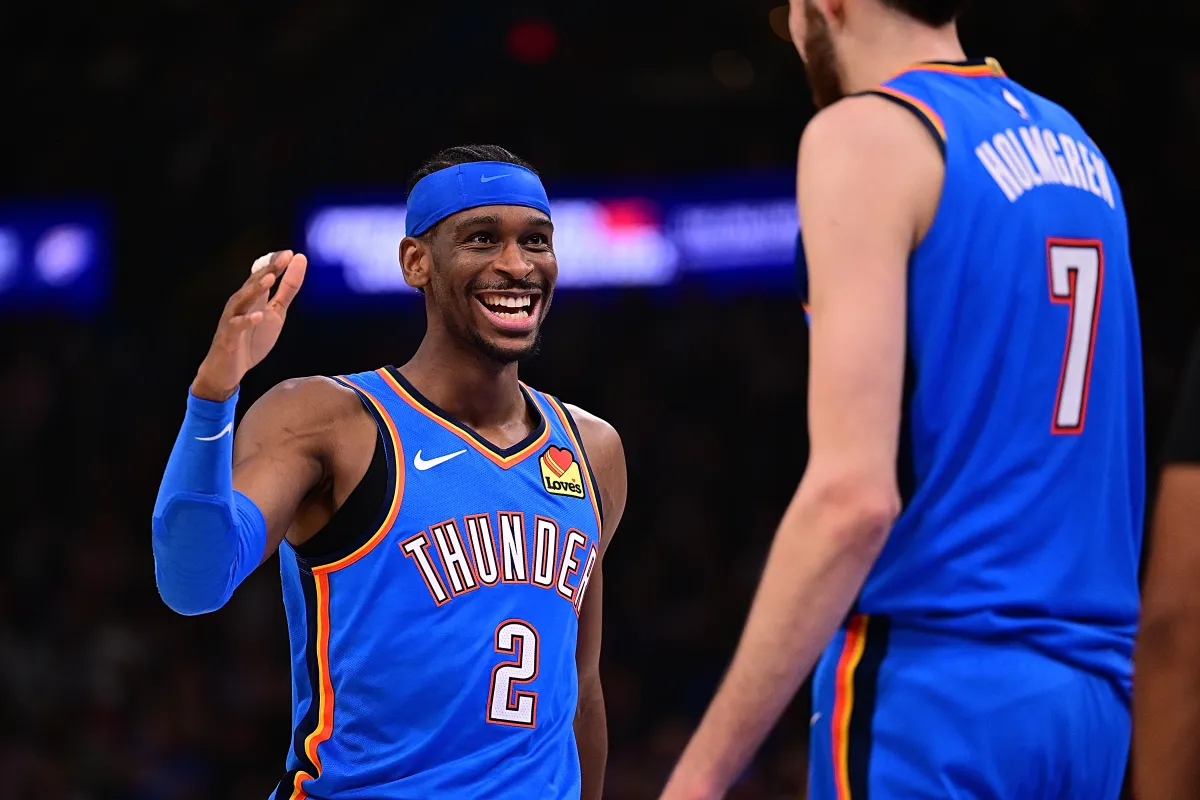
The heavy silence that draped itself over the Paycom Center on Saturday night was a stark, almost suffocating contrast to the deafening cacophony that had fueled the Oklahoma City Thunder through one of their most exhilarating seasons in franchise history. As the final buzzer sounded, signaling a heartbreaking defeat to the San Antonio Spurs in Game 7 of the Western Conference Finals, the collective dream of an NBA championship evaporated into the rafters. On the court, Shai Gilgeous-Alexander stood with his hands on his hips, his chest heaving after a heroic, exhausting performance where he poured in 35 points and dished out nine assists, practically dragging his young squad through the fire. He had operated with his signature, hypnotic rhythm, finding seams in the defense and converting difficult floaters, refusing to let the season slip away without a fight. Yet, despite his back-to-back MVP pedigree and a display of sheer competitive will that cemented his status as one of the league’s premier postseason performers, the ultimate prize remained agonizingly out of reach. The arena, usually a fortress of blue and orange energy, felt hollow as fans slowly filed out, leaving only the echoing sounds of the opposition celebrating on the hardwood. The locker room afterward was a sanctuary of quiet grief, a place where jerseys were pulled slowly over bowed heads and the realization set in that the marathon of the regular season, the grueling playoff battles, and the shared sacrifices of the journey had culminated in a premature exit. It was a brutal reminder that in the unforgiving landscape of the NBA playoffs, even a masterpiece by a superstar is sometimes not enough to overcome the collective depth and veteran poise of a disciplined opponent, leaving the franchise to ponder what might have been in the cold, quiet light of the off-season, and forcing a young roster to confront the painful reality of their first real postseason heartbreak.
While Gilgeous-Alexander’s brilliance kept the Thunder within striking distance, the spotlight of scrutiny inevitably shifted toward his co-star, Chet Holmgren, who experienced the kind of devastating, frustrating night that can haunt a young athlete for an entire summer. In 33 grueling minutes on the court, the young seven-footer was a ghost of his usual impactful self, finishing the game with a meager four points and four rebounds while attempting a mere two shots from the field. For a player who had spent the entire season establishing himself as the interior anchor and the primary offensive release valve for Oklahoma City, this offensive vanishing act was as shocking as it was painful. The physical toll of a long, punishing 82-game season, combined with the intense, highly analytical preparation of a seven-game playoff series, seemed to have caught up to the young big man all at once, leaving him looking tired, tentative, and occasionally overwhelmed by the magnitude of the moment. It was a heartbreaking performance to witness, as Holmgren’s body language on the court betrayed a deep frustration with his own inability to impact the game in his normal, multi-faceted way. Every missed rotation, every rebounded ball that slipped through his fingers, and every passive offensive possession seemed to weigh him down further, highlighting the immense physical and mental pressure placed on modern NBA centers who are expected to protect the rim, switch onto guards, and score efficiently on the other end. In the hyper-reactive theater of social media and modern sports talk television, a stat line of four points in a Game 7 is instantly weaponized as a defining failure, ignoring the sheer exhaustion, the minor lingering injuries, and the steep learning curve that every young star must navigate on their path to greatness.
Predictably, the post-game fallout was swift and merciless, as analysts and fans alike began to dissect Holmgren’s performance with a level of hyperbole that threatened to overshadow everything he had accomplished up to that point. Within hours of the final buzzer, trade machines were being fired up, talk show segments were being drafted, and speculative questions about whether Holmgren possessed the requisite physical strength and mental toughness to coexist with Gilgeous-Alexander on a championship stage began to dominate the basketball conversation. It is in these moments of intense external pressure that the true culture of a team is revealed, and SGA did not hesitate to draw a line in the sand during his exit interview on Sunday afternoon. Dressed in civilian clothes and carrying the quiet dignity of a veteran leader, Gilgeous-Alexander shut down the brewing media storm with a powerful, unwavering defense of his young teammate. “We need Chet Holmgren,” SGA stated firmly to the assembled reporters, his voice cutting through the noise of skepticism. “Before Chet was here, we weren’t who we are today. We wouldn’t have the success we have today.” He went on to articulate a profound understanding of their symbiotic relationship, concluding with a sentiment that highlighted his belief in Holmgren’s ultimate potential: “When he’s the best version of himself, we’re the best version of ourselves.” This was not just standard public relations platitudes or a captain offering polite support; it was a deeply human moment of solidarity from a superstar who recognized that a young player’s confidence is a fragile thing, and that protecting a teammate from the vultures of public opinion is just as important as setting him up for an open layup on the floor.
To truly understand the weight of Gilgeous-Alexander’s defense, one must look back at the trajectory of the Oklahoma City Thunder before Holmgren’s arrival, a period characterized by a meticulously planned rebuild but also a glaring lack of defensive identity and interior presence. For years, general manager Sam Presti had accumulated draft picks and young assets, but the team lacked the elite, modern rim protection and floor-spacing capabilities required to transition from a fun, high-scoring young squad into a legitimate Western Conference juggernaut. Holmgren transformed all of that, serving as the defensive savior who instantly elevated the Thunder’s defensive rating to elite levels while providing a unique offensive versatility that allowed Shai to operate with unprecedented space in the paint. His ability to block shots, recover on perimeter shooters, and run the floor as an elite transition threat gave Oklahoma City a dynamic two-way identity that surprised the league and propelled them to the upper echelon of the standings. This regular-season brilliance had earned Holmgren a highly coveted spot on the All-NBA Third Team, a remarkable achievement for a young big man that proved his worth as one of the elite players at his position. By reminding the public of this context, Gilgeous-Alexander was reminding everyone that one bad series, or one abysmal Game 7, does not erase an entire foundation of success that Holmgren helped build. The transition from a lottery team to a championship contender is rarely a straight line, and Holmgren’s presence was the catalyst that accelerated that timeline, proving that his long-term value to the franchise is far too vast to be measured by a single disappointing performance in May.
A significant portion of Holmgren’s struggles in the Western Conference Finals can be attributed to the gargantuan, almost mythical presence of San Antonio Spurs superstar Victor Wembanyama, his long-standing rival and a player whose career is destined to be forever intertwined with Holmgren’s. This series was not just a battle between two Western Conference powerhouses; it was the latest, most dramatic chapter in a personal rivalry that has captivated basketball fans around the globe, dating back to their matchups in international youth tournaments. Wembanyama, who had already edged out Holmgren in several high-profile award races—including finishing ahead of him in both the 2023-24 Rookie of the Year voting and the 2025-26 Defensive Player of the Year honors—once again proved to be a uniquely difficult puzzle for Holmgren to solve. Throughout the series, Wembanyama’s unprecedented combination of size, length, and guard-like skill seemed to specifically target and disrupt Holmgren’s normal comfort zones, forcing him into difficult, unnatural positions on both ends of the floor. In this crucible, Holmgren’s numbers plummeted to an average of just 10.7 points and 7.1 rebounds per game over the course of the conference finals, representing a significant regression from his stellar regular-season averages. Facing Wembanyama is a grueling mental and physical tax; every shot must be adjusted, every drive must be calculated, and the sheer fatigue of wrestling with a giant for seven games under the bright lights of national television can erode even the most disciplined player’s confidence. This matchup served as a painful, necessary lesson for Holmgren, highlighting the physical milestones he still needs to reach and the tactical adjustments he must make to overcome his ultimate nemesis in the years to come.
Ultimately, the painful exit of the Oklahoma City Thunder on Saturday night should not be viewed as a final destination, but rather as a necessary rite of passage on the long, arduous road to a championship. History is littered with legendary teams and iconic duos who had to endure devastating playoff setbacks before they were ready to hoist the Larry O’Brien Trophy together. The public defense of Chet Holmgren by Shai Gilgeous-Alexander is a testament to the strong emotional foundation and culture of mutual trust that exists within this young locker room, a bond that will undoubtedly be strengthened by the shared pain of this defeat. As Holmgren enters the offseason, he does so with a clear blueprint of the physical strength he needs to gain, the post-counter moves he needs to develop, and the mental resilience required to perform when the pressure is at its absolute highest. Meanwhile, Gilgeous-Alexander’s leadership both on and off the court has solidified his position as the emotional anchor of this franchise, a superstar who understands that building a championship team requires patience, loyalty, and an unwavering belief in his teammates. The rivalry with San Antonio and Wembanyama is only in its infancy, and this defeat will serve as fuel for a fire that will burn in the hearts of these young Thunder players throughout the summer. When next season begins, the basketball world will once again turn its eyes to Oklahoma City, not to see if they can rebuild, but to watch how a matured, unified duo of Shai and Chet responds to the crucible of defeat, ready to prove that their best version is indeed good enough to conquer the NBA.