

Paragraph 1: The Silence After the Roar
The desert sun dipped below the horizon, casting long shadows across the Las Vegas valley, as the final whistle blew inside the cavernous Allegiant Stadium. The scoreboard told a story of dominance and grit—a 27-13 triumph over the Miami Dolphins—and the 65,000 faithful who packed the stands erupted in a cathartic roar that seemed to shake the very foundation of the building. It was a statement win, a physical, grinding victory that sent a message to the rest of the league that the Raiders were not to be taken lightly. Players embraced on the sideline, coaches smiled with relief, and the energy was electric. But if you looked closely, there was a palpable undercurrent of anxiety weaving its way through the celebration, a nagging sense that something integral was missing. Down on the field, amidst the high-fives and the victory laps, the team’s most potent offensive weapon, All-Pro tight end Brock Bowers, was nowhere to be found. The Dolphins had been vanquished, yes, but the victory felt incomplete, almost hollow. The real battle—the fight against an uncertain timeline for a surgically repaired knee—was just beginning. The immediate question burning in the minds of players, coaches, and fans alike wasn’t simply, “Did we win?” but rather, “Where is our star, and when will he be back?” This game was a resounding testament to the team’s depth and character, proving they could weather a storm, but the looming shadow of Bowers’ injury cast a long, foreboding pall over the entire proceedings, turning what should have been a purely celebratory evening into an anxious vigil.
Paragraph 2: The Bombshell That Silenced Raider Nation
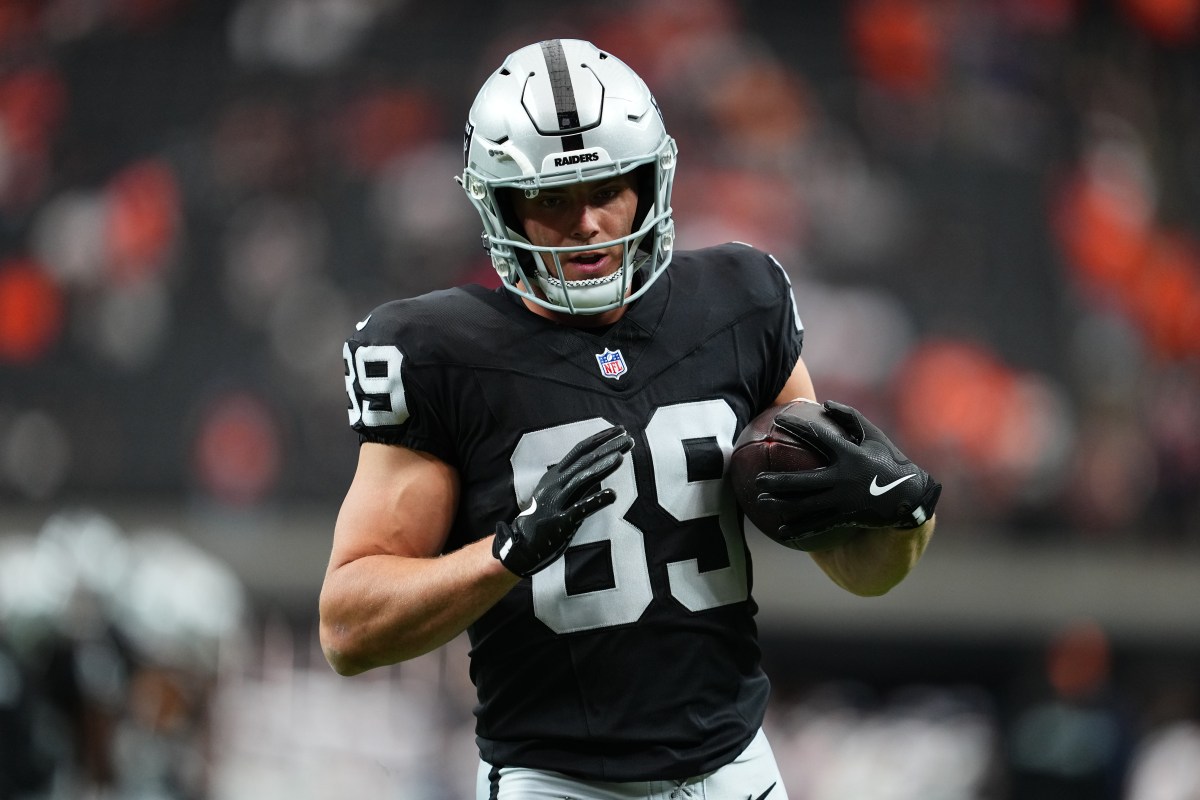
To truly grasp the immense pressure and fear that gripped the franchise, one must rewind just a few chaotic days before kickoff. It was a quiet Friday afternoon when head coach Klint Kubiak stepped to the microphone and delivered a bombshell that sent shockwaves through the entire Raider Nation. Brock Bowers, the second-year phenom who had redefined the tight end position, would undergo a meniscus trim procedure on his left knee. The phrase “meniscus trim” sounds almost benign on the surface—a routine arthroscopic cleaning of a joint, common in sports medicine. But to any seasoned football fan, it carries the weight of potential disaster, a harbinger of lost time and lingering pain. Kubiak initially framed it as a short-term fix, stating that Bowers was expected to miss “a game or two,” a timeline that sounded reassuring in a press conference but did little to quell the rising tide of dread. The fanbase had been burned before, and their collective memory was scarred. They vividly remembered the nightmare of the 2025 season, a year that had begun with so much promise but was brutally truncated by a persistent, nagging knee injury. That season, Bowers battled a PCL issue and a painful bone bruise in his left knee, a combination of ailments that ultimately forced him to miss four games and left him a shell of his explosive self in the games he did manage to play. In those 12 games, he scraped together just 64 catches for 680 yards and seven touchdowns—respectable numbers for an average tight end, but a catastrophic decline for a player who had shattered records the year prior. The fear was visceral and immediate: was history about to repeat itself? Was this the beginning of a chronic, career-altering condition that would rob the team of its centerpiece? Social media erupted in a frenzy of panic, with doomsayers predicting a season-ending injury, questioning the medical staff, and calling for Kubiak’s head before the first snap of Week 1 had even been taken.
Paragraph 3: A Glimmer of Hope Pierces the Dread
But then, like a bolt of lightning cutting through the darkest storm clouds, Monday brought a revelation that felt almost too good to be true. ESPN’s Adam Schefter, the undisputed arbiter of NFL insider information, dropped a report that directly contradicted the initial wave of anxiety. Klint Kubiak now considers Bowers “day-to-day.” Those three simple words hung in the air, offering a glimmer of hope that had seemed utterly impossible just 48 hours prior. The distinction between a “meniscus trim” and a more serious “meniscus repair” is the difference between a week of recovery and months of rehabilitation. A trim is minimally invasive, smoothing the frayed edges of the torn cartilage, allowing for a rapid return to weight-bearing activity and explosive movement. The fact that Bowers has already graduated to “day-to-day” status so quickly suggests the tear was minor and the procedure was almost textbook in its simplicity. It means he is walking without a brace, moving freely, and undergoing rehab without significant swelling or setbacks. It signals a very real, tangible possibility that he could be back on the field this Sunday against the Los Angeles Chargers. The collective exhale from Raider Nation was audible, a wave of relief washing over living rooms and sports bars across the city. The panic that had gripped the fanbase evaporated, replaced by a cautious, yet increasingly optimistic, hope. This wasn’t just about the physical health of a player; it was about the psychological state of the entire franchise. Having their best offensive player sidelined indefinitely would hang over every practice, every game, and every press conference like a guillotine blade. The “day-to-day” label allows the team to breathe, to strategize, and to prepare as if their leader will be on the field when the whistle blows, rather than planning for a season of life without him.
Paragraph 4: The Unlikely Hero Steps Out of the Shadows
While the city held its breath and refreshing its Twitter feeds all week, the football team had a business to attend to on Sunday afternoon. And in Bowers’ absence, the spotlight fell squarely on a familiar, yet often overlooked, face: fourth-year tight end Michael Mayer. This was his moment to prove he wasn’t just a backup riding the coattails of a superior talent, but a legitimate, game-changing difference-maker in his own right. And he delivered with a gritty, blue-collar performance that won the hearts of his coaches. In Sunday’s victory over the Dolphins, Mayer was the team’s leading target, hauling in six catches on seven passes for 32 yards. On the surface, that yardage seems pedestrian, even unremarkable. But the context is everything. He was quarterback Kirk Cousins’ ultimate safety valve, the reliable pair of hands who worked the short crossers, the quick outs, and the crucial third-down conversions that kept long drives alive and chewed up the clock. He became a physical security blanket in the middle of the field, sealing off defenders with his sturdy frame and moving the chains with a relentless determination. It wasn’t flashy, and it certainly won’t make any highlight reels, but it was exactly what the team needed to secure a victory without their star. Mayer is a fundamentally different kind of player than Bowers. Bowers is an athletic anomaly, a blur of motion who can stretch the seam and outrun cornerbacks with ease. Mayer is a throwback, a bruising, relentless blocker who uses his size and mental acuity to dominate the short-to-intermediate zones. His performance proved that this offense has legitimate depth, that the drop-off, while significant, isn’t a total cliff. His reliability gave the coaching staff a strategic blueprint for survival if Bowers needs an extra week of rest, and it gave Cousins the confidence to trust his second option implicitly, which is crucial for the team’s long-term success.
Paragraph 5: The Incomparable Value of a Healthy Star
However, even as Mayer shined in the spotlight, his performance served as a stark and powerful reminder of what the Raiders truly possess in Brock Bowers. Cast your mind back to his transcendent rookie campaign in 2024. It was a season for the ages, an absolute assault on the NFL record books. He hauled in an astonishing 112 catches on 153 targets, amassing 1,194 receiving yards and five touchdowns. He didn’t just lead all tight ends in those categories; he obliterated the competition, setting a new gold standard for the position in the modern era. His ability to get open at every single level of the field is almost supernatural. He runs routes with the precision of a 6’4″ wide receiver, possesses hands that act like vacuums, and has the open-field vision and agility of a seasoned tailback. When Bowers is on the field, he completely warps the opposing defensive game plan. Defensive coordinators are forced to allocate a dedicated safety or a premier linebacker to shadow his every move, which in turn opens up precious one-on-one opportunities for the other weapons on the outside. He is the gravity that holds the solar system of this offense together. Without him, Cousins has to be more precise, more conservative, and the offense loses its explosive, downfield potential. The 2025 season, hampered by injury, was a painful lesson in just how crucial his health is to this team’s identity. When he was healthy, the offense looked dynamic and unstoppable; when he wasn’t, they stagnated and struggled to move the ball. Monday’s news restores the hope that the dynamic, high-flying version of the Raiders is not lost, but merely postponed, waiting for the official clearance to unleash hell on their next opponent.
Paragraph 6: Gazing Toward the Horizon and the Road Ahead
Now, all eyes shift to the glitz and glamour of Los Angeles. The Raiders travel to SoFi Stadium on Sunday to face the Chargers, with kickoff scheduled for 4:05 p.m. ET. The matchup is a classic AFC West rivalry, and the Chargers will be desperate and hungry for a win after suffering a shocking upset loss to the Arizona Cardinals in their own season opener. If Bowers is cleared to play—and the “day-to-day” designation makes that a legitimate coin flip—he would instantly change the entire complexion of the game. His presence would give the Raiders a massive advantage in the red zone and on critical third downs, allowing them to control the tempo and keep the chains moving against a formidable defense. But even if he doesn’t suit up, Sunday’s victory proved a valuable and empowering truth to the locker room: this is not a one-man show. They have a resilient, opportunistic defense, a capable and savvy quarterback in Cousins, and a tight end room that goes two deep with reliable talent. The story of this week is a story of resilience—the resilience of a team that found a way to win without its star, and the resilience of the star himself, who is fighting his way back from yet another surgical procedure. The road to the playoffs is long, treacherous, and filled with obstacles, but for the first time in an entire week, the Raider Nation can look forward with genuine excitement rather than paralyzing dread. The shadow has been lifted, the prognosis is favorable, and the future, for now, looks incredibly bright. The 27-13 win was excellent, but the “day-to-day” status of Brock Bowers is the real victory that has everyone talking, breathing a sigh of relief, and dreaming of what this team can truly accomplish with their best weapon back in the lineup.