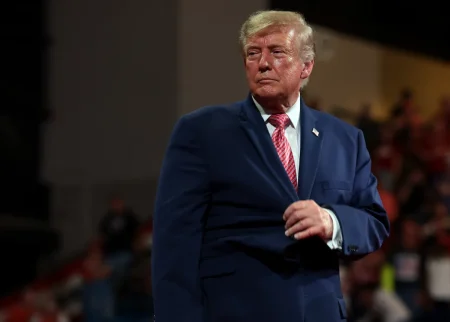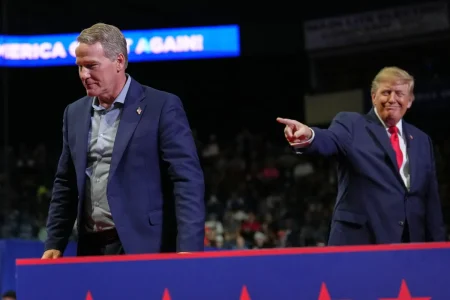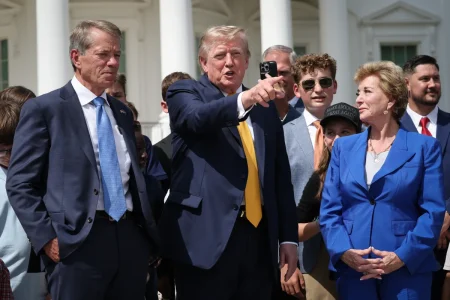


The scene could hardly have been more Irish: a windswept course on the Atlantic coast, a roaring crowd, and Shane Lowry rolling in a thirty-foot birdie putt on the final green at Doonbeg to seal a record eleven-shot victory at the Amgen Irish Open. Lowry spread his arms wide before the ball even dropped, as if the moment itself was too perfect to be real. And then, as if the script needed one more twist, Donald Trump appeared. The U.S. president, who owns the golf resort, watched from a box seat and came down to hand over the trophy. But with the cameras still rolling, Trump did what Trump does: he changed the subject. The conversation turned from sport to tariffs, specifically the ten percent duty on Irish whiskey. Everyone, he said, had been asking him about it—the taoiseach, Micheál Martin, Lowry, just about everyone. So, on behalf of the United States, he announced he was taking it off. The crowd erupted. The luck of the Irish, or perhaps the charm of the moment, had delivered. But if you looked closely, this was not just a spontaneous act of generosity; it was the latest installment of a curious and recurring pattern in which whiskey has become a surprisingly personal tool of global trade politics.
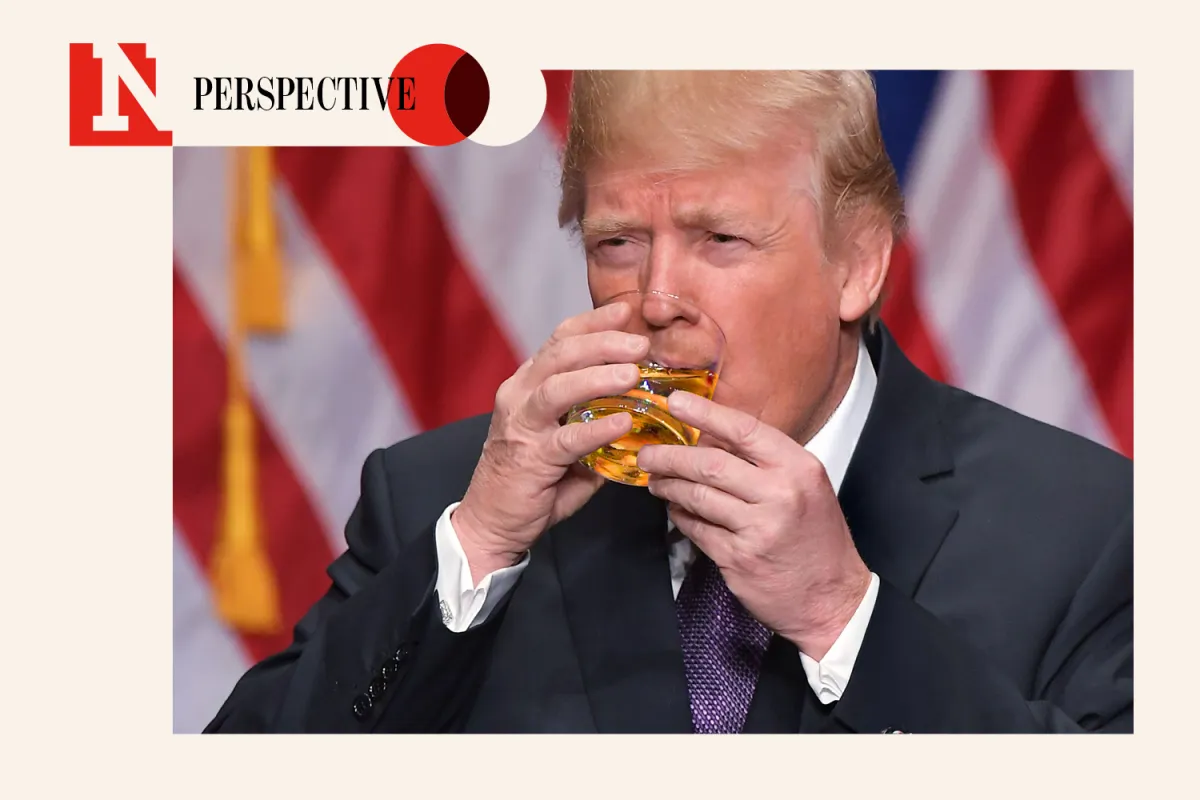
The numbers behind the announcement are significant. The Irish Whiskey Association values annual U.S. exports at roughly €450 million, about $519 million, and Irish whiskey has been one of the great success stories of modern spirits, growing from a niche product into a global favorite. Yet Trump gave no implementation date, and those who follow his trade policy know that a promise is not the same as a policy. When he made a similar pledge about Scotch whisky, it took nearly three months to take effect. There is also a strange human irony at the center of this story: Trump himself never drinks. He has said he doesn’t touch alcohol, citing the warnings of his late older brother, Fred, who died at forty-two of alcoholism. That tragedy shaped Trump’s personal habits, but it has not stopped him from using alcohol as a central prop in his trade diplomacy. Whiskey, in particular, has become a recurring vehicle for personalized, crowd-pleasing announcements, a product category that is culturally iconic, nationally branded, and politically useful in a way that steel or semiconductors simply are not. It is big enough to matter to the countries that produce it, but small enough against a national trade balance that a well-publicized carve-out does not reopen the entire tariff war. It gives a president who loves deals and drama a chance to play the role of benefactor, rewarding friends and punishing rivals with a single product that carries far more emotional weight than its raw trade value might suggest.
This was, after all, the second time in a single year that Trump had publicly waved a magic wand over whiskey. On April 30, the final day of King Charles III’s state visit, Trump announced he would scrap the tariff on British whisky, saying he was doing it in honor of the King and Queen. He admitted that the royal couple had persuaded him to do something others had failed to achieve. That pledge took effect on July 24, and Scotch, whose American market was worth around £933 million in 2025, began entering the United States duty-free. The tempting conclusion is that Trump is a soft touch for whiskey, flattered by monarchs, charmed by sportsmen, and sentimental about a drink he has never tasted. But the truth is more complicated. The U.K. government credits the Scotch exemption to sustained, government-led engagement with Trump. Scotland’s first minister nodded to the King’s influence but also pointed to a wider campaign by Scottish ministers and the industry. The Irish Whiskey Association, for its part, had been pressing publicly for the same treatment since the day after the Scotch decision, arguing that a single protected product was facing two different U.S. tariffs depending on which side of the Irish border it was distilled. And the Irish rate had already been falling: it was 15 percent under the 2025 regime, then dropped to 10 percent after a broad round of U.S. tariff action in July that covered sixty trading partners. The line was moving before anyone teed off at Doonbeg. So while Lowry’s victory and Trump’s on-camera announcement made for a memorable moment, the reality is that the Irish exemption was the result of sustained lobbying, political pressure, and a trade environment that had already shifted in Ireland’s favor.
Whiskey, however, is not always the beneficiary of Trump’s bottle diplomacy; sometimes it is the victim. In March 2025, when Brussels proposed a 50 percent tariff on American whiskey in retaliation for U.S. steel and aluminum duties, Trump threatened to impose 200 percent tariffs on European wine and spirits unless the proposal was dropped. The stakes were enormous: Eurostat put all EU alcoholic-beverage exports to the United States at €8.9 billion, roughly $10.3 billion, in 2024. The French, in particular, had every reason to reach for a very stiff drink. Then there is the Canadian conflict, which shows how alcohol can be weaponized just as easily as it can be rewarded. After Canadian provinces pulled American liquor from their state-run systems, Trump reached for a dormant provision of the Tariff Act of 1930, Section 338, which permits retaliation against discriminatory treatment. His July 20 proclamation on alcohol found that U.S. alcohol exports to Canada had collapsed from about $718 million to $137 million, a drop of roughly 81 percent. Fifty percent duties followed, were delayed for three days while Ottawa talked, and then were imposed on August 22 after the White House said Canada had reneged on its commitment. Canadian Prime Minister Mark Carney disputed that account, saying he suspended the talks because late changes to American terms were unfair and uneconomic. Trump went even further on September 8, ordering specified Canadian alcoholic beverages excluded from importation altogether. Five days later, he was standing on a green in Clare, promising to lift the Irish duty. The whiplash is dizzying, but it is not random. Part of what makes alcohol so useful in this kind of diplomacy is that its reciprocity is already physical. Scottish distilleries buy around $270 million of used Kentucky bourbon barrels every year, and the Irish industry describes Ireland as the EU’s largest importer of American oak, with most Irish whiskey maturing in ex-bourbon casks. The trade is not one-way; it is a web of mutual dependence, which gives negotiators leverage and talking points in equal measure.
Yet for all the drama of the Doonbeg announcement, enormous questions remain. We still do not know what legal instrument will implement the pledge, or when it will arrive. We do not know if anything is moving in the other direction, whether there is an EU concession or a separate Irish commitment in return. The European Union does not allow individual member states to negotiate bilateral trade agreements, which raises a thorny question: if the exemption applies to Irish whiskey, why not French liquor, or Italian wine, or any other European spirit? Trade policy is supposed to be uniform across the bloc, and a special deal for one member could unravel the carefully constructed common commercial policy. Until those questions are answered, what happened on the eighteenth green is best understood as a promise rather than a policy. It belongs to a pattern that is still an open question rather than a closed conclusion. Trump has now twice put whiskey at the front of a public trade announcement, at the request of people whose names everyone knows. Whether that is how policy is actually made, or merely how it is announced, is not yet clear. What is clear is that the president enjoys the theater of it all: the crowds, the cameras, the chance to play Santa Claus with a tariff. He has discovered that whiskey is a product that makes people emotional. It is tied to national pride, to family memories, to a sense of place and history. You cannot say the same about a semiconductor.
And so, after all the negotiations and the threats and the promises, perhaps the most fitting image is this: a teetotaler president handing a trophy to a golfer on a sunlit Irish green, then announcing a tax break on a drink he will never taste. The crowd cheers, the Irish celebrate, and somewhere a distiller raises a glass to the strange twists of politics. Trump, meanwhile, reaches for his Diet Coke. There is something almost poetic about it. A man who has spent decades in the worlds of business and power, who has negotiated with kings and prime ministers, who has used every tool at his disposal to get what he wants, has found in whiskey a kind of diplomatic magic. It is a product that carries centuries of tradition, a craft that has survived wars and famines and economic crises, and now it has become a pawn and a prize in the endless game of international trade. For the people of Ireland, the promise of zero tariffs on their whiskey is a genuine victory, a chance to sell more of what they make so well. For Trump, it is another headline, another moment of applause, another reminder that he can bend the rules of the global economy to reward those who please him. Whether the promise holds, whether the policy follows, whether the rest of Europe demands the same treatment—all of that remains to be seen. But for one evening, at least, the oldest story in Ireland was true again: the rain held off, the putt dropped, and the Americans left with a smile. Sláinte, lads. Trump’s glass is still full of Diet Coke, but that hardly matters. The whiskey is flowing, the cameras are rolling, and the world is watching to see what happens next.