


The Los Angeles Chargers walked into Sunday’s season opener cloaked in the kind of gilded confidence that only a Super Bowl contender can carry. The betting lines had them as the week’s biggest favorites, a generous 9.5-point buffer against a visiting Arizona Cardinals squad that was, by all reasonable estimations, in the middle of a full-scale rebuild under a first-year head coach. The air in SoFi Stadium was thick with swagger, with fans eager to watch new offensive coordinator Mike McDaniel unleash a fireworks show on an unsuspecting opponent. Yet, by the time the fourth quarter wound down, the building had fallen strangely silent, save for the celebratory shouts of a desert team that had just flipped the entire league’s script. The Arizona Cardinals, the team nobody thought would show up, had not only shown up; they had crashed the party, dismantling the Chargers’ offense, frustrating their vaunted defense, and striding out of Los Angeles with a stunning 26-14 victory that sent shockwaves through the NFL landscape.
The first half was a masterclass in quiet resilience versus unchecked arrogance. While the Chargers expected to waltz through the Cardinals’ porous defense, it was Arizona that dictated the tempo and the physicality of the contest. Jacoby Brissett, a veteran journeyman often dismissed as a stopgap, played with a poise that belied his reputation. He stepped up in the pocket, surveyed the field with veteran calm, and distributed the ball with surgical precision, keeping the chains moving and the clock ticking. Trey McBride, the Cardinals’ oversized tight end, proved to be the human mismatch the Chargers simply had no answer for, boxing out defensive backs and hauling in contested catches over the middle as if they were routine. By halftime, the scoreboard read a disorienting 13-7 in favor of the visitors—a margin that felt less like a fluke and more like an indictment. The Cardinal defensive front had begun to clamp down on Justin Herbert, and the growing unease in the home crowd was palpable, a feeling that the comfortable afternoon they had paid top dollar for was slowly morphing into a tense, ugly slog.
What happened after the break was not a spirited comeback attempt but a systematic deconstruction. The Cardinals refused to loosen their grip, instead leaning on a running attack that churned out the tough yards necessary to control the clock. Tyler Allgeier and Jeremiyah Love split the workload effectively, combining for over 100 yards on the ground, which kept the Chargers’ defense off balance and gave Brissett pristine play-action opportunities. McBride capped a stellar outing with a touchdown, finishing with nine catches for 95 yards, while the Arizona offensive line displayed a grit that had been missing in their recent seasons. Defensively, the Cardinals were relentless. They swarmed to the football, contested every passing lane, and applied consistent interior pressure that rattled Herbert. They forced the Chargers into desperate third-and-long situations, and Arizona’s secondary, often cast as a weak link, locked down receivers with a ferocity that suggested they had studied the game plan endlessly. The 26-14 final score flattered the Chargers, masking the reality that this game was never truly competitive after the opening quarter.
For Los Angeles, the loss was a brutal, demoralizing gut punch that piled embarrassment onto technical failure. Justin Herbert, the franchise cornerstone expected to elevate the McDaniel scheme to new heights, finished a pedestrian 17 of 27 for 209 yards, with one touchdown and a crippling interception that killed a crucial drive. Beside him, the running game was anemic; second-year back Omarion Hampton managed just 43 yards on 12 carries, a paltry 3.6-yard average, and his costly fumble deep in Arizona territory snuffed out the Chargers’ final hope of a comeback. The overall offensive output was a mere 268 total yards—one of the lowest totals of the entire week—and their inefficiency on money downs, converting just 2 of 8 third downs and 0 of 3 fourth downs, pointed to a systemic schematic failure. Even more shocking was the uncharacteristic sloppiness brought on by seven penalties for 64 yards. The defense, the supposed bedrock of the team, imploded under the weight of Arizona’s balanced attack, surrendering 393 total yards while failing to force a single turnover. It was a complete, all-encompassing failure on both sides of the ball, a far cry from the disciplined, contending team they envisioned themselves to be.
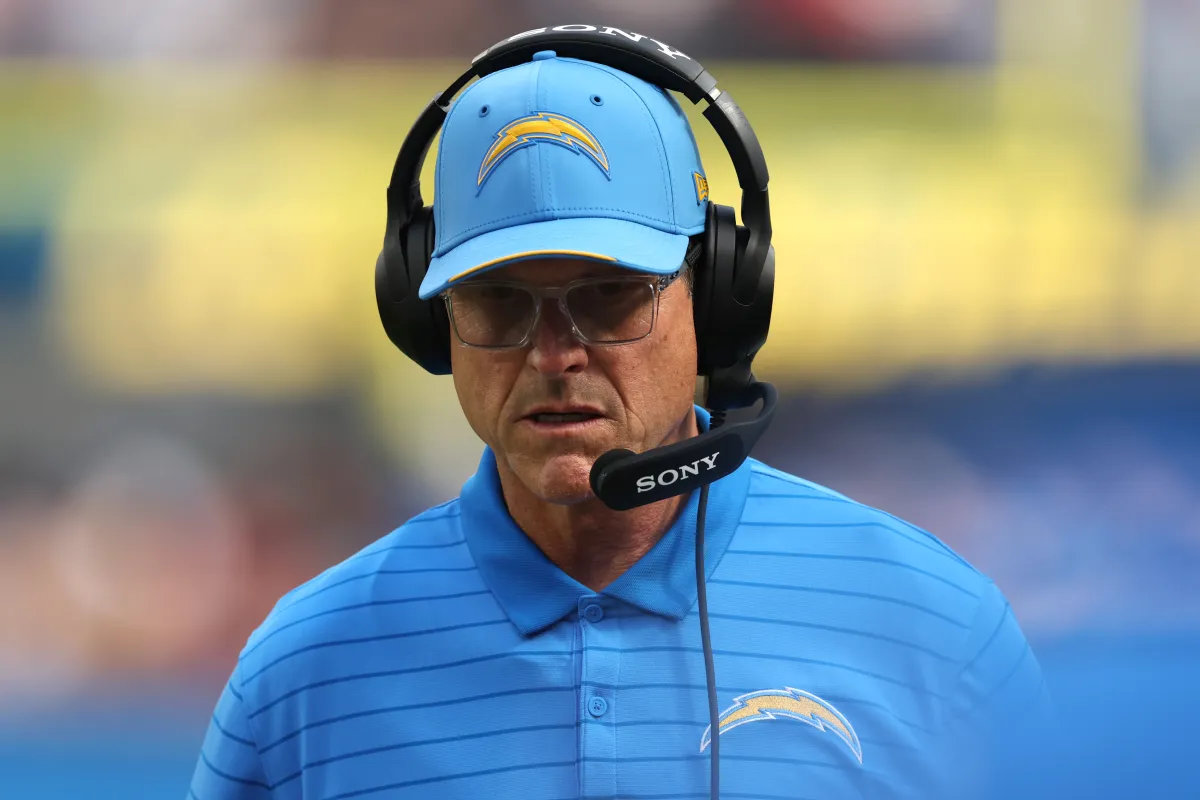
In the aftermath, head coach Jim Harbaugh stood before the assembled media, his face a mask of barely contained frustration. Direct and old-school to the core, he offered no sugarcoating. “Much to get better at. It’s a start. Not the start that we wanted, but credit to the Cardinals,” he began, his voice carrying an edge. “Some uncharacteristic things happened. Give them credit for making them happen. I would call it sloppy at times. Too sloppy. That’s something we need to get fixed.” His words echoed the sentiment of a locker room stunned into silence. For all the offseason hype—the new offensive coordinator, the playoff expectations, the media darlings anointing them as AFC contenders—they had been outcoached, outplayed, and outhustled by a team they were supposed to bury. The accountability had to start at the top, and Harbaugh’s clipped, honest assessment offered little comfort. The players knew the truth: they had choked on the big stage, and the rah-rah speeches from training camp meant nothing against the harsh, unforgiving reality of a professional football Sunday.
Yet, football is a game of short memories, and the immediate future stares back with a steely challenge. The Chargers do not have time to wallow. They must travel to Las Vegas in Week 2 to face a Raiders squad that just physically dismantled the Miami Dolphins, 27-13. That matchup, once viewed as a simple stepping stone, now looms as a potential crisis of identity. Can Los Angeles shake off the rust and the lingering stench of this upset? Is it possible that Arizona, with their first-year head coach and youthful energy, is simply better than the pundits predicted? The answer lies in the film room, where Harbaugh and his staff will dissect every missed assignment, every dropped pass, and every mental error. For the Cardinals, this victory was a monumental validation—a sign that the rebuild is ahead of schedule and that their culture of toughness is taking root. For the Chargers, it was a sobering reminder that hype never wins games; execution does. The NFL season is a marathon, and Week 1 upsets are its enduring tradition, but the scars of this shocking collapse will linger in Los Angeles until they prove they can bounce back against a division rival in hostile territory.