



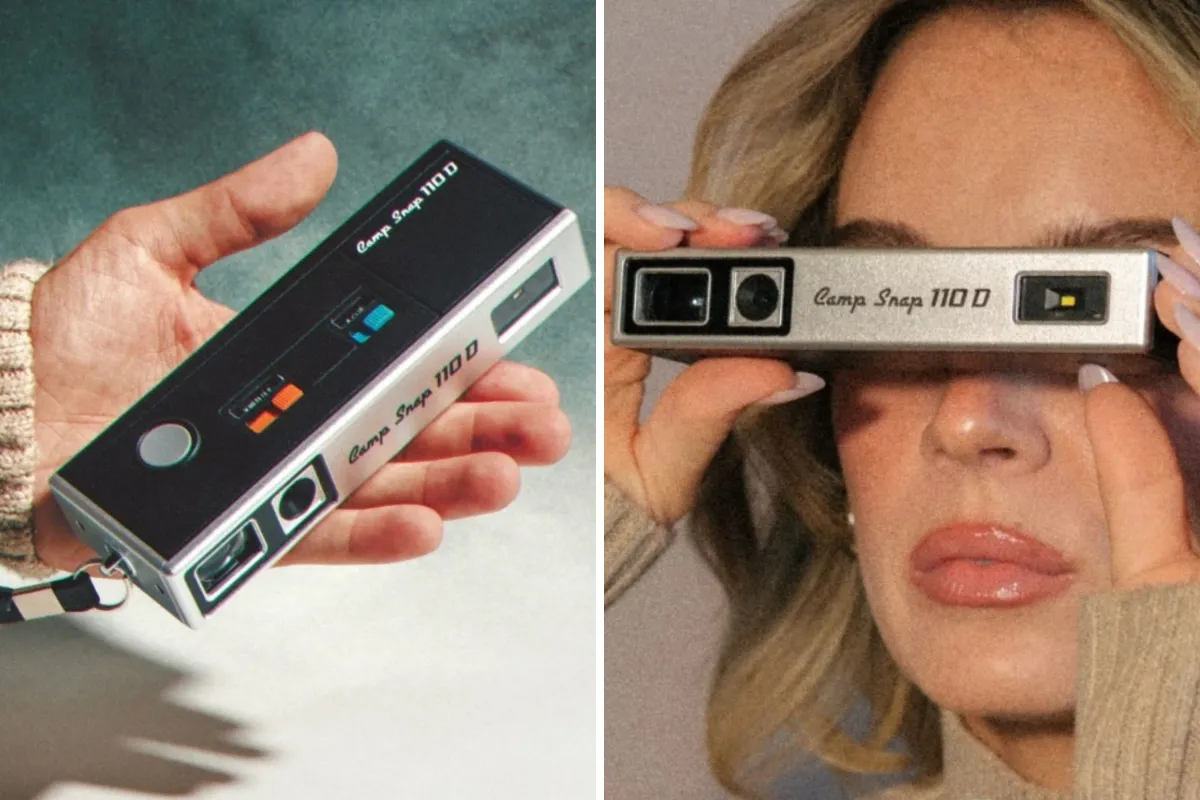
There’s something quietly thrilling about seeing an old friend redesigned. More than fifty years after Kodak introduced the iconic 110 camera in 1972, a new pocket camera called the Camp Snap 110 D is bringing that long, slim silhouette back into the world. At first glance it looks like a relic from a family photo album—a toy-like rectangle with minimal controls and an unmistakable retro charm. But inside is a thoroughly modern heart: a digital sensor, a rechargeable battery, and no film cartridge required. The most striking choice, though, is what’s missing. There’s no screen. No instant playback, no swiping through captured images, no endless retakes. Instead, a small status display shows only battery life and how many photographs have been taken. The company behind it says the design is meant to keep you from being distracted from the moment you’re actually photographing. You capture the image, and only later, after transferring files to a computer or phone, do you finally see what you got. That delay turns photography from an instant, disposable act into something closer to a ritual—an experience of anticipation that feels almost lost in a world of immediate gratification. It’s a deliberate return to a time when you had to wait for film to be developed, when every click of the shutter mattered because you couldn’t simply check the result and try again. The Camp Snap 110 D is therefore more than a cute novelty. It’s a small rebellion, a pocket-sized reminder that not everything needs to be seen in real time.
Why now? Because we are living through a strange cultural contradiction. Our digital devices are more powerful than ever, yet many of us are feeling an increasing pull toward old technology—analog cameras, film, flip phones, vinyl records—as if trying to recapture something that got lost along the way. It’s not just nostalgia for the objects themselves; it’s nostalgia for how those objects made us feel. There is a clear revival of retro technology happening around us, driven by a longing for authentic, real-life experiences and simpler times, especially as the digital age grows more demanding. The figures back it up: according to a report by Market Reports World, the global film photography camera market is projected to rise from $36.84 million in 2026 to $52 million by 2035. That forecast doesn’t even include digital retro-styled cameras like the Camp Snap, but it reflects a broader appetite for experiences that feel personal, physical, and less automated than smartphone photography. Teemu Suviala, global chief creative officer at Landor & Fitch and a former Meta Reality Labs executive, explains it simply: smartphone photography has become so good, so immediate, and so familiar that our pictures can start to feel interchangeable, and honestly, a bit boring. A point-and-shoot camera, by contrast, offers unpredictability. It gives you the softness of a real memory that might fade, the wonky crop, the imperfect focus, the lived-in texture of an actual moment. Those imperfections are exactly what make us feel something when we look back. There is an intimacy in not knowing exactly what you’ve captured until later. The camera creates a small boundary between taking a photo and getting sucked into a digital vortex. Instead of reviewing every shot as you go, you can just take the picture, put the camera away, and stay at the party. The wait, Suviala says, has become part of the appeal—a product feature. The point isn’t to ignore technology, but to be fully in the moment rather than drifting into social feeds, messages, and notifications.
This craving for pause is being driven by something deeper than style. Digital burnout is real, and it is shaping how younger generations choose to live. According to a July 2026 study by YPulse, around two-thirds of Gen Z and younger millennials are using analog or retro technology, such as digicams, instant film, film cameras, flip phones, and vinyl records. The same study suggests that this old-tech revival is rooted most strongly in a longing to escape the crushing weight of constant connectivity. A December 2025 study by the web browser Shift found that 62 percent of its users experience digital burnout, and 34 percent of Gen Z respondents say they regularly feel that burnout. That exhaustion translates into a desire for tools that place gentle friction between us and the digital world. Kate Trey, co-founder of lifestyle brand Coilie and creator of The Modern Landline—a wall-mounted phone perch with a coiled USB-C charging cord—has seen this mindset up close. Her product, which evokes the rotary phone era, had a 20,000-person waitlist and sold more than 1,300 units in presales within two months. Millennials and Gen Z, she says, are absolutely pushing back against digital overload. There is real relief in a device that can’t ping you. The appeal of old formats is that they put a natural pause in the experience, and that pause is the feature. Trey says people aren’t rejecting technology; they’re rejecting being always available. The more capable technology becomes, the more we crave permission to slow down. Even the anticipation of waiting—for film to be developed, for a call to come home to a landline—used to be part of life, and it made the payoff better. Retro products like the Camp Snap give people that feeling back without asking them to give up their modern lives entirely. They’re a compromise between the convenience we rely on and the slowness we secretly miss.
At the heart of this movement is nostalgia, but not the shallow kind that simply romanticizes the past. Nostalgia, in this context, is a deeply creative and social force. Craig Reynolds, co-founder of Locomotive, the global live-events studio behind Bingo Loco—where hundreds gather to sing and dance to 1990s and 2000s pop songs and hip-hop anthems—has built a career on this exact energy. Nostalgia, he says, disarms people. A familiar song or a camera that reminds you of childhood can lower the guardrails we build around ourselves as adults, making it easier to be silly, spontaneous, and present. The real power of retro is using something familiar to unlock a feeling. The same logic works for a camera. The Camp Snap doesn’t simply imitate the old 110 cameras; it summons the feeling of a younger, freer self—the self who snapped pictures without overthinking, who trusted that the moment would be good enough, who didn’t need to see the result to believe in its magic. Suviala adds that nostalgia works when it reconnects people with a meaningful behavior or feeling, rather than simply borrowing a look. And that’s exactly what the Camp Snap does. It understands what the original 110 camera gave us: simplicity, portability, and a strange kind of faith in the photograph. It doesn’t just reproduce a retro shape; it reintroduces the behavior that came with that shape. You have to be a little more deliberate, a little more patient, a little more willing to let go of control. That, more than the plastic and rounded edges, is what makes it feel vintage. Nostalgia, in this sense, isn’t about looking backward longingly. It’s about mining the past for tools that can make the present richer.
So what is it actually like to use a camera like this? On the surface, it’s a wonderfully simple thing. You point it at your friends, press a button, and hear a familiar click that feels suspiciously like the old mechanical shutters of childhood. There’s no immediate feedback, no tiny screen to lean over and evaluate, no chance to decide whether the composition is flattering or whether someone had their eyes closed. That might sound frustrating in a culture that glorifies perfection and careful curation. But it’s also oddly freeing. Because you know you can’t check, you stop trying to control. You take your shot, lower the camera, and get back to the life happening in front of you. When you finally transfer the photos later, you experience the day again with fresh eyes. Some shots will be blurry, awkward, or entirely accidental. Others will capture a laugh or a glance that would have been lost in the desperate attempt to get the “right” image. The absence of a screen is not a mistake or a shortcoming; it’s the entire point. It restores the human ability to be a participant rather than just a documentarian. It also makes photography feel scarce, even in a digital camera. Since you can’t endlessly retake and delete, you become more careful. You save your shots for moments that genuinely matter. There’s a mindfulness to that, a gentle pressure that pushes you to notice the world around you. And by the time you sit down to look at the images, they carry more weight. They’re not just pixels you’ve already scrolled past a thousand times; they’re little treasures you waited to uncover, full of surprise and memory.
This moment, then, is more than a trend. It’s a cultural recalibration. We’re not going to throw away our smartphones or abandon the internet. But we are starting to understand that there is value in boundaries, in moments of solitude, in objects that don’t demand our attention every second. The Camp Snap 110 D is a small symbol of that understanding. It takes the familiar shape of a 1970s icon and fills it with modern convenience—digital, rechargeable, easy to use—while intentionally leaving out the most modern thing of all: instant feedback. It asks us to trust ourselves, to be present, to let the photo live outside our immediate control. It’s a camera for people who miss the feeling of not knowing, who want to see the world through a frame instead of through a notification badge. The revival of retro tech is not a rejection of progress; it’s a renegotiation with it. We’re learning to say no to the endless ping, to the constant feed, to the pressure to document and broadcast every slice of life. In that light, the Camp Snap is not a step backward. It’s a quiet step forward into a more intentional way of being. It encourages us to keep the best parts of modern life while restoring the elements of wonder, anticipation, and human connection that digital technology sometimes steals. Because ultimately, the photographs we remember are not the ones we curated diligently on a screen. They’re the ones we took with our hearts, developed with time, and rediscovered with joy. The Camp Snap 110 D is an invitation to take those kinds of pictures again.