



In the quiet archives of global football, some moments are so laced with retrospective magic that they feel less like coincidence and more like the deliberate handwriting of fate itself. Long before Lamine Yamal became the electrifying teenage sensation destined to carry the hopes of both Barcelona and Spain on his young shoulders, he was merely an innocent, fragile infant cradled in the somewhat awkward, tender grasp of a twenty-year-old Lionel Messi. The year was 2008, a time when Messi was just beginning to shed his cocoon of youthful promise to emerge as the undisputed creative center of Barcelona’s historic golden era. Through a charitable collaboration between the club, the Barca Foundation’s childhood protection program, and UNICEF, professional photographer Joan Monfort was tasked with capturing a series of intimate portraits for a “solidarity calendar” aimed at raising vital funds for vulnerable children. Fate, in its infinite wisdom, guided the lottery of selection to place a baby Yamal into a plastic baby tub right before Messi’s gentle, curious gaze in a chilly locker room at Camp Nou. The young Argentinian genius, notoriously shy, soft-spoken, and entirely unfamiliar with handling newborn infants, coaxed the giggling baby with a mixture of endearing timidity and quiet warmth, pouring water over him in a scene that would, decades later, look like a sacred baptism of sporting destiny. At the moment, it was a simple act of goodwill, a fleeting afternoon of community service completely oblivious to the reality that the tiny baby splashing in the suds would one day walk the very same corridors of power, inheriting the weight of a club and a nation’s burning expectations. This serendipitous encounter serves as a beautiful reminder of how closely knit the world of football truly is, showing us that the seeds of future greatness are often planted in the quietest, most humble moments of human connection.
This long-forgotten relic of the past remained buried in personal family albums until July 2024, when Yamal’s father, Mounir Nasraoui, gifted the sports world a moment of pure collective awe by posting a snapshot of the historic photoshoot to Instagram. Accompanied by the simple yet profound caption, “The beginning of two legends,” flanked by a solitary red heart emoji, the image spread across the digital landscape like wildfire, quickly becoming a visual scripture for football romantics and casual fans alike. As both Messi and Yamal began their preparations for their respective journeys toward the highly anticipated 2026 FIFA Men’s World Cup, the image ceased to be a mere photograph; it transformed into a symbol of a cosmic passing of the torch. Fans and sports analysts have enthusiastically attached the image to every monumental achievement the two players register, delighting in the surreal narrative arc that links the twilight of the grandest career in football history with the dawn of its most promising new chapter. For Nasraoui, sharing the photo was a testament of immense, tearful paternal pride, a quiet acknowledgment of the unimaginable journey his son had taken from a humble neighborhood kid to a global icon. In the eyes of the public, however, the photo became proof of a mythical transmission of power, prompting whimsical theories that a secret, magical elixir must have been mixed into that bathwater, granting the infant Yamal a spark of the legendary grace, vision, and resilience that has defined Messi’s career for nearly two decades. This digital resurgence highlights our deep human craving for narrative symmetry, transforming a simple charitable gesture into a modern footballing myth.
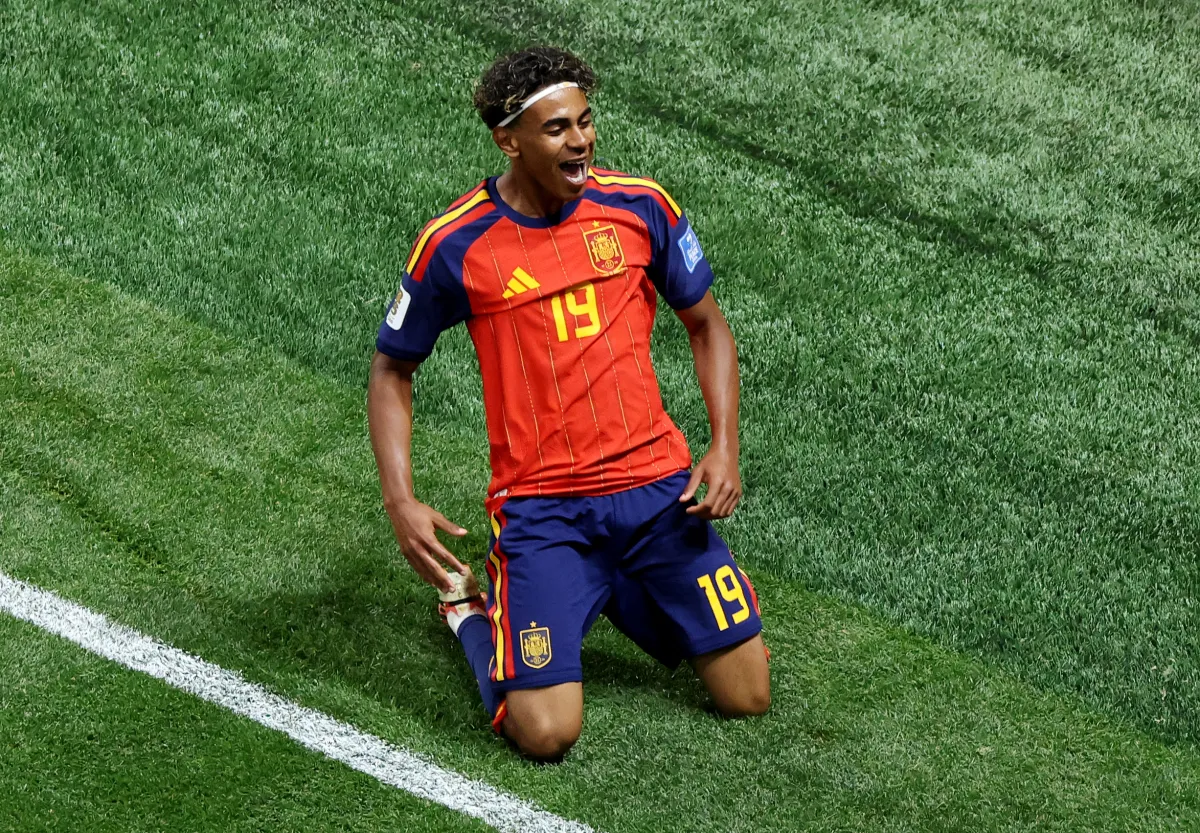
Now, against the grand and high-pressure backdrop of the 2026 World Cup, that mythical spark has ignited into a blazing reality as the eighteen-year-old Yamal takes center stage for Spain. Making his highly anticipated official debut on the world’s grandest stage, the wunderkind did not merely participate; he commanded the pitch with the audacity, tactical discipline, and seasoned intelligence of a veteran twice his age. During Spain’s clinical, breathtaking 4-0 demolition of Saudi Arabia, Yamal was handed his first career World Cup start and wasted absolutely no time writing his name into the history books, scoring a spectacular opening goal in just the tenth minute to set a fierce tempo for La Roja’s dominant campaign. His blend of explosive speed, hypnotic dribbling, and chilling composure in front of the net has left international defenders paralyzed and stadium spectators thoroughly captivated, propelling Spain to the absolute summit of Group H. With only one final group-stage encounter on the horizon against a fiercely physical and defensively organized Uruguayan side, the stakes remain incredibly high, as securing a victory would guarantee Spain the top seed and a highly favorable pathway through the grueling knockout rounds of the tournament. The sheer weight of expectation resting on Yamal’s young shoulders is immense, yet he moves across the pitch with an effortless, joyous fluidity that suggests he is entirely comfortable operating in the high-altitude pressure of international football’s biggest stage, flashing the same quiet confidence we saw in that plastic tub nearly two decades ago.
While the youthful exuberance of Yamal lights up Spain’s future, the enduring, age-defying brilliance of Lionel Messi continues to illuminate the present for the defending champions, Argentina. Now thirty-nine years old, an age where the vast majority of players have long hung up their boots or retreated to less physically demanding leagues, Messi remains the undisputed heartbeat of his beloved national team, guiding them with a magisterial, calm serenity through the challenges of Group J. Argentina’s journey has been defined by two masterclasses of collective dominance—a spectacular 3-0 victory over Algeria followed by a calculated, authoritative 2-0 defeat of Austria—both of which were brilliantly orchestrated by the legendary number ten himself. Against Algeria, Messi rolled back the years to net a magnificent hat-trick, following it up with a decisive brace against Austria to mathematically secure Argentina’s place in the coveted knockout stages. These stellar performances pushed his historic, all-time World Cup goal tally to a staggering eighteen, cementing his status as the most prolific goal-scorer in the history of the tournament, across both the men’s and women’s categories. Watching Messi glide across the pitch, dictating the tempo of games with a simple drop of his shoulder or a perfectly weighted, defense-splitting pass, is an inspiring reminder of the enduring beauty of human excellence, proving that time itself seems to stand still when he operates in his element, still playing with the same childlike passion that he had when he was a twenty-year-old volunteering for charity.
Naturally, the striking parallels between these two icons have sparked an endless stream of media inquiries and analytical comparisons, creating a psychological pressure cooker that could easily overwhelm even the most secure teenager. Yet, Yamal possesses a profound emotional maturity that beautifully matches his physical talent, a trait he demonstrated with immense grace during a deep-dive feature on the legendary American television program “60 Minutes.” When gently pressed by journalists about the endless comparisons to the legendary Argentinian, Yamal spoke not with arrogance or fear, but with a deep, grounded humility, emphasizing that his admiration for Messi is centered on mutual respect rather than a desire to copy his template. He articulated a clear, self-assured philosophy: while he openly reveres Messi as the greatest player to have ever graced the game, he has no desire to live in anyone’s shadow, nor does he wish to inherit the heavy psychological burden of wearing Messi’s iconic number ten jersey or mimicking his style. “In the end, because we are players, and because for me, he’s the best in history, and he also knows that I am a player and that I respect him,” Yamal explained with striking clarity. “So it’s a mutual respect, and I think we both know that I don’t want to be Messi, and Messi knows that I don’t want to be him. I want to follow my own path, and that’s it.” By stating his firm intention to walk his own path, Yamal is consciously protecting his mental peace, rejecting the toxic cycle of media comparison to ensure he can define his own unique legacy on his own terms.
As the 2026 World Cup tournament progresses toward its dramatic crescendo, the narrative of these two extraordinary athletes continues to offer a beautiful, poetic symmetry to sports fans around the globe. Yamal has set his expectations incredibly high, boldly guaranteeing that Spain will rise to the pinnacle of the tournament and capture their first men’s World Cup trophy since the historic 2010 squad conquered South Africa. To witness a teenager play with such fearless, unbothered conviction on one side of the world, while on the other, a thirty-nine-year-old icon continues to rewrite the history books, is to witness the past, present, and future of football colliding in a magnificent display of human achievement. The journey that began with a quiet charity photo shoot in a freezing locker room in 2008 has blossomed into one of the most compelling, cinematic stories in sports history, proving that destiny behaves in mysterious, beautiful ways when left to unfold naturally. Whether or not Spain and Argentina ultimately meet on the pitch in a dramatic, high-stakes final showdown, the bond between Messi and Yamal remains a testament to the generational bridge of football, proving that a single, simple act of kindness toward a baby can echo throughout sporting history. In a world often dominated by fierce rivalry and commercialism, their interconnected story stands as a beautiful reminder of the sport’s human heart, where destiny is hand-delivered through a warm bath and a smile.