


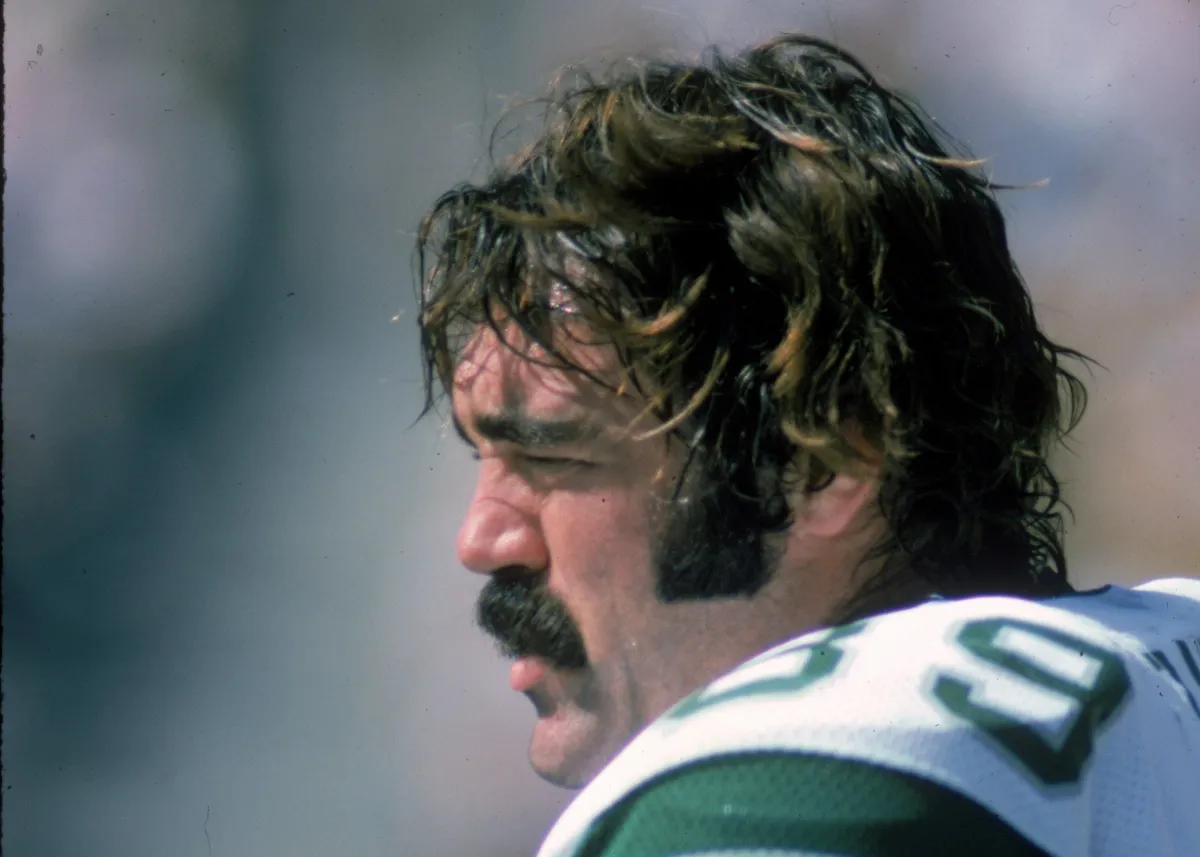
The sports world has lost one of its most uniquely fierce, charismatic, and captivating spirits with the passing of Steve Zabel at the age of 78. A larger-than-life figure who perfectly personified the raw, uncompromising grit of 1970s professional football, Zabel was a man whose relentless drive and indomitable presence left an indelible mark on every field he graced throughout his illustrious decade-long career. To truly understand Zabel is to understand an era of the National Football League where games were decided in the mud, where defensive battles were psychological wars of attrition, and where a player’s sheer will could reshape his entire professional destiny. Though he entered the league as a highly coveted offensive weapon, his untamed energy, fierce competitive nature, and penchant for physical confrontation quickly forced a reassessment of his role, transforming him from a pass-catching threat into one of the most formidable and feared outside linebackers of his generation. His journey through the ranks of the Philadelphia Eagles, the New England Patriots, and the Baltimore Colts was not merely a series of statistics in a record book, but a colorful testament to human adaptability, raw passion, and an unwavering love for the heavy-hitting reality of the gridiron. Zabel played the game with a joyful, chaotic intensity that commanded instant respect from teammates and opponents alike, embodying a bygone golden age of football where players relied on raw instinct, heart, and bone-crushing physicality. Yet, beneath the rugged exterior of a man who spent ten grueling seasons in the NFL trenches lay a deeply thoughtful, sensitive individual whose life was eventually shaped as much by his profound compassion off the field as his historic ferocity on it. As fans, sports historians, and the football community mourn his loss, they celebrate a rich, multifaceted legacy that spans from the heartlands of Minnesota to the roaring stadiums of Philadelphia and New England, reminding us all of the profound human stories that lie behind the helmets, the face masks, and the iconic plays of NFL history.
Before he became a household name in the professional ranks, Steve Zabel’s journey began in the crisp, competitive landscapes of his native Minnesota. Growing up as a naturally gifted three-sport star in high school, he possessed an innate athletic grace combined with a rare, heavy-boned strength that made his future in sports almost inevitable, excelling in every arena he stepped into. When the University of Oklahoma beckoned, Zabel packed his dreams and headed south to Norman, embarking on a collegiate career that would establish him as an absolute legend in Oklahoma football lore. Interestingly, his tenure with the Sooners began on the defensive side of the ball, where he first honed his instincts for tracking down ball-carriers and embracing high-velocity collisions. However, as the program evolved under the legendary guidance of head coach Chuck Fairbanks, the coaching staff recognized that Zabel’s unique physical dimensions and soft hands could be weaponized on offense to devastating effect. Transitioning to tight end, Zabel became an absolute revelation for the team. Over three spectacular varsity seasons from 1967 to 1969, he helped guide the Sooners to two prestigious Big Eight Conference titles, cementing Oklahoma’s status as a national powerhouse. By his senior season in 1969, Zabel’s dominant performances earned him All-American honors and placed his name at the very top of the draft boards of every professional scout in the country. He played with a joy and a competitive fire that was deeply contagious, charming the Norman community with his approachable personality while simultaneously terrifying division rivals. He was a player who loved the daily camaraderie of the locker room just as much as the glory of a touchdown catch, and his time as a Sooner laid the foundational worldview that the game of football was a deeply personal, brotherhood-driven endeavor that required both maximum physical exertion and absolute loyalty to one’s teammates.
The Philadelphia Eagles, recognizing a generational athletic specimen, selected Zabel with the prestigious sixth overall pick in the first round of the 1970 NFL Draft, eagerly earmarking him as the cornerstone of their offensive future for the decade to come. As a rookie, Zabel was immediately thrown into the professional fire, starting eight games at tight end and demonstrating the breathtaking physical tools that had made him a collegiate superstar. However, the Eagles’ coaching staff quickly realized that while Zabel possessed the physical attributes of an offensive weapon, his internal wiring and psychological constitution belonged entirely to the dark, aggressive world of defense. Zabel was simply too combative, too restless, and too eager for physical confrontation to be confined to the structured, disciplined routes of an offensive system. In his own words, his rookie campaign was defined by a fiery temperament that saw him get kicked out of three different games for fighting on the field. He was a man who refused to back down from anyone, treating every blocking assignment and every route as an existential battle of wills against his defender. The blue-collar fans of Philadelphia loved his passion, but the coaching staff knew they had to channel this chaotic energy productively. Recognizing this untamable wildness, the Eagles’ front office made a bold and unorthodox decision at the conclusion of his rookie season: they approached Zabel and informed him that his temperament was ill-suited for the offense, proposing a permanent move to outside linebacker. Rather than view this as a setback, Zabel embraced the transition with unbridled enthusiasm, later recalling that he jumped at the opportunity to finally hit people legally on every single play. This pivotal position swap saved his career and redefined his legacy, as he spent the next nine seasons unleashing his controlled fury on opposing offenses, shifting seamlessly between left and middle linebacker roles and proving to be a beloved fan-favorite during his five emotionally charged seasons in the City of Brotherly Love.
In 1975, a new chapter began for Zabel when he was acquired by the New England Patriots, a transaction that reunited him with his beloved former college head coach, Chuck Fairbanks. This reunion sparked a competitive renaissance in Zabel’s career, as Fairbanks intimately understood how to maximize the linebacker’s unique blend of football intelligence, deceptive speed, and raw physical power. Playing in the crisp, windswept environment of Foxboro, Zabel found himself perfectly suited to the Patriots’ burgeoning defensive identity of the mid-70s. In his debut season in New England, he put on a clinic of defensive efficiency, securing 72 tackles, three sacks, and a crucial fumble recovery that energized his teammates. The following year, 1976, would prove to be the absolute zenith of his professional career, a season in which he played with an enlightened intensity that baffled opposing offenses. Leading all New England linebackers with a career-high 88 tackles, Zabel’s brilliant playmaking and stubborn refusal to yield yardage earned him the prestigious title of the Patriots’ Most Valuable Defensive Player. He became the emotional anchor of the locker room, a veteran leader who mentored younger players while leading by example on the frozen turf. His contribution to this turnaround era of Patriots football was so enduring that he was eventually named to the New England Patriots’ All-Decade Team for the 1970s. For Zabel, this period was about more than just personal accolades; it was about the profound joy of playing under a coach who believed in him, alongside a band of brothers who shared his uncompromising work ethic. Whether he was stopping a sweep on third-and-short or dropping back into pass coverage to disrupt an opponent’s scheme, Zabel played with a relentless spirit that made him a beloved figure across New England, proving that the violent tight end from Oklahoma had truly found his calling as a master of defensive warfare.
However, the brutal and unforgiving reality of professional football in the 1970s eventually exacted a profound emotional toll on Zabel, leading to a moment of deep personal awakening that transcended the sport entirely. In 1978, Zabel witnessed a tragedy on the field that would forever alter his perspective on the game he loved. During a preseason clash, his young and incredibly talented Patriots teammate, wide receiver Darryl Stingley, was paralyzed following a devastating, controversial collision on the field. The sight of his vibrant, promising teammate suddenly rendered immobile on the turf struck a deep, agonizing chord within Zabel, instantly stripping away the romanticism of the sport and forcing him to confront the terrifying, mortal stakes of the game he had dedicated his life to. Speaking decades later in 2010 to a publication in his adopted hometown of Edmond, Oklahoma, Zabel candidly admitted that witnessing Stingley’s paralysis was the precise catalyst that inspired his decision to retire from professional football. After playing one final, contemplative season with the Baltimore Colts in 1979, Zabel hung up his cleats, realizing that there was a vast, beautiful world beyond the stadium lights that deserved his protection and care. Rather than allowing the violence of his career to embitem him, Zabel beautifully channeled his competitive energy into a new, deeply compassionate calling. Settling in Edmond, he founded a highly impactful nonprofit organization, transforming his local celebrity status into a vehicle for humanitarian aid. He dedicated the second half of his earthly journey to lifting up those who had fallen on hard times, proving to the world that his true greatness lay not in his ability to deliver bone-crunching tackles on Sunday afternoons, but in his infinite capacity to heal, support, and bring hope to the vulnerable members of his community.
Steve Zabel’s remarkable life came full circle in 2015 when he was rightfully inducted into the Oklahoma Sports Hall of Fame, an elite honor that celebrated not just his legendary athletic prowess, but the enduring integrity and depth of his character. This lifetime achievement stood as a monumental tribute to a boy from Minnesota who had embraced Oklahoma as his true, adoptive home, leaving behind a dual legacy of gridiron excellence and quiet, dedicated civic duty. Yet, if you were to ask Zabel what his greatest life achievement was, he undoubtedly would have pointed far away from the polished trophies and glass display cases, gesturing instead toward his beloved family. He was a deeply devoted husband who shared a profound, lifelong partnership with his wife, a proud and guiding father to his three children, a doting grandfather to several grandchildren, and a cherished great-grandfather who took immense joy in the laughter of his youngest descendants. To his family, he was not the ferocious, hard-hitting linebacker who once struck fear into the hearts of opposing quarterbacks, but a gentle giant of warmth, wisdom, and humor—a man whose very presence could fill a room with complete comfort and security. His passing at the age of 78 leaves a massive void in the hearts of those who loved him, but his memory will continue to burn brightly through the lives he touched, the community programs he established, and the stories of his courage. In remembering Steve Zabel, we honor a man of incredible depth: a fierce competitor, a visionary athlete who turned his life’s challenges into triumphs, a compassionate soul who prioritized human life over sports glory, and a silent champion who spent his final decades making his community a kinder place. His journey ultimately teaches us that our greatest legacy is not measured by the accolades we collect, but by the profound love and gentle kindness we leave behind.