


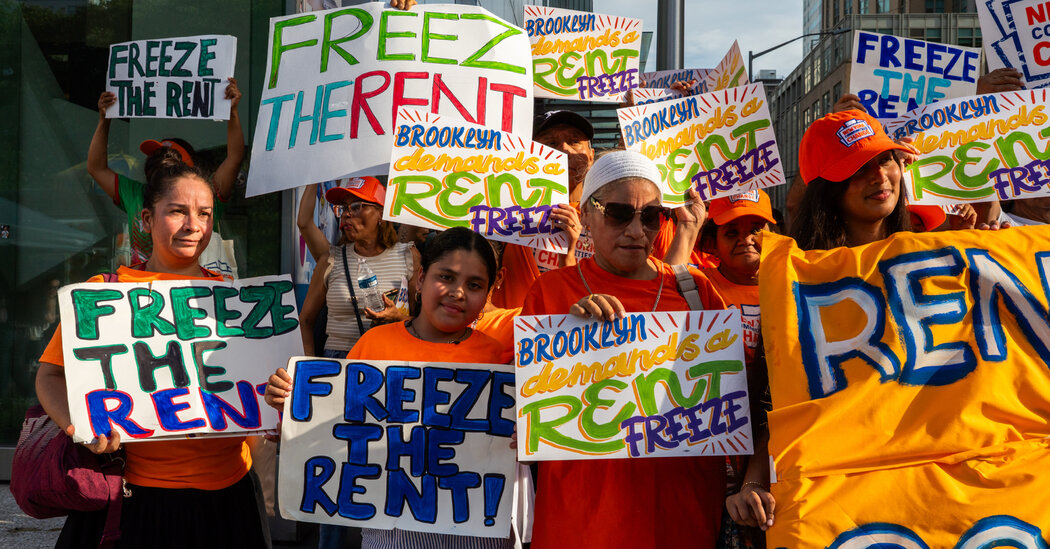
On a humid Thursday evening in East Harlem, the auditorium inside El Museo del Barrio became the unlikely epicenter of a political earthquake that will reshape the daily lives of nearly two million New Yorkers. In a tense and historic 7-to-1 vote, the New York City Rent Guidelines Board agreed to completely freeze rents for both one- and two-year leases across the city’s vast portfolio of nearly one million rent-stabilized apartments. The sheer emotional magnitude of the moment erupted instantly within the hall as the final vote was tallied; tenant organizers, many of whom have spent decades fighting the steady erosion of their neighborhoods, wept openly, embraced strangers, and waved colorful, hand-painted cardboard signs in triumph. Outside the museum, the concrete plaza transformed into a celebratory street festival, where slices of cheap pizza were passed through the crowd and the anthemic strains of Queen’s “We Are The Champions” echoed off the brick facades of the surrounding blocks. This sweeping decision represents a colossal, early-career triumph for Mayor Zohran Mamdani, who is just six months into a tumultuous first term that has already profoundly disrupted the traditional balances of power in America’s largest metropolis. By halting rent increases on a massive cross-section of the city’s housing stock—ranging from deteriorating, 150-year-old walk-ups in the outer boroughs to sleek, tax-abated luxury towers piercing the Manhattan skyline—the board has not only fulfilled Mamdani’s signature, highly controversial campaign promise but has also established a sweeping, aggressive blueprint for municipal tenant protections that cities across the United States, grappling with their own affordability crises, will undoubtedly watch with intense scrutiny.
For Mayor Mamdani, this historic victory capstones an almost unbelievably successful week of progressive political organizing, arriving just two days after three left-leaning congressional candidates he vigorously endorsed swept their primary elections. Mamdani’s meteoric rise and his governing philosophy are built upon a bedrock belief that the public sector must aggressively step in to curb the unbridled forces of the private real estate market, a viewpoint that has steadily gained mainstream traction among urban voters who feel increasingly squeezed out of the communities they helped build. A year ago, during the height of a grueling mayoral campaign, Mamdani released a viral social media video pledging to dismantle the traditional, landlord-friendly leanings of the Rent Guidelines Board by appointing only members who deeply “understood landlords are doing just fine.” By February of this year, he had successfully installed six new members onto the nine-person panel, effectively shifting its ideological center of gravity. This newfound progressive majority spent months absorbing grueling public testimony, parsing complex economic data, and listening to the raw, unfiltered anxieties of everyday New Yorkers, culminating in a policy change that is unprecedented in the board’s fifty-year history. While previous administrations have occasionally passed one-year rent freezes during times of acute economic duress, such as the immediate aftermath of the 2008 financial crisis or the height of the COVID-19 pandemic, this is the first time the city has ever frozen rents on two-year leases, effectively insulating vulnerable tenants from the threat of rising housing costs until at least the final quarter of 2027.
The human weight behind this bureaucratic policy is perhaps best illustrated by the lived realities of working-class New Yorkers who view the freeze not as a statistical data point, but as an existential lifeline. For Elisa Martinez, a thirty-year-old lifelong resident of Washington Heights, the board’s decision felt like the first time her family’s voice had actually penetrated the marble halls of municipal government. Martinez lives in a modest, two-bedroom rent-stabilized apartment costing about $2,000 a month, where she provides round-the-clock care for her brother who suffers from multiple sclerosis, all while staying close to her aging parents—a neighborhood handyman and a school receptionist—who live just a few blocks away. In a city where the housing vacancy rate has plummeted to a staggering, emergency-level 1.4 percent, finding an alternative, affordable home is a mathematical impossibility; a single rent hike could have forced her family to relocate entirely, severing the deep-rooted community ties and vital care networks that keep her brother safe. This sentiment of profound relief was echoed loudly by Farhana Rahman, a seasoned tenant organizer from Astoria, Queens, working with CAAAV: Organizing Asian Communities, who emphasized that for the working-class families who keep New York’s essential infrastructure running, a two-year reprieve from rent hikes represents twenty-four months of dignity, structural stability, and psychological peace of mind. To these communities, the freeze is a hard-fought recognition that shelter is a fundamental human right rather than a liquid financial asset designed to maximize investment returns for corporate landlords.
Conversely, the real estate industry and property owners across the five boroughs have reacted to the historic vote with a mixture of burning outrage, panic, and warnings of an impending, slow-motion disaster for the city’s aging housing infrastructure. Industry lobbyists and independent economists have long warned that a strict rent freeze, while politically popular in the short term, will ultimately starve building owners of the vital capital needed to maintain, repair, and upgrade their properties. Samantha Magistro, the chief executive of Bronx Pro Group—a family-owned, mission-driven developer that maintains roughly 3,700 heavily subsidized, rent-stabilized apartments across the Bronx—describes a grim, highly unsustainable economic reality where the rising costs of building operations have vastly outpaced regulated rent adjustments. Between 2019 and 2025, Magistro’s company watched property insurance premiums skyrocket by an astronomical sixty percent, while overall maintenance expenses, municipal property taxes, utility bills, and labor costs surged by forty percent due to persistent, post-pandemic inflation. Operating on razor-thin developer margins where nearly half of her portfolio now either barely breaks even or runs at an active financial deficit, Magistro has been forced to make agonizing operational compromises, such as repeatedly patching up aging stoves, refrigerators, and leaky pipes rather than replacing them with modern, energy-efficient fixtures. Industry leaders argue that by depriving landlords of the revenue required to combat the natural decay of New York s century-old tenement structures, the city is inadvertently setting the stage for a dramatic decline in the quality of life for the very tenants it aims to protect.
The high-stakes drama surrounding the vote was laid bare within the boardroom itself, exposing deep ideological fissures and raising serious questions about the political survival of the nominally independent panel. Just hours before the final vote was scheduled to take place on Thursday morning, Christina Smyth, one of the two board members officially designated to represent the interests of landlords, abruptly and publicly resigned her post in protest, declaring in a scathing statement that the entire process had become a highly politicized, predetermined theater orchestrating Mamdani’s political agenda. This sudden departure forced Chantella Mitchell, the newly appointed public chair of the board, to issue an extraordinary, defensively worded public statement affirming the absolute intellectual independence and integrity of the remaining board members throughout the monthslong review process. Yet, the most stunning twist of the evening came from Maksim Wynn, a Mamdani-appointed representative who was technically selected to speak for landlords on the panel, but who ultimately broke ranks with his constituency to cast a historic vote in favor of the rent freeze. In an eloquent, highly nuanced post-vote explanation, Wynn argued that the acute, systemic crises facing the city’s housing market—such as exorbitant insurance rates and crumbling infrastructure—are far too massive to be solved by forcing low-income tenants to pay an extra fifty or eighty dollars a month, a stopgap measure that he warned would only drive up non-payment rates and push struggling families into eviction courts. Instead, Wynn insisted that the city and state governments must step in with sweeping tax relief, insurance subsidies, and direct public investments, rather than rely on a broken system of incremental rent increases that harms both tenants and owners alike.
As the dust begins to settle on this historic decision, New York City find itself standing at a profoundly critical crossroads, serving as a high-stakes laboratories for a bold, progressive housing experiment that could redefine urban policy across the United States. James Whelan, the highly influential president of the Real Estate Board of New York, issued a stern, dark warning following the vote, accusing the Rent Guidelines Board of willfully ignoring its own economic data and predicting that the freeze will ultimately choke off private investment, exacerbate the housing shortage, and accelerate the decay of the city’s existing housing stock. Yet, for Mayor Mamdani and the energetic coalition of grassroots organizations that propelled him to power, this victory is merely the opening salvo in a much broader, highly transformative campaign to build a more equitable, affordable city by expanding public housing, lowering corporate operating barriers, and aggressively educating tenants on their legal rights. Whether this historic two-year rent freeze will ultimately successfully stabilize working-class neighborhoods or slowly suffocate the financial foundations of the city’s housing infrastructure remains an open, deeply polarizing question. For now, however, the millions of working-class families, immigrants, and essential workers who form the cultural and economic backbone of New York City will sleep a little easier tonight, knowing that their homes have been shielded from the volatile currents of the real estate market, and that for the first time in a generation, their voices were loudest in the halls of power.