





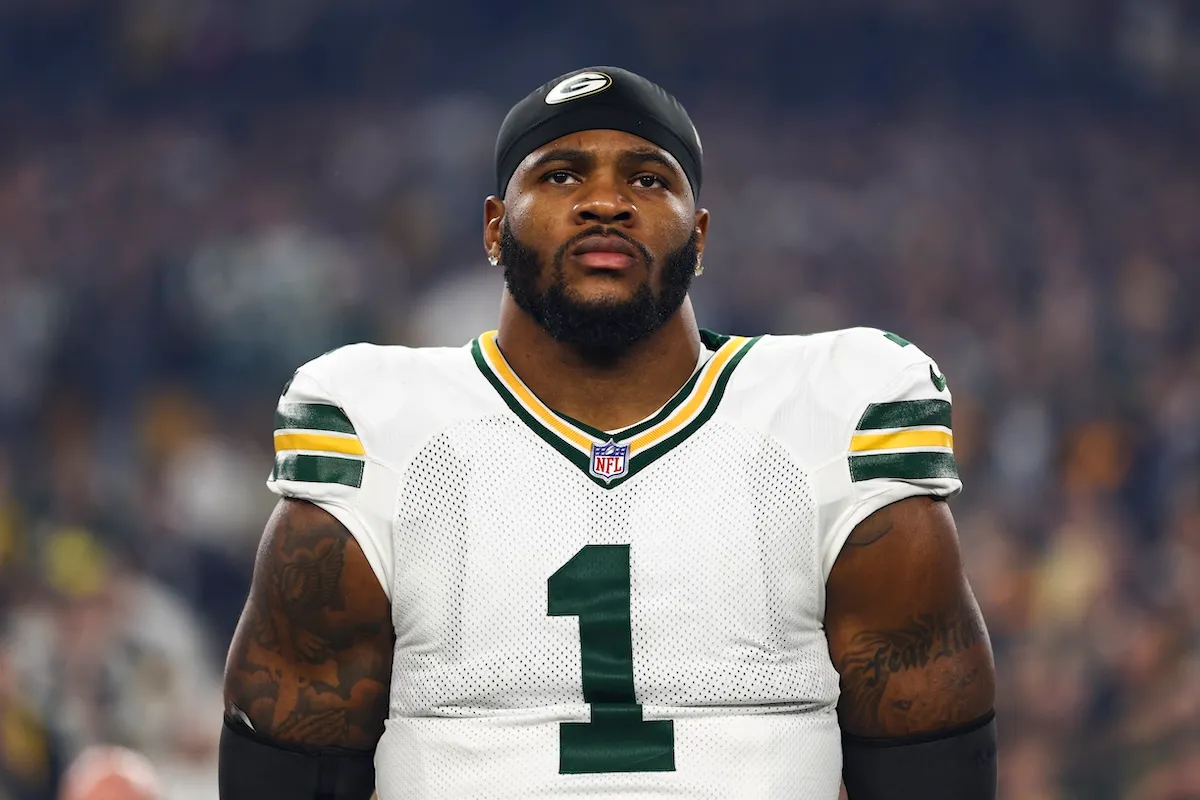
The journey of an elite athlete is defined as much by its sudden, heartbreaking valleys as it is by its spectacular, multimillion-dollar peaks. For superstar edge rusher Micah Parsons, his transition from the glitz of Dallas to the historic, blue-collar cradle of Green Bay was supposed to be the ultimate coronation of his status as the NFL’s premier defensive weapon. When the Packers secured his legendary talents with a staggering four-year, $188 million contract extension, the entire state of Wisconsin erupted in a collective wave of euphoria; they had not just signed a player, but acquired an insurance policy for a championship run. For the first fourteen weeks of the 2025 season, Parsons lived up to every penny of that historic investment, terrorizing opposing quarterbacks and transforming the Packers’ defense into an impenetrable wall. But the brutal, unforgiving reality of professional football is that a lifetime of preparation can be derailed in a single, agonizing fraction of a second. In Week 15, during a tense matchup against the Denver Broncos, the Lambeau Field crowd fell into a terrified silence as Parsons collapsed to the turf with a non-contact knee injury. The subsequent medical diagnosis—a completely torn anterior cruciate ligament (ACL)—struck the franchise like a physical blow, culminating in Parsons being placed on the injured reserve list on December 17 and undergoing major reconstructive knee surgery on December 29. It was a devastating somatic reminder of the fragility of human anatomy, leaving a larger-than-life superhero suddenly grounded and pointing him toward a long, lonely winter of grueling physical therapy.
The immediate fallout of Parsons’ injury illustrated the profound truth that a truly elite player is far more than just a collection of impressive statistics on a spreadsheet; they are the emotional and psychological heartbeat of an entire locker room. Before Parsons went down, Green Bay was flying high with a stellar 9-3-1 record, actively jostling for the top seed in the fiercely competitive NFC and looking like a team destined for a Super Bowl appearance in February. The moment their defensive anchor was carried off the field, however, the oxygen seemed to completely escape the Packers’ season, exposing the intense vulnerability of a team suddenly stripped of its identity. Deprived of Parsons’ relentless energy and his uncanny ability to command double-teams, the Packers collapsed, spiraling into a catastrophic five-game losing streak to close out the year. This heartbreaking skid culminated in a painful home playoff defeat during the wild-card round, where their oldest and bitterest rivals, the Chicago Bears, embarrassed them on their own turf and sent them packing into an early, cold off-season. This dramatic collapse was no mere coincidence or twist of bad luck; it was the direct, agonizing consequence of losing the single most dominant player in the entire organization, proving that while football is a team sport, there are certain transcendent individuals whose absence leaves a void that simply cannot be filled by schemes or willpower alone.
As the physical wounds of the winter began to heal, the focus of the franchise shifted from the despair of what could have been to the quiet, painstakingly slow road of recovery. The public received a sobering reality check regarding Parsons’ timeline during a recent press conference following the Packers’ organized team activities (OTAs), when head coach Matt LaFleur met with the media to provide an update on his star player’s progress. LaFleur, speaking with his characteristic mix of honest pragmatism and protective empathy, revealed that Parsons is highly unlikely to participate in the grueling practices of training camp when the team gathers to begin their preseason workouts. While the coach noted that a final, official roster decision has not yet been set in stone, he admitted that the organization fully expects Parsons to open the summer workouts on the Physically Unable to Perform (PUP) list. This update serves as a humanizing reminder of the immense patience required to recover from a modern ligament reconstruction, showcasing a franchise that refuses to let short-term competitive desires compromise the long-term career of their franchise cornerstone. Behind the closed doors of the training facility, away from the roaring crowds and the bright stadium lights, Parsons is engaged in a daily, monotonous battle against his own body, learning to run, cut, and trust his knee once again under the watchful eyes of concerned trainers.
While the news of Parsons starting the season on the sidelines might initially trigger a wave of anxiety among the passionate Packers faithful, a closer look at the administrative chess match of the NFL reveals a highly calculated and brilliant piece of roster management. Placing a recovering player on the PUP list—especially the regular-season reserve version—is a strategic maneuver that allows the front office to protect both the athlete and the team’s depth. Under league rules, players who are activated from the reserve/PUP list do not count against the team’s maximum of eight allotted short-term Injured Reserve activations during the regular season, meaning Green Bay can slowly integrate Parsons back into the active lineup without burning a precious roster transactional chip. This calculated patience was hinted at earlier in the spring when NFL insider Adam Schefter reported that Parsons was a prime candidate to begin the year on this list, requiring him to sit out at least the first four games of the regular season. For a front office, this is a delicate balancing act between the clinical calculations of roster optimization and the physiological reality of muscle atrophy and graft healing, recognizing that the true goal is not to have Parsons healthy for the warm afternoons of September, but to have him dominant during the freezing, high-stakes battles of January.
Fortunately for Green Bay, the football gods have provided a soft landing spot in the early weeks of the upcoming campaign, offering a schedule that looks surprisingly manageable even without their $188 million defensive terror. The Packers are slated to open their season against a slate of opponents that includes the division-rival Minnesota Vikings, the New York Jets, the Atlanta Falcons, and the Tampa Bay Buccaneers—four franchises that all failed to secure a postseason berth during the previous year. This fortuitous stretch of games provides the Packers with a golden opportunity to build early momentum, allowing young, hungry defenders to step out of Parsons’ massive shadow and prove they can carry the load of a championship-caliber team. It is entirely realistic to envision a scenarios where Green Bay navigates this opening stretch with a highly respectable 3-1 or even an undefeated 4-0 record, proving to themselves and the rest of the league that they possess the depth and mental fortitude to survive adversity. This early stretch will be a crucial test of character for LaFleur’s squad, forcing them to find creative ways to generate a pass rush, rely on disciplined defensive schemes, and allow their quarterback-led offense to carry the team until their defensive savior is ready to run out of the tunnel.
Ultimately, the story of Micah Parsons’ recovery is building toward a narrative arc of cinematic redemption that could define the franchise’s trajectory for years to come. If his recovery continues on its projected path and he completes his mandatory four-game stay on the PUP list, the target date for his triumphant return to the field aligns perfectly with a Week 5 showdown at Lambeau Field. The opponent that afternoon happens to be none other than the Chicago Bears—the exact team that ruthlessly ended the Packers’ season in the wildcard round and celebrated on their sacred turf while Parsons watched helplessly from the sidelines in a knee brace. The poetic justice of having the game’s most terrifying defender make his season debut in a high-stakes revenge game against Green Bay’s most historic rival is the stuff of sports legend, a moment that would undoubtedly send electricity through the entire state of Wisconsin. It serves as a powerful reminder of why we care so deeply about these games and the men who play them: because the journey through pain, isolation, and patient rebuilding makes the eventual return to glory taste that much sweeter. As Parsons continues his quiet rehabilitation in the shadows of Lambeau Field, the anticipation builds for the day the gates open, the green and gold faithful roar, and the $188 million man finally steps back onto the grass to reclaim his throne.