





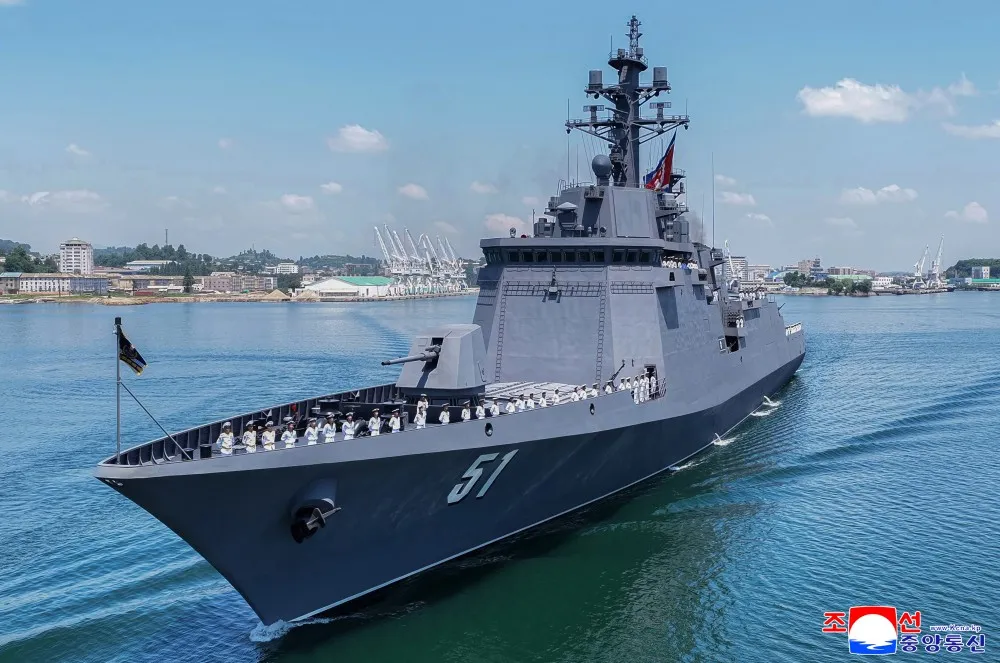
Against the damp, gray backdrop of the western port city of Nampo, the stark silhouette of the Choe Hyon rose from the shipyards, a 5,000-ton monument to North Korea’s unrelenting military ambitions. This colossal destroyer represents the first of its class, a steel-plated manifestation of leader Kim Jong Un’s promise to aggressively militarize the surrounding oceans. Addressing a crowd of military officers, shipyard workers, and state media personnel, Kim declared a terrifying transformation for his nation’s naval forces. He announced that the country’s navy is rapidly evolving into a strategic, nuclear-armed service, with plans to construct new, sprawling naval bases designed to accommodate even more massive warships. This strategic pivot signals a dramatic and chilling shift in regional dynamics. By placing nuclear warheads onto naval vessels, Pyongyang aims to project power far beyond its coastal borders, creating a new, unpredictable maritime theater of tension. For families living in neighboring South Korea and Japan, as well as defense analysts in Washington, this announcement is not merely bureaucratic posturing; it is a visceral, looming threat that shatters any lingering hopes for a peaceful, denuclearized Korean Peninsula. The ocean, historically a medium for trade and cultural exchange, is being deliberately refashioned by the Kim regime into an arena of potential existential catastrophe, forcing the international community to grapple with a heavily armed nuclear navy operating right along the critical shipping lanes of East Asia.
The birth of the Choe Hyon and its sister vessels reveals a narrative of intense pressure, technical desperation, and the immense human cost inherent in North Korea’s forced industrialization. While state media painted the commissioning ceremony as a flawless triumph of socialist engineering, the reality behind Pyongyang’s shipyards is far more chaotic and hazardous. Just eighteen months after the regime first teased the construction of the destroyer class, the Choe Hyon was launched into the waves in April 2025, a blistering timeline that undoubtedly placed a bruising physical toll on the shipyard workers of Nampo. The structural strain of meeting these impossible, politically driven deadlines became painfully apparent just a month later on the nation’s eastern coast. At the Chongjin shipyard, the second vessel of this class, the Kang Kon, suffered a catastrophic failure, capsizing entirely during its highly anticipated launch ceremony. Though the massive warship was eventually righted and salvaged, the incident exposed the deep vulnerabilities, safety shortcuts, and structural instability running through North Korea’s rapidly accelerated manufacturing programs. Behind the polished propaganda photos of Kim Jong Un smiling in front of looming grey hulls lie thousands of unnamed, overworked laborers pushing steel to its breaking point, knowing that failure to deliver these instruments of war can carry severe, life-threatening consequences under a regime that views human safety as entirely secondary to military pride.
This maritime escalation is the direct consequence of a profound structural shift within the North Korean state, which formalized its nuclear ambitions by writing them directly into the national constitution in late 2023. This constitutional amendment was not just a symbolic gesture; it was a permanent rejection of the denuclearization demands championed by the United States and its allies. By embedding nuclear status into the supreme law of the land, Kim Jong Un effectively slammed the door on future diplomatic negotiations that might require him to dismantle his arsenal. This political reality has deep, distressing domestic consequences for the everyday citizens of North Korea. Capital resources, elite engineering talent, and vital raw materials are systematically diverted from civilian infrastructure, agricultural development, and healthcare programs to feed the insatiable appetite of the military-industrial complex. While Pyongyang pours billions into nuclear propulsion, advanced enrichment facilities, and massive naval destroyers, the country’s civilian population continues to endure chronic shortages of food, energy, and medicine. The tragedy of the North Korean nuclear program lies in this stark divergence of human experience: a ruling elite that celebrates the launching of advanced warships, while millions of ordinary citizens live in a state of suspended economic animation, paying for these destructive symbols of national power with their daily survival, health, and dignity.
The international diplomatic community has watched this internal transformation with growing alarm, recognizing that traditional diplomatic strategies have reached a frustrating, dangerous dead end. During his presidency, Donald Trump attempted to break the geopolitical stalemate, embarking on high-stakes personal diplomacy with Kim Jong Un, only to find himself confronted by a regime unwilling to compromise on its core military identity. Even Trump’s efforts to enlist the geopolitical leverage of Chinese President Xi Jinping have exposed deep fractures in global cooperation. During a critical state visit to Beijing, the United States asserted that both Washington and Beijing shared a commitment to the complete denuclearization of the Korean Peninsula. However, the Chinese state narrative of the very same talks conspicuously omitted any mention of denuclearization, highlighting the deep geopolitical divisions that allow North Korea to continue its buildup with relative impunity. For the citizens of South Korea and Japan, who live within direct striking distance of Kim’s expanding arsenal, these diplomatic disagreements are frustratingly detached from the daily reality of survival. The failure of regional super-powers to present a united front means that the threat remains active, evolving, and growing closer to their shores, leaving local populations to build bomb shelters and practice evacuation drills under the constant shadow of potential annihilation.
This grim reality is echoed by seasoned foreign policy analysts, who suggest that the global community must finally abandon the unrealistic fantasy of complete denuclearization and pivot toward a pragmatic strategy of containment. Sean King, a senior vice president at the Park Strategies consultancy in New York, pointed out that Kim Jong Un and his powerful sister, Kim Yo Jong, must be taken at their word when they state that they will never surrender their nuclear weapons. King noted that even the realist commitment of American leadership to absolute denuclearization has grown increasingly shaky in the face of North Korea’s stubborn resistance. This perspective represents a profound, sobering shift in the global security paradigm, moving from a hopeful quest for lasting peace to a exhausting, unending effort to merely manage an active and volatile crisis. For those living in the direct line of fire, this pivot to crisis management offers cold comfort, as it means accepting a perpetually nuclear-armed North Korea as a permanent fixture of life in East Asia. It requires a permanent state of high military readiness, massive expenditures on missile defense systems, and the psychological burden of knowing that a single miscalculation, an accidental missile launch, or an overreaction in the contested waters of the Yellow Sea could instantly trigger a devastating conflict affecting millions of innocent human lives.
As the world looks toward an uncertain future, the trajectory of North Korea’s strategic forces points toward a dangerous, unchecked expansion that threatens to destabilize global security far beyond the borders of Asia. Alongside his naval ambitions, Kim Jong Un recently visited a highly secretive nuclear enrichment facility, where he openly vowed to expand the country’s strategic forces exponentially, signaling a frantic push to amass an even larger stockpile of weapons-grade material. The commissioning of the Choe Hyon is not the culmination of a program, but rather the opening chapter of a highly militarized maritime era, where nuclear-tipped cruise missiles may soon patrol the deep waters of the Pacific. Ultimately, the story of North Korea’s nuclear navy is not just one of steel plates, naval bases, and geopolitical statistics; it is a profoundly human story of fear, survival, and the fragile nature of peace. It reminds us that behind the grandiose, carefully choreographed statements of dictators and the complex calculations of international diplomats, are the real lives of sailors, shipyard workers, and millions of ordinary families across the globe whose hopes for a peaceful future are directly tied to the containment of this escalating, ocean-bound threat.