





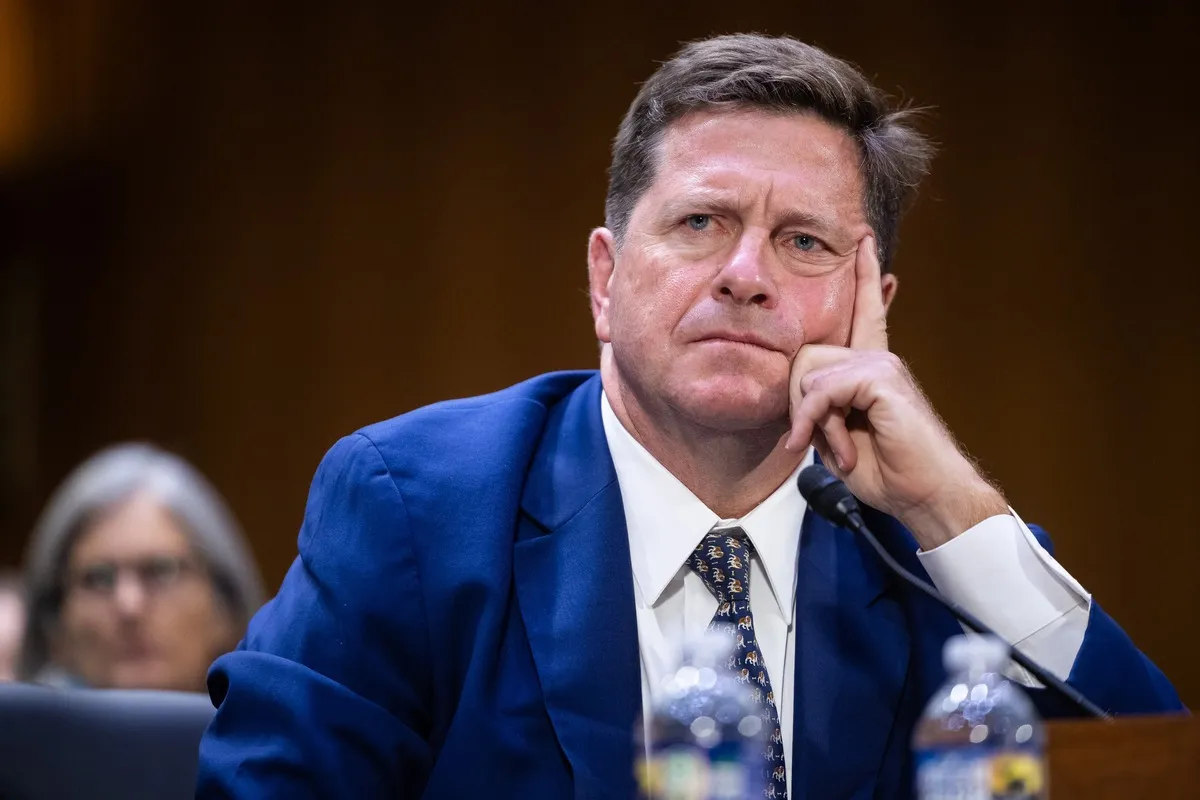
The quiet tension inside the Senate chamber on Tuesday afternoon was palpable as lawmakers prepared to cast their votes on one of the most contentious, high-stakes national security nominations in recent American history. By a razor-thin margin of 51 to 47, Republican senators managed to secure the confirmation of Jay Clayton to serve as the United States’ next Director of National Intelligence (DNI). The incredibly close vote followed weeks of polarized hearings, revealing a deep-seated anxiety on Capitol Hill regarding whether Clayton, a newcomer to the clandestine world of espionage, possesses the unique skills and temperament required to lead the nation’s intelligence community through an era of unprecedented global volatility. Throughout this process, Senate Democrats found themselves trapped in a difficult political dilemma: they harbored intense, public reservations about Clayton’s lack of security credentials, yet they were equally desperate to replace the highly controversial acting spy chief, Bill Pulte, who had been aggressively hollowed out the agency’s infrastructure in the weeks leading up to the vote. Now officially confirmed, Clayton takes on the monumental responsibility of overseeing all eighteen of America’s intelligence agencies, inheriting a position that demands absolute clarity, strategic genius, and an unwavering commitment to the truth. He steps into this role at a highly volatile juncture, with veteran intelligence officers warning that the nation faces a compounding, multi-front array of threats to its citizens both at home and abroad, leaving virtually no room for error or on-the-job training.
To understand the depth of the skepticism surrounding Clayton’s appointment, one must look closely at his professional background, which stands in stark contrast to the intelligence community’s traditional leadership profile. Rather than rising through the ranks of the military, the diplomatic corps, or the covert services, Clayton spent the vast majority of his career in the corporate world, anchoring his professional identity in financial regulation and complex corporate law. He is perhaps best known for his previous tenure as the chairman of the Securities and Exchange Commission (SEC) and broad experience as the U.S. Attorney for Manhattan, roles in which he earned a reputation as a highly capable legal mind and a meticulous manager of financial markets. However, critics argue that regulating Wall Street, prosecuting white-collar criminals, or negotiating corporate merger disputes is vastly different from deciphering hostile foreign wiretaps, anticipating paramilitary movements, or managing deep-cover covert ops. Prior to Clayton’s confirmation, Democratic Senator Mark Warner of Virginia, who serves as the vice-chair of the Senate Select Committee on Intelligence, publicly praised Clayton as an honorable and capable public servant but insisted that the role of DNI requires an individual with comprehensive, battle-tested national security experience. This glaring disconnect has left many career observers questioning whether a corporate lawyer can successfully navigate the shadows of the global intelligence network without getting lost in its immense operational complexities.
Beyond the technical requirements of the job, Clayton faces an equally daunting challenge regarding his perceived independence from the executive branch that appointed him. Historically, the Director of National Intelligence is expected to stand as an unbiased, non-partisan truth-teller who provides objective, unfiltered intelligence assessments to the President, even when those assessments directly challenge the administration’s political agenda or personal narratives. However, Clayton’s close alliance with President Donald Trump has provoked intense scrutiny and fueled deep-seated fears that the nation’s premier spy office could become politicized. These anxieties reached a fever pitch during his confirmation hearings when Clayton repeatedly dodged direct questions and refused to acknowledge that Joe Biden won the 2020 presidential election—a historical fact that Trump has continuously disputed without presenting credible evidence. This evasiveness drew fierce, public condemnation from Democratic lawmakers, including Oregon Senator Ron Wyden, who accused Clayton of demonstrating an inability to tell the truth or show even a modicum of independence from Trump’s personal grievances. Senator Warner also voiced serious reservations, expressing doubt that Clayton would possess the moral fortitude required to resist intense political pressure from the White House when delivering uncomfortable, vital intelligence projections that conflict with executive policy, threatening the objective reporting of global dangers.
Adding to the immediate pressure of his confirmation, Clayton inherits a critical, domestic legislative crisis that has left America’s electronic surveillance capabilities severely degraded during a period of high international tension. Last month, a bitter partisan standoff in the Senate resulted in the lapse of Section 702 of the Foreign Intelligence Surveillance Act (FISA), a law that officially expired on June 12 after Congress failed to reach an agreement on its reauthorization. This crucial tool historically granted American spy agencies the authority to monitor the digital communications of foreign nationals located outside the country without needing to secure an individual warrant for every single electronic target, forcing U.S. communications giants to provide necessary data on approved high-priority targets. While the program has long been a major lightning rod for privacy advocates who fear that the communications of innocent American citizens are swept up in the dragnet, the intelligence community views Section 702 as an absolutely vital shield against terrorist plots, sophisticated state-sponsored cyberattacks, and foreign espionage networks. Senate Democrats deliberately blocked the reauthorization of Section 702 in a high-stakes legislative gamble designed to force the White House to remove Bill Pulte from his post as acting DNI. Now that Pulte has been replaced, Clayton must work quickly to mend fences on Capitol Hill and jumpstart the legislative process, even as the White House warns that every day without Section 702 places the nation’s security at grave risk.
The global arena Clayton must now monitor is widely considered to be more dangerous and unstable than it has been in decades, with threats compounding by the day. On the international stage, Russia continues to brandish the world’s largest nuclear arsenal, while China rapidly expands and modernizes its military forces, achieving a naval fleet that is already numerically superior to that of the United States. Furthermore, Beijing and Moscow are drawing increasingly closer to hostile regimes in North Korea and Iran, cooperating on advanced military technologies and establishing a formidable axis of geopolitical disruption that threatens Western influence. This threat became incredibly real just hours before Clayton’s confirmation, as tensions in the Middle East flared dangerously when the U.S. accused Iranian forces of attempting a major, coordinated surprise attack on American military bases scattered across the region. At the same time, the domestic front is experiencing a dramatic spike in volatility, with the U.S. Secret Service reporting a staggering forty percent increase in threats against individuals under its protection over the past year. Coupled with warnings from the newly released 2026 Annual Threat Assessment about the rising frequency of stealthy cyberattacks and devastating ransomware assaults that are nearly impossible to detect before they strike, Clayton is stepping into a perfect storm of global and domestic instability that will test his leadership to its absolute limits.
Perhaps the most heartbreaking and operationally crippling obstacle Clayton must address is the catastrophic state of his own agency’s internal structure and staff morale. In the weeks preceding his confirmation, the Office of the Director of National Intelligence was subjected to a series of brutal, highly chaotic personnel cuts that have devastated staff morale and severely hollowed out the agency’s core capabilities. Tulsi Gabbard, the former DNI who resigned earlier this year, initiated the purge by slashing the agency’s workforce by an astounding forty percent, only for her successor, acting director Bill Pulte, to carry out five successive rounds of rapid-fire layoffs. Pulte proudly announced his fifth “Near Final” round of staff cuts on the eve of Clayton’s confirmation, leaving the agency with roughly a third of its previous workforce in a matter of weeks. These drastic personnel reductions have left remaining career analysts and officers feeling abandoned, exhausted, and deeply anxious about their professional futures. Clayton’s most urgent task will not just be analyzing global threats, but repairing a profoundly broken and demoralized institution, restoring trust among a traumatized security staff, and finding a way to successfully protect a vulnerable nation with a severely diminished human resource base.