






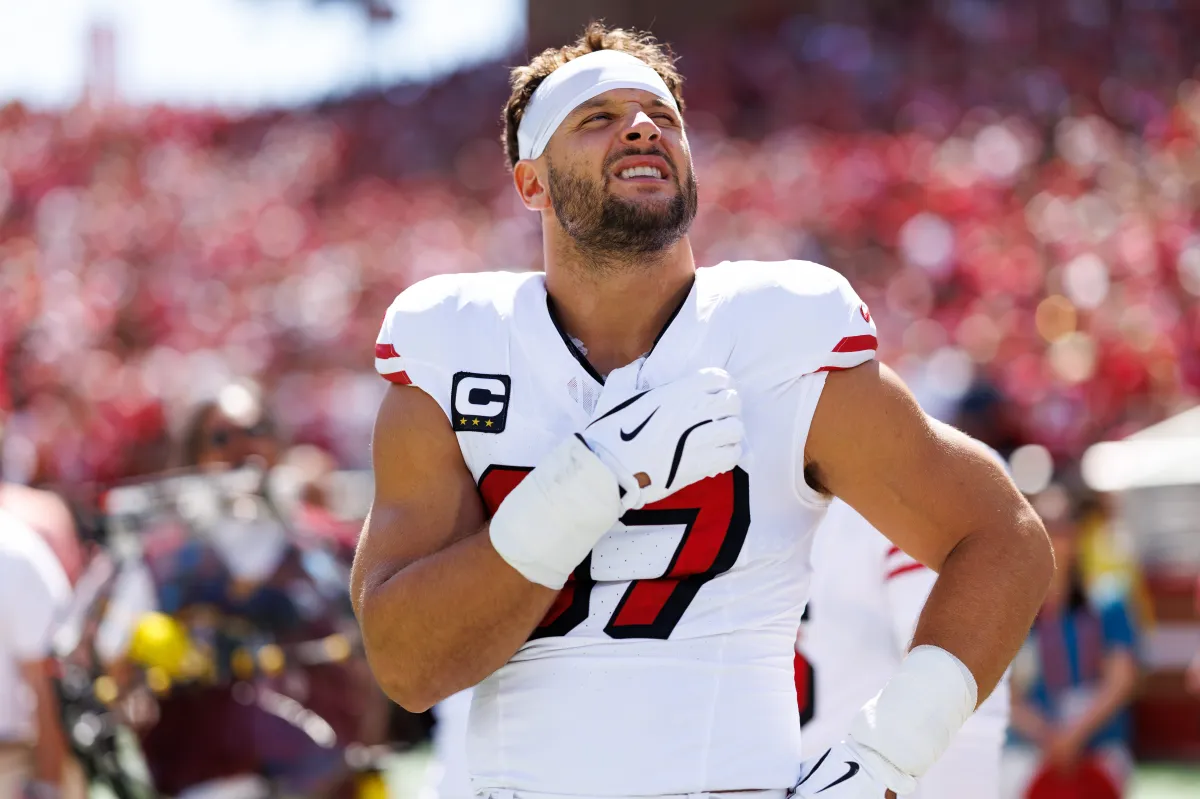
When the latest NFL rankings dropped, San Francisco 49ers fans immediately scanned the list for their defensive anchor, Nick Bosa. Coming in at No. 8 on ESPN’s prestigious rankings of the league’s top edge rushers, his placement represents a fascinating intersection of immense respect and lingering anxiety. Securing a top-ten spot is incredibly impressive when you look at the grueling road he has traveled recently. The 49ers organization and its loyal fanbase should view this high ranking as a massive victory, especially considering the immense physical adversity the star defender has faced en route to this point in his career.
The elephant in the room is, of course, the brutal injury bug that bit him hard. A second career torn ACL completely derailed his previous season, cruelly limiting the feared pass rusher to a mere three games. In a league where the “what have you done for me lately” mentality reigns supreme, and at a position that demands absolute physical perfection, missed time usually tanks a player’s stock. Yet, despite having virtually no recent tape to evaluate due to his absence, the league’s coaches, executives, and scouts simply couldn’t ignore his pedigree. His inclusion in the elite tier proves that his reputation as a game-wrecker precedes him, even when he is rehabbing in the training room.
For many close observers, however, seeing Bosa slip to eighth feels a bit like a penalty for bad luck rather than a reflection of his true talent. Before disaster struck, the metrics showed he was operating at an otherworldly level, boasting a mind-boggling 21.6% pass rush win rate in his limited snaps. The tape didn’t lie: the explosive first step was as lethal as ever, his hand fighting resembled a martial artist, and his unique ability to turn a left tackle’s Sunday into a psychological crisis remained entirely intact. He wasn’t just surviving out there; he was actively terrorizing backfields with the same terrifying elegance we have come to expect.
What truly separates the former Defensive Player of the Year from his peers is a rare blend of textbook technique and raw, unadulterated strength. As one anonymous NFL personnel evaluator put it, Bosa possesses what is widely considered the absolute best speed-to-power transition move in professional football. Unlike pure speed rushers who simply run around the arc and hope for the best, Bosa plays a high-speed chess match. He consistently gets offensive tackles on their heels with his initial burst, only to violently convert that momentum into bull-rush power that collapses the pocket from the outside in.
This masterclass in heavy-handed rush technique has already secured his legacy in the Bay Area. Bosa recently cemented his place in franchise lore by becoming one of only three players in the illustrious history of the San Francisco 49ers to surpass the 60-career-sack milestone, sharing historic ground with legendary icons Bryant Young and Charles Haley. Achieving this feat in the modern era, while constantly fighting through double-teams and chips, solidifies his status as a generator of defensive panic. He doesn’t just accumulate statistics; he dictates how opposing offensive coordinators design their entire weekly game plans.
Ultimately, the debate surrounding Bosa’s ranking doesn’t center on his ceiling, which everyone agrees is Hall-of-Fame worthy. Instead, it is a referendum on his durability and whether his body can withstand the relentless violence of the trenches over a full calendar year. If he can avoid the training table and reclaim his permanent home on the gridiron, this number-eight ranking will quickly look like an absolute steal. A healthy, motivated Nick Bosa remains an existential threat to quarterbacks everywhere, and he is undoubtedly itching to remind the football world that he is still the ultimate defensive nightmare.