





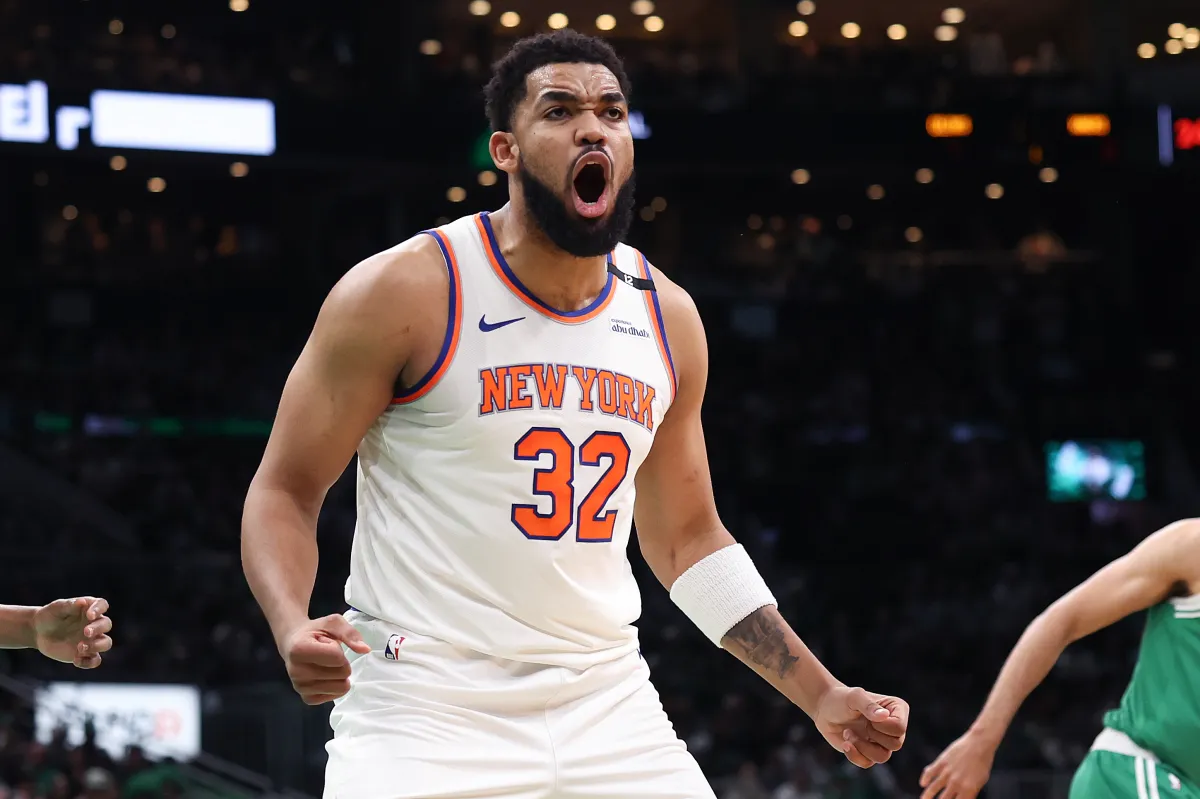
The legendary sirens of New York City have finally quieted down, but the historic echoes of the parade still linger in the crisp air of Manhattan. For the first time in fifty-three excruciating years, the New York Knicks are NBA champions, and the city’s faithful are still pinched in disbelief. At the absolute apex of this sports renaissance stood Karl-Anthony Towns, the versatile and resilient big man who served as the emotional foundation and on-court anchor throughout the grueling postseason run. He did what legends before him failed to do: he brought the Larry O’Brien Trophy back to Madison Square Garden, cementing his legacy in New York basketball lore forever. Yet, as the ticker-tape is swept from the streets and the championship banners are prepared for the rafters, an underlying tension is brewing behind the scenes. The romanticism of a sports championship is a beautiful thing, but the modern NBA is a ruthless, fast-moving business where the honeymoon phase is famously brief. Now that Towns has delivered the ultimate prize to a starved metropolis, he is ready for the front office to show him the same level of commitment he poured onto the court, setting up a high-stakes standoff that will shape the franchise’s future.
To truly understand the quiet drama that is now unfolding, one must look back at the private frustration that simmered during the regular season. According to respected NBA insider Vincent Goodwill, Towns was actively seeking a contract extension during the course of the historic 2025-26 campaign, eager to secure his long-term future in New York before the playoff battle began. However, the Knicks’ front office declined to offer him a deal at the time—a calculated risk that left the elite center deeply disappointed and frustrated. For a player of his caliber, playing under the cloud of financial uncertainty is a heavy mental burden, yet Towns displayed the rare maturity of a consummate professional. Instead of allowing his disappointment to fracture the locker room or fuel media speculation, he decided to quiet the noise and put his faith entirely in his own abilities. He famously noted that these massive business decisions have a way of resolving themselves in the offseason as long as he handled his responsibilities on the floor. It was the ultimate bet on himself, and by transforming into the indispensable hub of the Knicks’ championship machine, Towns succeeded in forcing the front office’s hand.
Now that the championship dust has settled, the cold, hard financial arithmetic of the NBA salary cap takes center stage. Towns is currently entering the final guaranteed season of his contract for the 2026-27 year, which will pay him a handsome $57.1 million, followed by a player option for the 2027-28 season valued at a staggering $61 million. Because he has already met the league’s strict criteria, he is fully eligible for a contract extension right now, and the numbers are jaw-dropping. The maximum deal the Knicks can offer their championship center is a historic four-year package worth $272 million, which averages out to an unbelievable $68 million annually. To the average working-class sports fan, these figures sound like telephone numbers, representing a level of generational wealth that is difficult to conceptualize. In the premium ecosystem of today’s NBA, however, this is simply the going rate for a franchise-altering big man of his unique skill set. Towns is not looking for a discount or corporate charity; he is asking for his proven market value and expecting the organization to finally step up and match his on-court dedication with long-term financial security.
If the Knicks’ front office chooses to play a dangerous game of chicken and hesitates to offer him the max extension, the consequences could easily derail their hopes of creating a multi-year dynasty. If no agreement is reached soon, Towns holds the ultimate leverage over the organization: he can simply decline his player option in the summer of 2027 and walk away into unrestricted free agency. Should he choose to test the open market, there is absolutely no doubt that rival contenders with deep pockets would line up to offer the thirty-year-old superstar whatever he wants. During his championship season with the Knicks, Towns put up incredibly efficient elite numbers, averaging a dominant 20.1 points, 11.9 rebounds, and 3.0 assists over 31 minutes of action per night. Perhaps most importantly, he proved his durability by appearing in 75 games, silencing critics who had previously questioned his stamina and physical toughness under high-pressure scenarios. Elite, floor-spacing centers who can protect the paint, knock down three-pointers, and carry a championship pedigree do not grow on trees, and New York cannot afford to let such a rare asset slip away over executive hesitation.
The pressure to get this massive deal done is mounting by the day because the Knicks are facing an incredibly crowded financial dashboard. The front office does not operate in a financial vacuum, and Towns’ contract is merely the first major domino in a looming cap crisis that could quickly spiral out of control. Next summer, both superstar guard Jalen Brunson and elite defensive wing OG Anunoby will become eligible for highly lucrative contract extensions of their own. Under the NBA’s restrictive collective bargaining agreement—especially the highly punitive rules surrounding the first and second tax aprons—budgeting for multiple supermax players is an administrative nightmare. If the Knicks choose to delay Towns’ negotiations now, they risk his asking price escalating even further as the league’s global revenues push the salary cap higher. A prolonged delay could compromise their ability to build a deep, competent roster around their star core, leaving the front office trapped in a corner where they might have to choose between sacrificing key pieces of their title team or paying an astronomical, crippling luxury tax bill.
Ultimately, this situation is about much more than dollar signs and salary cap excel sheets; it is a profound test of loyalty, trust, and organizational vision. Throughout this entire process, Karl-Anthony Towns has made it clear that he loves New York, openly expressing his heart’s desire to remain a “Knick for life.” In an era of professional sports dominated by frequent player movement and mercenary mentalities, finding a superstar of his magnitude who genuinely wants to stay in the Big Apple is an incredibly rare blessing. For a franchise that spent over half a century wandering through the wilderness of irrelevance, keeping a player of this caliber happy should be the easiest decision in the world. The ball is now firmly in the Knicks’ court: they can choose to reward the man who helped break their fifty-three-year curse and lock in their championship window for years to come, or they can let financial caution alienate their beloved center. The basketball world is watching Jersey and Madison Square Garden closely, waiting to see if New York will pay the king his ransom or allow their brand-new crown to begin to slip.