





As the scorching heat of the Louisiana summer begins to settle over the bayou, the rhythmic, familiar pulse of the NFL calendar shifts into a high-octane gear, signaling to football communities across the country that the long, barren desert of the offseason is finally giving way to the promise of a new campaign. For the New Orleans Saints, this period of rebirth carries a heavy, almost tangible sense of urgency and redemptive opportunity, set against the backdrop of an NFC South division that remains one of the most volatile, unpredictable, and highly winnable real estates in professional football. Last season, the division was claimed by a modest eight-and-nine Carolina Panthers squad, a reality that serves as both a source of profound frustration and an inspiring beacon of hope for a Saints franchise that finished only two victories shy of that mark with a roster that often felt like it was fighting against its own structural limitations. Looking ahead to the 2026 campaign, the math is simple yet tantalizing: a modest progression of just a few games, resulting in a nine- or ten-win season, could easily propel New Orleans back to the top of the division and secure a coveted home playoff game in front of a raucous Superdome crowd. This realization hangs over the team’s training facilities like a charge of static electricity, fueling the immense sweat equity poured into these early workouts by players who know how thin the margin for error is in the NFL. The front office has spent the spring feverishly retooling a roster that had threatened to grow stagnant, seeking to inject a blend of dynamic youth and proven veteran leadership to bridge the narrow gulf between postseason exclusion and division supremacy. It is a delicate, high-stakes balancing act of managing tight salary cap constraints while simultaneously trying to convince a passionate, demanding fanbase that the iconic black and gold can once again march proudly deep into the winter months.
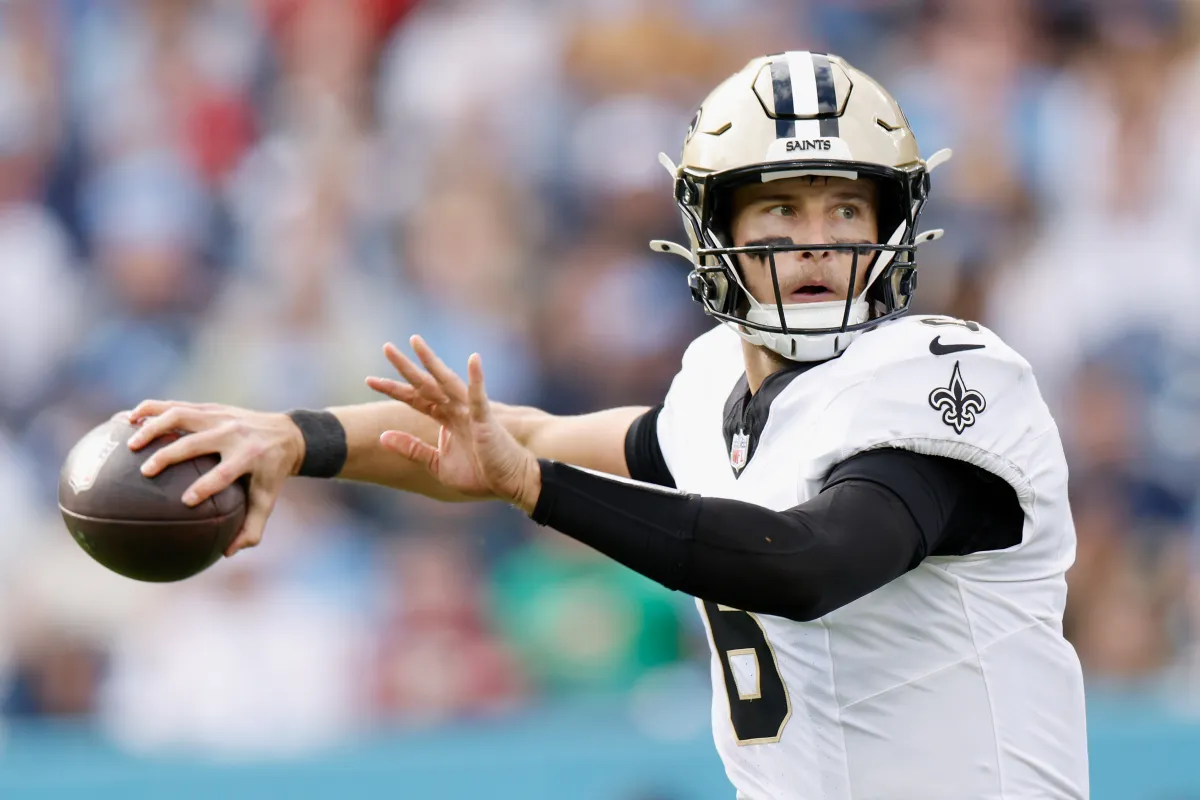
At the absolute epicenter of this ambitious franchise rebuild is the quarterback room, where the Saints have placed their confidence and their future in the hands of sophomore signal-caller Tyler Shough after a rookie season that offered tantalizing flashes of high-end potential interspersed with predictable, educational growing pains. Shough’s rookie stat line—comprising 2,384 passing yards, ten touchdowns, and six interceptions—was far from eye-popping on the national stage, but it demonstrated a level of poise, functional pocket mobility, and ball security that convinced the coaching staff he deserves a genuine, uninterrupted opportunity to establish himself as the long-term solution under center. Recognizing the inherent volatility and physical demands of the position, the front office made a fascinating depth-chart addition by acquiring former first-round pick Zach Wilson, a talented reclamation project who arrives in the Big Easy looking to quietly rebuild his career away from the harsh, unforgiving glare of his previous high-pressure media markets. Wilson projects as an incredibly capable backup who can push Shough in practice every day, while himself benefiting from a low-stress environment focused on mechanical refinement and mental reset under a coaching staff renowned for quarterback rehabilitation. This young quarterback group will spend the warm weeks of June trying to establish a seamless chemistry with an entirely revamped supporting cast, fully aware that their performance under pressure will ultimately dictate the trajectory of the entire organization. The mental and leadership burden resting on Shough’s shoulders is immense; he must complete the rapid transition from a wide-eyed rookie just trying to survive the speed of the professional game to a vocal, commanding general capable of orchestrating a complex offense that must find a way to score points consistently, convert in the red zone, and minimize turnovers if they hope to survive a daunting schedule that will test their resolve at every turn.
To ensure that Shough has the requisite tools to catalyze this offensive awakening, the front office orchestrated a dramatic, comprehensive overhaul of the skill positions, surrounding their young quarterback with an enviable wealth of dynamic playmakers. The headline-grabbing acquisition of the spring is undoubtedly former star running back Travis Etienne, a three-time one-thousand-yard rusher whose explosive acceleration and refined pass-catching versatility out of the backfield should immediately transform a running game that too often felt flat, static, and predictable last season. When paired with the hard-nosed, downhill running style of fellow newcomer Ty Chandler, the Saints suddenly possess a formidable and highly diverse ground attack designed to wear down opposing front sevens and lighten the cognitive burden on Shough’s shoulders. Through the air, New Orleans completely reimagined its receiving corps, headlined by the bold selection of the explosive Jordyn Tyson in the first round of the NFL Draft, a prospect whose route-running sophistication, elite catch radius, and run-after-catch ability make him an instant focal point for opposing defensive coordinators to worry about. The front office doubled down on this aerial influx by drafting physical receiver Bryce Lance in the fourth round and the blisteringly fast Barion Brown in the sixth round, effectively creating a multi-dimensional track team of pass-catchers who can stretch defenses vertically and manipulate them horizontally. This injection of young speed is further bolstered by the savvy veteran signing of tight end Noah Fant, a proven, athletic target over the middle of the field who will work in tandem with third-round draft pick Oscar Delp to give the Saints a dynamic two-tight end package that offensive coaches can use to exploit mismatches across the formation. The arrival of Fant and Delp was necessitated by the offseason departures of tight ends Foster Moreau and Jack Stoll, who both walked during free agency, leaving the position in desperate need of a talent infusion. By surrounding their young quarterback with such a diverse array of physical profiles—ranging from Etienne’s elusive speed to Fant’s size and Tyson’s sharp routing—the coaching staff has constructed an environment where excuses are no longer viable, and offensive execution must take a massive leap forward.
While the offensive upgrades have understandably captured the imagination of the fan base, the defensive unit must undergo a profound philosophical and tactical transformation as they cope with the devastating departure of several foundational, culture-setting leaders. The most painful and poignant loss is undoubtedly the legendary linebacker Demario Davis, whose departure leaves a massive, echoing void not just in the middle of the defensive alignment, but in the very heart, soul, and vocal leadership hierarchy of the entire locker room. Alongside the irreplaceable Davis, the defense will sorely miss the primary playmaking ability of cornerback Alontae Taylor in the secondary, as well as the physically imposing trench presence of defensive linemen Jonathan Bullard and Jonah Williams. To plug these cavernous gaps, the front office orchestrated the return of a familiar face in linebacker Kaden Elliss, whose relentless motor, blitzing capability, and intimate familiarity with the defensive structures should help stabilize the defense and ease the painful transition away from the Davis era. The secondary receives its own massive boost with the addition of physical cornerback Martin Emerson, who joins a unit desperate to maintain the stingy, ball-hawking standard that yielded the league’s ninth-best defense a year ago despite constant offensive struggles. Up front, the Saints are counting on second-round draft pick Christen Miller to make an immediate, disruptive impact along the interior defensive line, working alongside newly signed edge-rusher Anfernee Jennings, the re-signed Chris Rumph II, and reliable defensive tackle John Ridgeway, who was brought back to solidify the run defense. Meanwhile, the offensive trenches have been heavily reinforced with veteran guard David Edwards and the re-signing of Dillon Radunz, who will join fourth-round rookie Jeremiah Wright in a fierce training camp battle designed to establish a physical identity up front and protect the team’s substantial investment in their sophomore quarterback. This battle along the line of scrimmage will be critical, especially after losing offensive tackle Landon Young and center Luke Fortner in the offseason, making the protection of Shough and opening lanes for Etienne the absolute cornerstones of the team’s new offensive philosophy.
The blueprint of this massive roster transformation will be put to the test across a rigid, highly intensive offseason schedule designed to push these athletes to their absolute physical and mental limits under the hot Louisiana sun. The journey began in earnest with voluntary Organized Team Activities scattered throughout early June—specifically on June 1, June 3-4, June 8, and June 10-11—providing an invaluable runway for the coaching staff to install their new playbook and observe how the chemistry of this newly assembled roster begins to coalesce. These voluntary sessions serve as the necessary preamble to the high-stakes mandatory minicamp scheduled for June 16-17, where the entire roster must assemble under one roof, and the intensity levels rise exponentially as coaches begin to evaluate bubble players, refine scheme details, and establish preliminary depth charts. Following a brief, final summer recess for the players to recharge, the true crucible of the calendar year begins in mid-July when the team reports for the grueling humidity of training camp, a physical gauntlet where roster spots are earned and starting jobs are finalized in the dirt. This summer’s preparation carries an extra layer of accelerated urgency, as the Saints are scheduled to participate in the prestigious NFL Hall of Fame game on August 6, physically shortening their traditional ramp-up time and forcing rookie contributors like defensive back T.J. Hall and veteran safety Terrell Burgess to find their footing with extreme speed. Every single repetition in the sweltering heat is a precious commodity, serving as the raw material from which a cohesive, resilient football team must be forged list by list and play by play. Specialist battles, such as the punting competition featuring newly acquired Ryan Wright, and defensive back rotations with players like Lorenzo Styles Jr., will be closely monitored by a coaching staff that knows a single missed assignment in August can translate to a devastating loss come September.
When stripping away the natural optimism that accompanies every NFL offseason, a sober, realistic analysis of the New Orleans Saints reveals a team teetering on a razor-thin margin between surprising divisional success and another year of frustrating mediocrity. Despite the impressive, shiny collection of new weapons surrounding Tyler Shough and the undeniable talent still residing on the defensive side of the football, external skeptics and analytical models remain highly cautious, projecting a modest five-to-six-win campaign for this transitioning squad. The loss of an elite, culture-setting defender like Demario Davis simply cannot be overstated, and if the defense experiences even a minor regression from its top-ten ranking from a year ago, the pressure on Shough and his new coordinators to win high-scoring, high-stress shootouts could prove overwhelming for a developing offense. However, in the famously chaotic, unpredictable ecosystem of the NFC South, a dark-horse path to a division crown remains entirely plausible if Travis Etienne can recapture his elite, explosive form and the rookie receiver trio of Tyson, Lance, and Brown can quickly adapt to the demands of the pro game. For the coaching staff, this upcoming season represents a definitive, high-stakes referendum on their overall vision for the franchise, requiring them to extract every ounce of potential from a roster that is younger, faster, and arguably more volatile than any Saints team we have seen in recent history. As training camp rapidly approaches, the passionate city of New Orleans prepares itself for a fascinating, highly emotional journey, holding tight to the hope that this bold, raw brand of Saints football can defy the grim national projections and once again bring winning, post-season football back to the loyal fans who pack the Superdome. Ultimately, the success of this season will not be judged by the beauty of their offseason plan or the pedigree of their draft class, but by the grit, adaptability, and resilience they display when the real whistle blows and the fight for the division begins in earnest.