


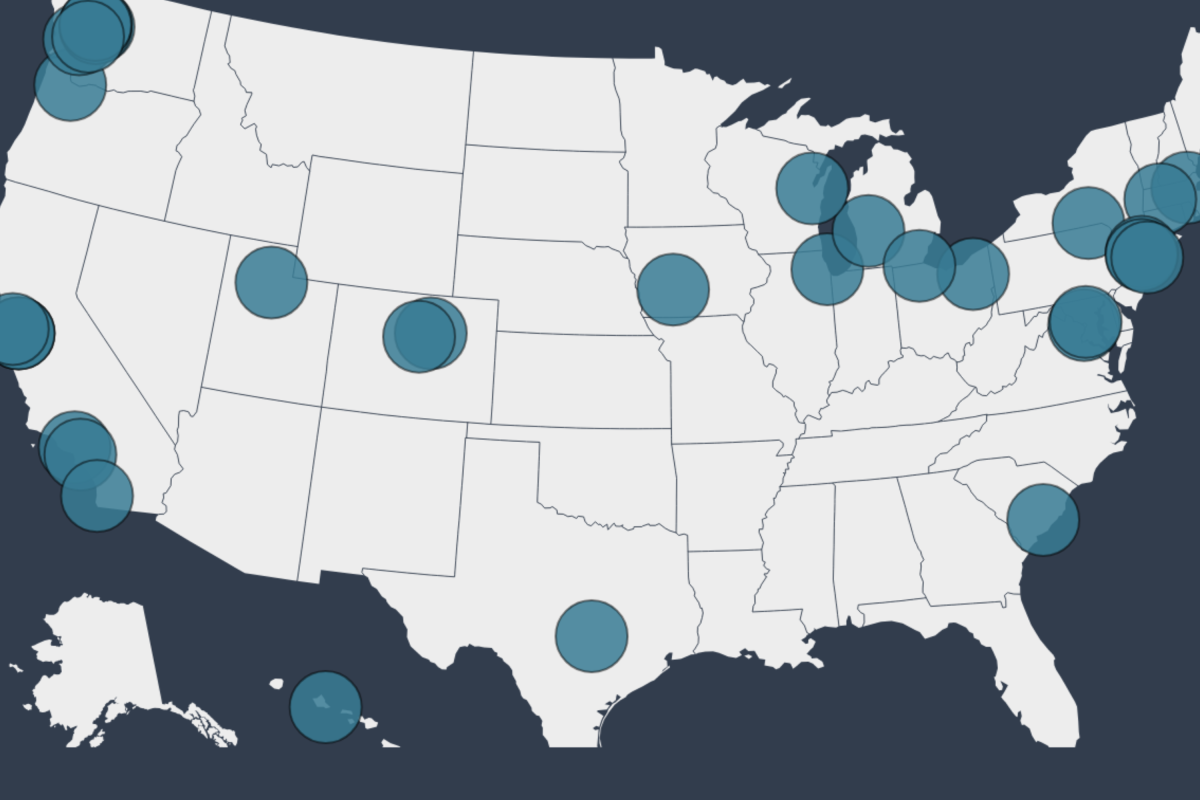
On a raw October morning, the calendar turns back to a date that has come to define an era of grief, anger, and unresolved conflict. Wednesday marks three years since Hamas militants attacked Israel, a day that killed roughly 1,200 people and saw 251 hostages dragged into Gaza. It also marks three years since the beginning of an Israeli military campaign in Gaza that, according to the territory’s health ministry, has now killed 74,245 people. The ministry’s figures do not distinguish between civilians and militants, but they represent an extraordinary human toll—families wiped out whole, neighborhoods turned to dust, generations lost in a landscape already scarred by decades of war. On this anniversary, at least 35 pro-Palestine protests have been planned across 16 states and Washington, D.C., according to a report released Tuesday by Israel’s Ministry for Diaspora Affairs and Combating Antisemitism. The report was meant as a warning, laying out where demonstrations were expected to take place throughout October, not just on the anniversary itself. For Israelis, the date remains a living wound, filled with memories of sirens, autopsies, hostage negotiations, and the impossible pain of waiting. For Palestinians, the date has become a symbol of what they describe as a relentless campaign of destruction, one that has turned their homeland into a space of ceaseless mourning. The Israeli military has reported that 87 of the hostages died while in captivity, and some of their remains were later returned to Israel; many others were freed, rescued, or recovered in the course of the war. But for every return, there is a story of loss. For every protest, there is a story of rage. The word “anniversary” feels too tidy for something so raw, but it is the word we have, and people are using it to fill the streets with meaning.
The demonstrations scheduled for this week are only part of a much larger wave of protest. According to the report, the United States has the highest number of pro-Palestine events planned throughout October—45 in total—followed by Spain with 40, Australia with 21, and the United Kingdom with 19. On Wednesday itself, California is hosting the largest number of demonstrations, with seven. Washington state follows with six, and New York state with five. The locations chosen for these rallies are not accidental. Protesters will gather in Washington Square Park and outside New York City Hall, two places where public dissent has echoed for generations. Students and activists will meet at the University of Washington Quad in Seattle, in the familiar open space where campus life and politics collide. At California State University, Northridge, Library Lawn will become a gathering point for speakers and signs. In Honolulu, the Campus Center will serve a similar purpose, a reminder that this conflict reaches far beyond the Middle East. Most of these events are being organized by student groups and activist networks, especially the Palestinian Youth Movement and Students for Justice in Palestine, whose campus chapters have grown dramatically since the war began. The university setting is no accident. American college campuses have become some of the most visible and contested battlegrounds in the broader debate over Gaza. Students are not just observing this moment; they are living inside it, debating it in classrooms, dormitories, dining halls, and group chats. For many young people, these protests are a form of civic participation, an attempt to force their schools, their lawmakers, and their country to confront what is happening in their name. They see the anniversary as neither an abstract date nor a political event, but as a summons to act.
For the organizers, the purpose of these rallies goes beyond marking a date. It is to make a claim about the nature of the war itself. Many pro-Palestinian movements have accused Israel of committing genocide in Gaza, a charge Israel has forcefully denied. Some protesters are calling on the United States to stop providing military aid to Israel, arguing that American weapons have enabled the destruction they see on screens every day. The Students for Justice in Palestine chapter at UCLA framed its October 7 protest as a “commemoration of three years of escalated genocide in Palestine.” In a statement posted to Instagram, the group said the demonstration was meant to “recognize and uplift the unabashed resistance of the Palestinian people.” It invoked the Palestinian writer Hussain Mroue’s concept of “Fighter Grief”—a grief that “compels you to action rather than debilitates you.” That phrase captures something essential about the emotional atmosphere of these protests. For many participants, this is not about celebrating violence; it is about refusing to be crushed by it. They speak of the dead in Gaza not as statistics but as martyrs. They describe October 7 not as a terrorist attack but as a moment of rupture in a long history of Palestinian dispossession. That framing is difficult, even painful, for many people to hear. Jewish communities with direct ties to the hostage crisis, in particular, hear the rallies as an assault on their own grief. But understanding why people march does not require agreeing with them. It requires recognizing that the numbers coming out of Gaza—74,245 dead, according to the health ministry—are not abstract. They are names, faces, childhood homes, and unfinished lives. The rallies offer those who mourn them a way to convert private pain into public witness, a way to say, “We are still here, and we will not look away.”
Israel’s government does not see these protests as acts of grief. It sees them as celebrations of a massacre. In its report, the Ministry for Diaspora Affairs and Combating Antisemitism warned that demonstrators would use the anniversary to spread anti-Israel and anti-Jewish rhetoric. Israeli officials have long rejected the accusation of genocide, and that position has been supported by President Donald Trump’s White House. In arguments before the International Court of Justice, where South Africa has filed a genocide case against Israel, the Israeli legal team said: “Israel is fighting Hamas terrorists, not the civilian population.” They described the campaign as “a war of defense against Hamas—not against the Palestinian people.” For many Israelis, October 7 remains the most traumatic event in their country’s modern history. The images of that morning—the sirens, the rocket fire, the reports of homes invaded, families taken, babies hidden in safe rooms—are not old news footage. They are personal memories. The death of hostages while in captivity, and the ordeal of those who survived, has made this third year unbearably heavy. When protesters gather on the same day to honor the fighters who crossed into Israel, that grief turns into outrage. Israel and its supporters do not draw a clear line between peaceful political protest and glorification of violence. For them, a rally held on this specific date sends a message that can be understood in only one way: that the murder of Israeli civilians was justified, or at least excusable, within a larger political story. That is why the demonstrations are so charged. They are not simply about policy disagreements over ceasefire terms or humanitarian aid. They are about the most basic question of all: whose suffering is recognized, and whose is erased.
That outrage is not confined to Israel. Several American advocacy groups have spoken out against the planned demonstrations, including New York’s Anti-Defamation League, or ADL. The group criticized a demonstration scheduled to take place outside City Hall, calling the organizers “extremist groups” and saying it was anti-Semitic to rally “on the third anniversary of the October 7 massacre, the deadliest attack on Jews since the Holocaust.” Representative Josh Gottheimer, a Democrat from New Jersey’s 5th Congressional District, made a similar point in a sharply worded message on X. “Let’s be clear: choosing the third anniversary of October 7 to glorify the barbaric murder of 1,200 people, including Americans, as ‘resistance’ is deeply offensive and morally bankrupt,” he wrote. “In America, we don’t glorify terrorists as ‘martyrs.’ We condemn them. When you glorify political violence, you only invite more of it.” Those words capture a powerful strand of American public opinion, particularly among those who have watched with alarm as student organizations and activist networks have amplified a narrative that frames October 7 as an act of liberation. To critics, these protests are not protected dissent but moral confusion, a willingness to overlook the massacre of civilians because the cause feels just. To organizers, the critics are refusing to confront the larger context of occupation, siege, and military force that has shaped Palestinian life for decades. The language itself has become a battleground. One side says “resistance.” The other says “terrorism.” One side invokes international law and human rights. The other side invokes memory and survival. In between stand ordinary Americans, many of whom feel exhausted by the relentlessness of the conflict, worried about the rise of antisemitism and Islamophobia, and uncertain about what they would say if asked to speak. The protests will not resolve that uncertainty. They will only sharpen it.
What will happen on Wednesday will be measured in numbers—how many people marched, how many speeches were given, how many counterprotesters shouted back. But the deeper story is harder to quantify. Each side carries its own documentation, its own lists of names, its own set of stories that the other side refuses to tell. The Israeli hostages who never came home; the Palestinian families buried under the wreckage of their own homes; the mothers in Tel Aviv counting the days since they last heard a voice; the mothers in Gaza counting the days since they buried a child. The rallies themselves are acts of grief, but grief looks different depending on who is doing the mourning. For some, it means standing quietly with a poster of a hostage, waiting for news that never comes. For others, it means marching through a campus quad with a megaphone, insisting that the world’s sympathy has been pointed in the wrong direction. What the upcoming demonstrations make clear is that this anniversary will not resolve anything by itself. It will, however, remind us that the conflict over Gaza is not an abstraction. It is continuous, intimate, and full of people who believe they are acting out of love and justice. The challenge for the rest of us is not simply to choose a side, but to remember that behind every political slogan is a living person, trying to make sense of a world that has broken in ways that may never be fully repaired. If that reminder is the truest purpose of an anniversary, then October 7—and every protest, speech, and memorial around it—is not an ending. It is a summons, an invitation to look more closely at the human costs of war, and to ask what kind of world we want after the shouting stops.