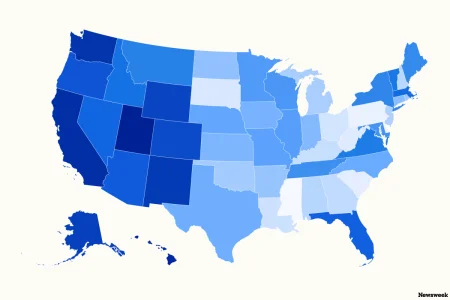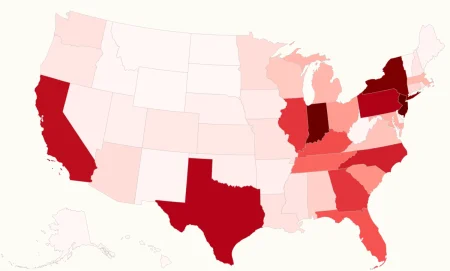





Deciding where to live has always been a deeply personal calculation, but for today’s young Americans it is increasingly being shaped by brutal math: where can a paycheck actually go further? According to a new Redfin analysis of U.S. Census Bureau data, Gen Zers and millennials are leaving some of the country’s most expensive coastal metros in search of something they often cannot find in New York, Los Angeles, or San Francisco — breathing room. Yet the two generations are not heading to the same places, and their different destinations reveal a lot about the moments they are in. Millennials, now aged roughly 30 to 45, are prioritizing space and stability, flocking to Houston, Atlanta, and Las Vegas, where a family-sized home is still within reach. Gen Zers, by contrast, are in their twenties, a time when career paths are still being forged. They are gravitating toward cities like San Antonio, Austin, and Nashville, places that offer a combination of entry-level jobs, social energy, and relatively manageable rent. As Redfin’s principal economist Sheharyar Bokhari put it, “Gen Zers are chasing opportunity, while millennials are chasing space.” It is a neat summation, but beneath it lies a more human story of trade-offs, compromises, and the quiet pressure of watching the American dream get more expensive.
For Gen Z, the decision to move is often less about finding a forever home and more about finding a foothold. The most popular destination for this generation was San Antonio, which saw a net inflow of 10,678 people in their twenties. Washington, D.C., came in second, followed closely by Austin, Nashville, and Dallas. What unites these cities is not cheap housing, though some are cheaper than the coasts. It is the sense that they are launching pads. Entry-level job postings have fallen by about 35 percent since early 2023, according to Revelio Labs, and the unemployment rate for recent graduates is hovering near 5.7 percent — significantly higher than the national rate of 4.1 percent. In such a tight market, moving across the country on a whim feels riskier than it once did. As Bokhari noted, “when entry-level hiring is tight, fewer young workers can afford to relocate on speculation, and those who do move go to metros with the deepest job markets for early-career workers, like D.C., Austin and Nashville.” That is why San Antonio’s healthcare and cybersecurity sectors make it attractive; why D.C. draws graduates in political science, international relations, law, and public policy; and why Austin offers a rare blend of tech jobs and a thriving cultural scene. Nashville brings more than country music — its marketing, healthcare, and tech industries are growing — while Dallas–Fort Worth has a broad corporate base. These cities let young people feel like they are moving forward, professionally and socially, without being priced out of the basic experience of being young. The compromise is intentional: they are choosing places with opportunity, but at a cost they can actually manage.
Millennials, on the other hand, are playing a longer game, and their choices reflect the weight of bigger life questions about marriage, children, and buying a home. Houston was the most popular destination for this generation, with a net inflow of 16,365 people. Dallas, Baltimore, Las Vegas, and Atlanta followed. These metros are more geographically scattered, stretching from the South to the West to the Northeast, but they share a common feature: median home-sale prices under $450,000. That matters because homeownership is no longer a distant thought for many older millennials; they are at the age where it is becoming an urgent goal. According to the National Association of Realtors, millennials accounted for 26 percent of all home buyers, while Gen Z accounted for just 4 percent. Millennials are also increasingly doing the emotional math of raising children in smaller apartments or renting indefinitely, and many have decided they want more. “The same city that works for a 25-year-old renter doesn’t work for a 35-year-old trying to buy,” Bokhari said. That helps explain why Houston and Atlanta, with their sprawling suburbs and relatively affordable housing stock, appeal to people who are tired of watching their savings evaporate into rent. They want a place where a paycheck stretches further, where a home with a backyard is attainable, and where the daily cost of living does not feel like a punishment. It is not about rejecting city life; it is about refusing to be trapped by it.
Despite their different destinations, the two generations share one striking similarity: they are leaving the same expensive coastal hubs. New York is losing more Gen Zers than any other metro, with a net outflow of 29,554, followed by Minneapolis, Los Angeles, Denver, and Detroit. Among millennials, New York again tops the list with a net outflow of 42,698, followed by Los Angeles, Miami, Washington D.C., and San Francisco. There is a particular irony in Washington D.C. appearing on the millennial exodus list while ranking as a top destination for Gen Z. The city is magnet for young graduates eager to work in policy, consulting, and law, but for older residents who are ready to settle down, the high cost of housing and the transient nature of the city make it less sustainable. The long-term consequences of this outmigration are sobering for cities that have spent years hemorrhaging young people. As Bokhari warned, the risk is to the workforce pipeline and the tax base, because these are the residents who would otherwise stay, build careers, buy homes, and contribute for decades. When young people leave, they take not only their energy but also their future earning potential, their civic participation, and their dreams. A city can replace a renter, but it cannot easily replace the hope and ambition that a twenty-something brings with their first real paycheck.
What may soften the blow is the fact that young people are not moving nearly as far as they used to, and many are not moving at all. The share of 19-to-24-year-olds who left their metro area fell from 15.3 percent in 2014 to 13.5 percent in 2024, and among 25-to-34-year-olds, relocation dropped from about 11 percent to 9 percent. Much of this is because housing costs have made the very act of moving more expensive. When people do make a change, they are increasingly making short moves within the same state or region. The most common route for Gen Zers is Los Angeles to Riverside, California; for millennials, it is the same exact corridor. New York to Philadelphia is also near the top, as is Washington D.C. to Baltimore. These are not dramatic cross-country odysseys or-chasing the sun to a new identity. They are quiet, practical adjustments — moving one train ride or one highway away to find slightly lower rent, a little more square footage, or a more reasonable commute. As Bokhari explained, “the metro loses the resident, but the broader region often keeps the worker.” This is a compromise that feels very human: not quite leaving, not quite staying, but edging outward just enough to make life feel possible. It suggests that young people are not rejecting their regions, but rather reorganizing their relationship to them, seeking the same familiar culture and networks while gaining a little more space.
In the end, the migration patterns of Gen Zers and millennials are less about running away from somewhere and more about running toward something. They are searching for places that still feel like they offer a return on investment — a place to launch a career, afford a family, or simply feel less squeezed. For Gen Z, that means moving to opportunity in the form of strong job markets and vibrant social scenes, even if it means settling in a city that is warmer, less glamorous, or smaller than the ones their parents once dreamed of. For millennials, it means finding a place where a paycheck feels meaningful, where the cost of a home is not a cruel joke, and where the future still feels like something they can build. The two generations are experiencing the same affordability crisis, but they are responding in ways that reflect their age: the youngest among them are still willing to bet on themselves, while those in their thirties are looking for safer ground. Neither path is easy, and both are shaped by a broader economy that makes mobility more difficult and more costly. Yet there is a resilience in these moves, a sense that young Americans are refusing to give up on the idea of a good life, even as they are forced to rethink where that life can happen. They are not fleeing America’s cities so much as rewriting the map of where opportunity lives, and in doing so, they are reminding the rest of the country that home is not necessarily where you start — it is where you can finally breathe.