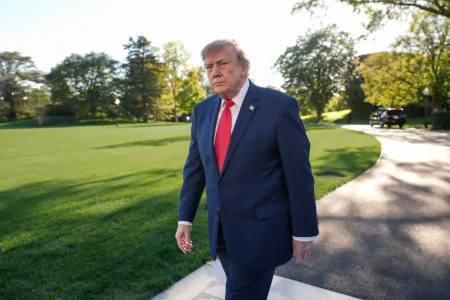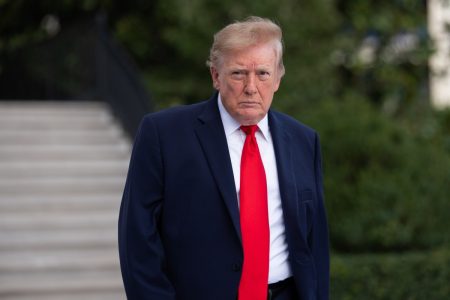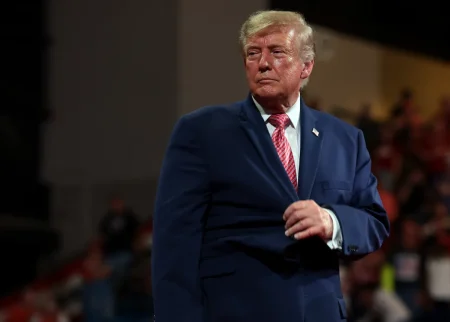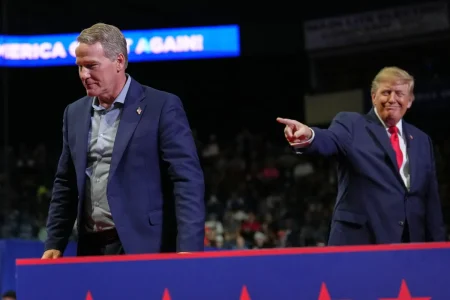



It started as another routine political trip—Air Force One touching down in North Carolina, a rally ahead, the familiar roar of supporters. But President Donald Trump turned Wednesday’s arrival into a new transatlantic crisis, threatening the European Union with “serious” tariffs or even an outright halt to trade if Brussels moves forward with a deepening partnership with Canada. European Commission President Ursula von der Leyen had just announced that the 27-member bloc was prepared to welcome Canada as its first “associate member”—an unprecedented arrangement that would tie the two allies closer on trade, security, and other matters. Trump dismissed the idea as “laughable,” called Canada a “terrible trade partner,” and warned that if the move looked at all like a hostile act, he would put “very serious tariffs or stop trading with Europe on many things.” Behind the bluster lay billions of dollars in commerce that American states enjoy with the EU, and a web of relationships that reaches into every corner of daily life. The European Commission’s trade spokesperson, Olof Gill, responded with a measured but pointed reminder that the EU-Canada proposal “is not against anyone else, but for our common strength.” Yet the damage may already be done: the threat alone introduced a new level of uncertainty for businesses on both continents, from German automakers to American farmers. For ordinary citizens, the stakes are not abstractions. They are the price of a prescription, the stability of a job, and the reliability of a supply chain that delivers everything from medical devices to breakfast cereals. What sounds like geopolitical gamesmanship in Washington can quickly become a personal crisis in a town that depends on exports.
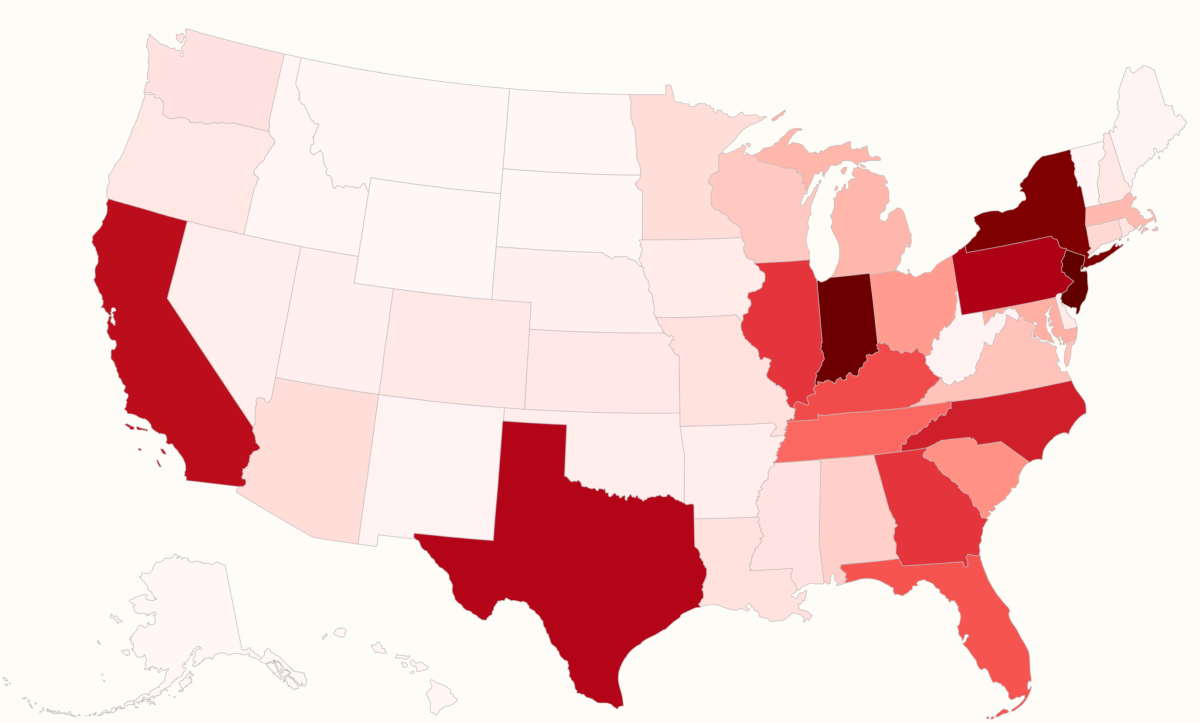
The likely economic fallout would not land evenly across the United States. Data from the U.S. Census Bureau, organized by Visual Capitalist, shows which states would suffer most if transatlantic trade collapsed. New Jersey, with more than $60 billion in EU imports in 2024, is the most exposed in raw dollars. Indiana and New York are not far behind, absorbing $58.7 billion and $56.3 billion worth of European goods respectively. Even Texas and California, the nation’s economic giants, are not as dependent on Europe as the eastern states, where ports and industrial corridors have been built around transatlantic commerce for generations. In relative terms, the reliance is even more dramatic: Indiana gets 46 percent of all its imports from the EU, South Carolina 45 percent, and Rhode Island 39 percent. These numbers translate into very human realities. A nurse in Gary, Indiana relies on German surgical instruments; a pharmacist in Charleston, South Carolina stocks vaccines made in Belgium; a family in Providence buys a Volvo that crossed the Atlantic from Sweden. Tariffs would not just make these goods more expensive—they could make them impossible to obtain. The threat comes on top of an existing trade war with Canada, still the United States’ second-largest trading partner. Trump has already placed 50 percent tariffs on roughly $28 billion worth of Canadian goods, and Prime Minister Mark Carney responded “dollar for dollar.” For the U.S. states that trade heavily with both Canada and Europe, the combination is potentially catastrophic. Auto parts, agriculture, machinery, and pharmaceuticals all flow across the Great Lakes and the Atlantic. When the commander in chief calls allies “laughable” and threatens to close the borders of commerce, the people who pack the lunch pails and fill the hospital cabinets are left to wonder what comes next.
Meanwhile, in the ornate chamber of the European Parliament in Strasbourg, France, Mark Carney was outlining a different vision. Canada’s prime minister spoke of a “deeper partnership” between his country and the European Union, one that would create a “protective canopy under which our citizens can thrive.” His words were carefully chosen. In Carney’s framing, this is not a matter of trade balances or tariff schedules; it is about sovereignty—the right of a nation to choose its own path, defend its values, and protect its people from shocks beyond its control. “This is about sovereignty, our ability to live as we wish,” he told the assembled parliamentarians. “It’s about the freedoms we must fight for every day because sovereignty requires resilience, the ability to withstand shocks.” The message was aimed as much at Washington as at Europe. For decades, Canada and the EU have relied on the United States as a stabilizing anchor. But the return of a transactional, combative American presidency has shaken that assumption. Both Ottawa and Brussels now see the value of diversifying their partnerships, not as an act of hostility but as an act of self-preservation. For citizens, this means something tangible: a country that cannot be easily intimidated, an economy that has friends when a superpower turns hostile. It means knowing that energy security, medical supplies, and critical technologies are not concentrated in the hands of one unpredictable partner. Carney’s vision is not flashy, but it speaks to a deep yearning for stability. For Americans watching from afar, there is an uncomfortable irony: the more Washington threatens its friends, the more it pushes them into each other’s arms. The “protective canopy” Carney describes is, in part, a shelter from the storm that the United States has created.
Back in Washington, the business community watched the president’s remarks with a mixture of dread and exhaustion. Jake Colvin, president of the National Foreign Trade Council, told Newsweek that it “does U.S. businesses no good to continue eroding America’s relationship with two of its closest allies and partners.” His organization represents some of the largest companies in the country, firms that have spent decades building transatlantic supply chains, opening factories in Europe, and selling American goods to European consumers. For them, a trade war with the EU is not a theoretical debate about fair trade; it is an existential threat to their operations. The hope had been that Trump’s second term would eventually settle into a more pragmatic phase, with deals made and tariffs deployed only as bargaining chips. Instead, the threat to “stop trading with Europe on many things” has injected chaos into boardroom planning. Businesses need certainty to invest, hire, and grow. They cannot build a factory or sign a long-term contract on the assumption that the president’s mood will not shift overnight. Colvin urged Canada and the United States to return to the negotiating table, specifically to make progress toward a renewed USMCA, the free-trade agreement among the U.S., Mexico, and Canada that Trump himself signed and that is now entering a period of renegotiation. The message from corporate America is simple: diplomacy is harder than demolition, but only diplomacy can produce a future that benefits workers and families. The longer the president threatens allies, the more companies will move production elsewhere, the more foreign governments will hesitate to invest in the United States, and the more ordinary people will pay the price for a strategy that has no endgame. This is not just about tariffs on European wine or Canadian lumber—it is about whether America can still be trusted to keep its word.
Across the Atlantic, the European Union is also bracing for pain, and the blow would fall hardest on Germany and central Europe. Aurélien Saussay, an economist at the London School of Economics and Political Science, told Newsweek that the bloc’s automobile sector would be the most severely affected. “The pain would be concentrated geographically, with Germany and central Europe being worst affected,” he said. German automakers—Volkswagen, BMW, Mercedes-Benz, Audi—are household names in America, but they are also the anchor of a massive industrial ecosystem that includes parts suppliers in Poland, the Czech Republic, Slovakia, and elsewhere. A tariff wall would send shockwaves through that ecosystem, threatening hundreds of thousands of jobs. But there is a twist that complicates the politics of protectionism. The largest single category of EU exports to the U.S. is not cars or machines; it is pharmaceuticals, accounting for 29 percent of the total. Saussay points out that a tariff on European medicines would not primarily hurt European companies—it would land “mostly on American drug prices.” This is the hidden cost of trade wars: when the U.S. taxes imports from Europe, it is effectively taxing its own consumers, its own hospitals, and its own patients. The same applies to the broader trade relationship. Both sides have become so deeply intertwined that the idea of “winning” is an illusion. A tariff on European steel raises costs for American manufacturers who buy that steel. A tariff on American soybeans raises food costs for European families. The real-world consequences are not abstract economic indicators; they are empty showrooms in Stuttgart, shuttered warehouses in Ohio, higher bills at the pharmacy counter, and workers laid off through no fault of their own. Saussay’s analysis is a sober reminder that economic power, when wielded recklessly, becomes a boomerang. It always returns to hurt the person who threw it.
The magnitude of the bond between the United States and Europe is best understood through the sheer volume of goods that cross the ocean every day. According to the European Commission, total bilateral goods trade reached €910.6 billion—about $1.04 trillion—last year. The U.S. imported €554.9 billion worth of European goods while exporting €355.7 billion to the EU, sums that translate to $636.8 billion and $408.2 billion in current dollars. Add in services, and the combined figure approaches $1.6 trillion, an 8 percent increase from the previous year. The U.S. carries a large deficit in physical goods, but it also runs a significant surplus in services, from finance and software to tourism and education. The products at the heart of this relationship are anything but trivial. Medicines and pharmaceuticals made up 29 percent of U.S. imports from the EU—€160.6 billion in recent trade data—because America depends on European laboratories for everything from cancer therapies to insulin. Other leading imports include road vehicles, industrial machinery, electrical equipment, and power-generating equipment, the very infrastructure of modern American life. In the other direction, the EU’s top imports from the United States are medicinal and pharmaceutical products (17 percent), followed by petroleum products, power-generating equipment, natural gas, and transport equipment. This means that American agriculture, energy, technology, and manufacturing all have a stake in the relationship. A decision to “stop trading with Europe on many things” would not be a surgical strike against a rival; it would be a wrecking ball aimed at the comforts, medicines, and machines that people rely on every day. Maybe the president believes his threats will bring Europe and Canada to heel. But the deeper truth is that the American economy, like the European and Canadian economies, is far too woven into the fabric of global trade to be unraveled without immense pain. The relationships that took decades to build—between unionized auto workers and German engineers, between American hospitals and Swiss labs, between Canadian farmers and European consumers—cannot be replaced by slogans. As the standoff intensifies, the hope is that leaders will remember that behind every trade statistic is a person: a worker waiting for a paycheck, a parent filling a prescription, a small business trying to survive. That is what “protecting American interests” should truly mean.