


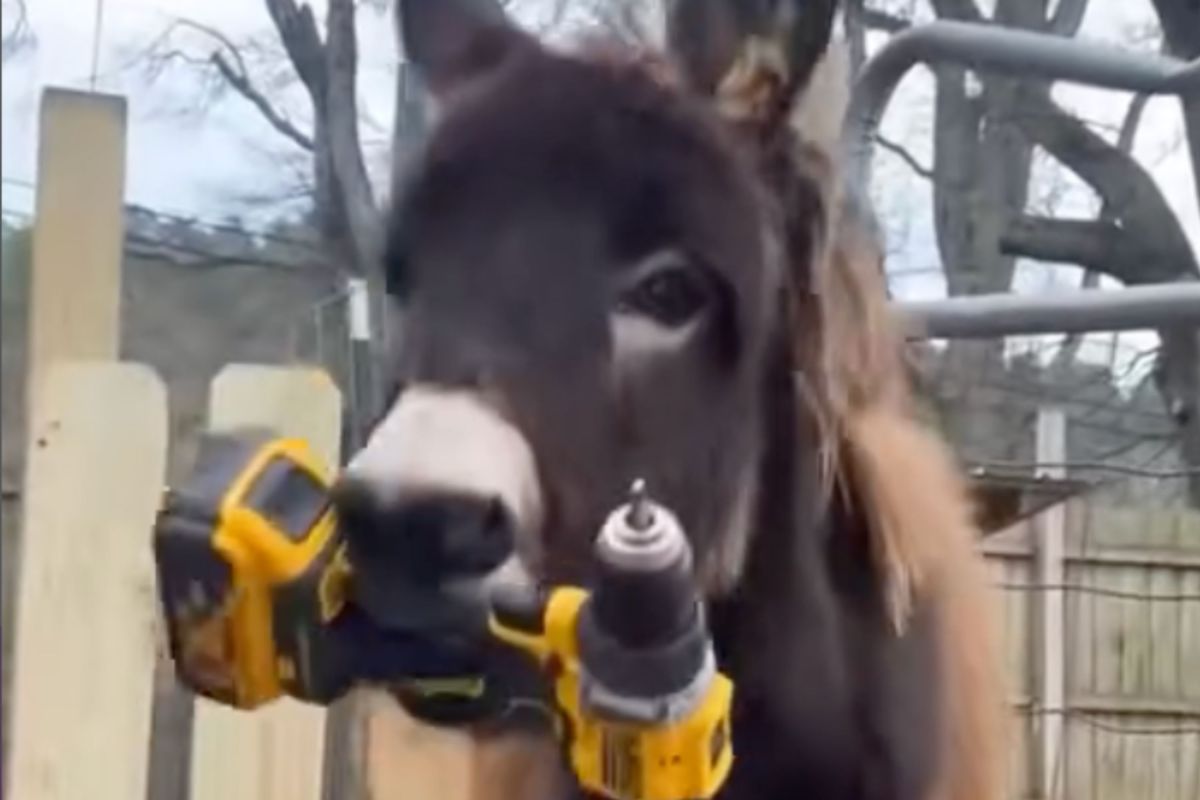
There is a particular kind of peace that settles over a small farm at night—the soft rustle of animals in their stalls, the low murmur of crickets, the sense that the world is safe and predictable. On a property called Elsbery Riding Farm in Rockmart, Georgia, that peace was shattered in the final hours of August 30, when law enforcement officers swept onto the land in search of a missing 12-year-old girl. Among the animals on the property was a young miniature donkey named HeeHaw, whom Hannah Israel had bottle-raised, caring for him almost like a child. HeeHaw was small, gentle, and accustomed to being around people. He had been part of petting zoos, letting children pat his nose and feed him from their palms. He was not a creature built for menace, and his owner insists he posed no threat to anyone. But by the time the search ended, HeeHaw was dead, shot by Cedartown Police Officer Trenton Ryan Garner. Israel has now filed a federal lawsuit, seeking accountability for what she describes as an unjustified killing, an unlawful entry onto her property, and a violation of her constitutional rights. The lawsuit, filed in the United States District Court for the Northern District of Georgia, is more than a legal document. It is a grieving owner’s attempt to make sense of an act she believes was both unnecessary and agonizingly cruel, and to force a reckoning over a death that could have been prevented.
The underlying facts are not in dispute in every particular. That night, officers were searching for a missing child, and they had the assistance of police dogs, while Rockmart firefighters used a drone to help from above. But Israel says no officer contacted her before entering the enclosed pasture, asked for her permission, or arrived with a warrant. She argues there was no emergency that justified crossing onto her fenced land without notice. Somewhere in that pasture, HeeHaw encountered the search party. According to the lawsuit, Garner shot the donkey despite the fact that he was young, small, and tranquil, and that there was no reasonable basis for believing he endangered the officers or their dogs. The missing girl was later found safe, but the donkey could not be revived. For Israel, the injustice is compounded by the way the animal was characterized after the fact. HeeHaw, she has said, was raised in the house and comfortable with human beings. He was not a feral threat. He was not a guard dog trained to attack. He was simply a donkey doing what donkeys have done for thousands of years when strangers appear in their territory: he noticed, he reacted, he alerted. In that sense, he was protecting his home. The lawsuit argues that a reasonable officer would have recognized the difference between an aggressive threat and a curious, harmless animal. Instead, the response was lethal, and a beloved animal paid the price for a misunderstanding that should never have escalated.
The legal claims at the heart of Israel’s complaint are substantial. She is seeking to hold Officer Garner personally responsible for what she calls an unlawful entry and an unconstitutional deprivation of property. The complaint emphasizes that police had no warrant, and the lawsuit contends that the exceptions to the warrant requirement simply do not apply to the situation on the farm. Even in a search for a missing child, officers are bound by constitutional limits, and entering an enclosed, private pasture without permission is not something to be taken lightly. Once inside, the lawsuit argues, the use of deadly force against a miniature donkey was wholly unreasonable. The Constitution protects citizens from unreasonable searches and seizures, and in Israel’s view, the shooting of HeeHaw was both a seizure of her property and an act of excessive force. The lawsuit says no reasonable officer in the same position would have believed the shooting was necessary, a powerful legal standard that cuts to the heart of the case. It is not asking for sympathy alone; it is asking for a jury to evaluate whether the officer’s actions were objectively justifiable. Israel is not only seeking compensation for the loss of her animal, but also damages intended to punish wrongdoing, along with legal fees and the unequivocal recognition that her rights were violated. She wants the record to show that this was not an accident, not a difficult choice made in the heat of a chaotic moment, but an avoidable tragedy caused by someone who acted without justification.
Perhaps the most haunting detail in the lawsuit is what happened after HeeHaw’s body was discovered—or rather, what did not happen. After the gunshot echoed across the pasture, Garner and the other officers reportedly left the property without directly contacting Israel and without telling her where they had left the donkey. She learned only later that night when a Cedartown Police Department supervisor called to say that a donkey on the property had been “dispatched.” The cold, bureaucratic word carried no apology, no explanation, and no practical assistance. Israel was left to wander across several acres of darkness, searching through the night for the animal she had raised from a bottle, not knowing whether he was suffering, not knowing where he had fallen. When she finally found him, the emotional weight was devastating. The lawsuit describes the experience as causing severe emotional distress, a phrase that in legal terms can feel clinical, but in reality means a woman had to stumble upon the body of a creature she had loved and cared for, in the dark, with no help from the people responsible for his death. The dehumanizing language of the phone call—that HeeHaw had been “dispatched”—only sharpens the sense that the officers treated the animal as a problem to be eliminated rather than a living being with value. Israel has previously voiced her outrage in her own words on social media, saying that HeeHaw was doing what donkeys do, alerting to a stranger, and that there was simply no way such an act could be legal. The lawsuit gives that outrage a legal voice.
Officer Garner has told a different story. In his police report, he says officers were following a trail with a K-9 handler and a bloodhound team when they entered the pasture and spotted HeeHaw on a hill. He claims the donkey began to charge at them, and that when another officer activated a Taser in an attempt to scare the animal away, HeeHaw kept coming. Garner says he fired a single shot to protect the K-9 handler and the bloodhound team from being injured, and that HeeHaw moved back up the hill before collapsing. That account is precisely what Israel’s lawsuit challenges. The complaint argues that a miniature donkey, one that was bottle-raised and had been around children, cannot reasonably be described as a charging threat that justified lethal force. The contrast between the two versions is stark, and the truth will have to be sorted out by the legal process. But even under Garner’s version, there is a difficult question: why was shooting the only option? Why could the officers not retreat, climb over a fence, or simply give the animal space? The lawsuit’s insistence that no reasonable officer would have fired suggests that Israel’s legal team sees this not as a split-second decision but as an unnecessary escalation that turned an already questionable entry into a fatal encounter. The fact that the missing girl was eventually found safe adds another layer of tragedy; the search that was meant to protect a child ended in the death of an innocent animal, and the child herself was not harmed. The justification of protecting people rings hollow, at least in Israel’s view, when no human was ever in real danger.
At its heart, this case is about more than one donkey on one farm in Georgia. It has struck a nerve because it touches on so many raw anxieties: the escalating presence of police in ordinary life, the willingness of authority to use violent force, the vulnerability of animals, and the grief of losing a creature who is part of the family. HeeHaw’s death has already drawn widespread attention after Israel shared her story on social media, and it has sparked outrage from people who see the shooting as a preventable act of cruelty. The Georgia Department of Agriculture’s Law Enforcement Division is investigating, and Garner has been placed on administrative leave while the matter is reviewed. Cedartown Police have not publicly said much, and this lawsuit ensures they will have to respond. Whatever the eventual outcome, Israel’s fight is not only for compensation or punishment; it is for acknowledgment that her animal mattered, that her property was not something to be crossed and violated without consequence, and that a living creature’s life should not be ended so casually. In a world where a donkey’s worth is often measured in practical terms, Israel is asking the legal system to recognize what she already knows: that HeeHaw was a friend, a companion, and a soul who deserved better. Her lawsuit is a memorial in ink, a way of saying that even a small, tranquil donkey has a place in the story of justice, and that his loss will not be ignored.