






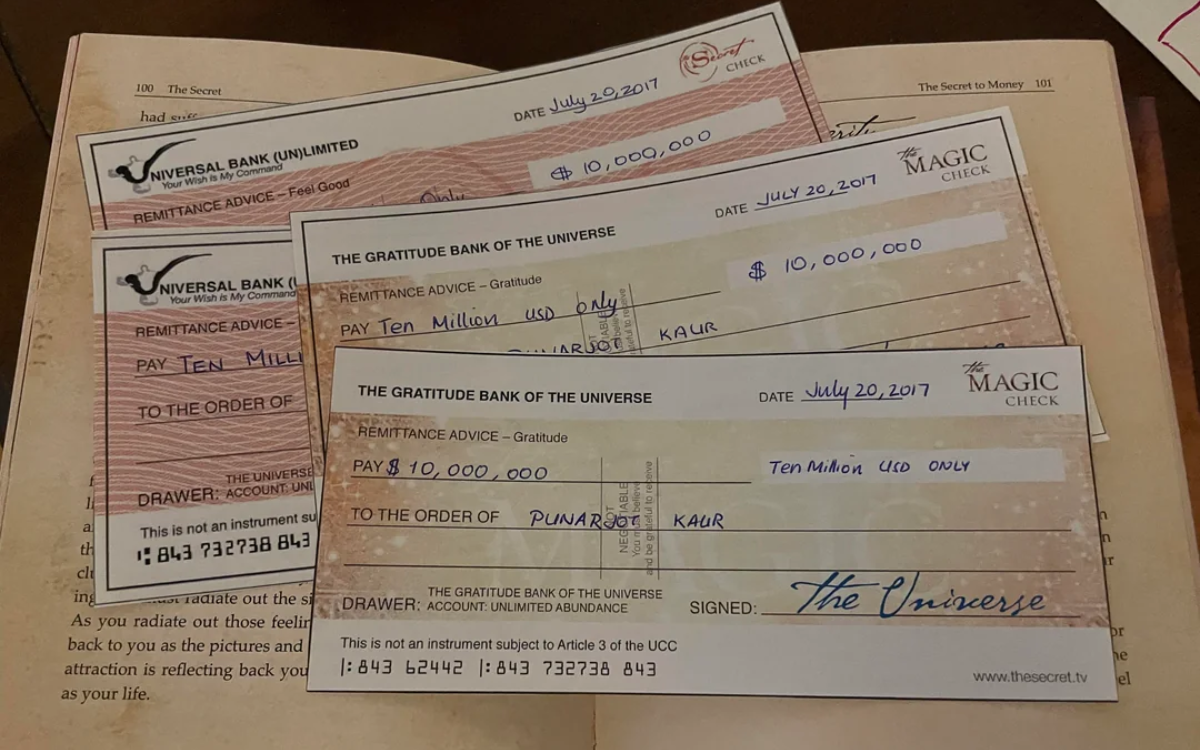
Imagine wandering through the cozy, dust-scented aisles of your local thrift store, hoping to find a hidden literary gem, only to open a book and find yourself holding $40 million. That was the brief, heart-stopping reality for Brian Davis of Guelph, Ontario, who was browsing the shelves when he decided to pick up a copy of The Secret by Rhonda Byrne. Having never actually read the wildly famous self-help guide, Davis opened the cover out of pure curiosity, only to discover a series of neatly tucked checks made out for a staggering fortune. For a split second, the discovery triggered that universal human rush of finding hidden cash, though reality quickly set in: even if these checks were legitimate, they would be completely useless in his hands.
The fortune, as Davis quickly realized, was not a real-life windfall but a physical manifestation of a cultural phenomenon. Published in 2006, The Secret became a global sensation, largely fueled by high-profile endorsements from figures like Oprah Winfrey, eventually selling over 30 million copies worldwide. The core of the book champions the “law of attraction”—the belief that focusing on positive thoughts and visualizing success can actively draw wealth, health, and happiness into a person’s life. The $40 million in checks Davis found were actually official “Magic Checks,” a visualization tool distributed by the franchise. Followers were encouraged to write their own names on the checks along with their ultimate financial dreams, keeping them close as a tangible symbol of the abundance they hoped the universe would deliver.
While the checks represented someone’s deeply personal dreams of wealth, Davis remains highly skeptical of the philosophy behind them. He acknowledges that while keeping your goals in mind is a healthy practice, passive wishing is no substitute for hard work. To Davis, merely asking the universe for a fortune is more akin to looking for a handout than taking active control of one’s destiny. He jokingly points out that believers often fall victim to confirmation bias, treating a random twenty-dollar bill found in an old winter coat as cosmic proof that the law of attraction is working. For skeptics like Davis, true progress requires concrete action and practical effort, rather than simply waiting for a magical financial rescue.
This skepticism mirrors the heavy criticism The Secret faced during its mid-2000s heyday. While millions found comfort and motivation in its pages, critics and scientists dismissed the book’s core concepts as pseudoscience, pointing out that there is zero empirical evidence linking positive thinking directly to physical wealth or biological health. More concerningly, many argued that the book promoted a form of “victim-blaming” and toxic positivity. By suggesting that individuals attract all their circumstances through their thoughts, the philosophy implies that people living in poverty, battling severe illnesses, or facing systemic injustices are somehow responsible for their own misfortune due to “negative thinking,” completely ignoring harsh socio-economic realities.
The discovery left Davis wondering about the story of the anonymous dreamer who filled out those checks. He reflects on two distinct possibilities for why the book and its $40 million fortune ended up on a thrift store shelf. The optimistic view is that the original owner achieved such immense happiness and success that they simply no longer needed the training wheels of manifestation. Conversely, the more pessimistic, and perhaps realistic, take is that the owner eventually grew tired of waiting on the universe and gave up on the exercise altogether. There is also the distinct possibility that the book was a well-intentioned gift from a friend, and the owner filled out the checks half-heartedly before realizing the philosophy just wasn’t for them.
Ultimately, Davis decided to purchase the book anyway, treating it not as a guide to wealth, but as a fascinating piece of modern cultural history. He harbors no illusions about a cosmic payout heading his way, but he genuinely hopes the original owner has found happiness—though he is certain that any joy they found came from real-world efforts rather than magical thinking. In the end, the discarded $40 million in checks serves as a gentle, humanizing reminder of our shared desires for a better life, the creative ways we try to achieve our dreams, and the quiet moments when we decide to fold up our fantasies and start looking for practical solutions in the real world.