





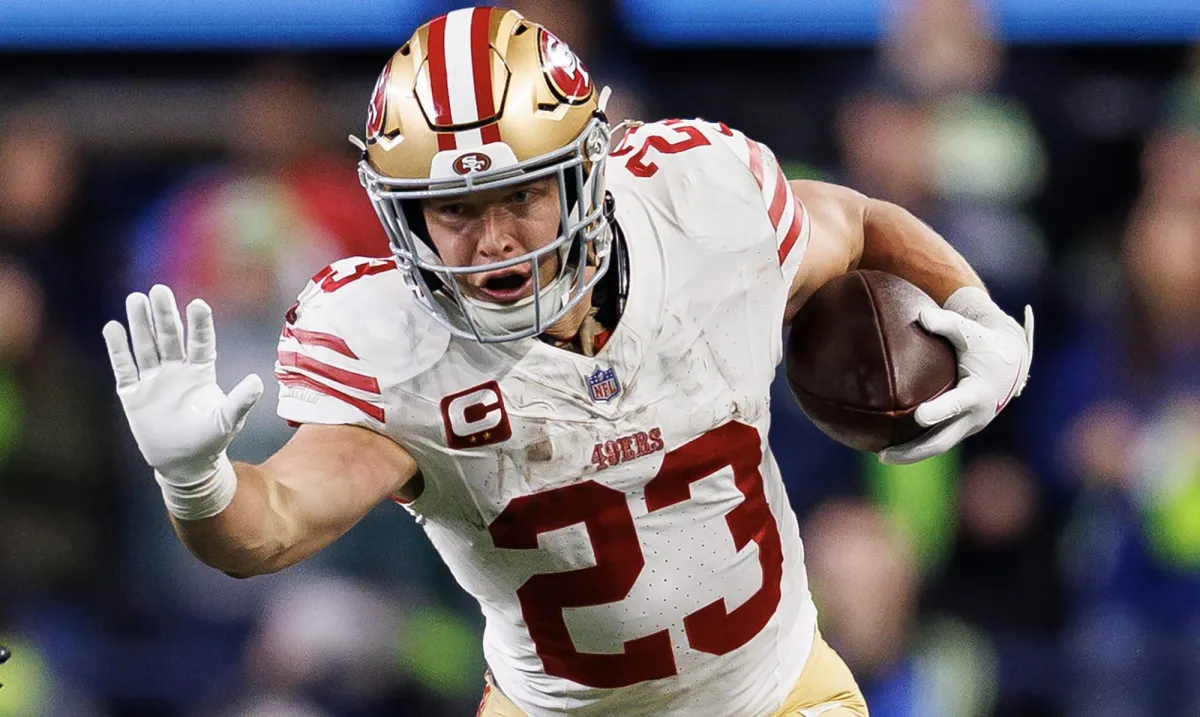
In the modern landscape of the National Football League, where extreme specialization often dictates a player’s utility, Christian McCaffrey stands out as a breathtaking anomaly—a football chameleon who seamlessly blurs the line between a traditional physical running back and an elite, route-running wide receiver. While purists and sports enthusiasts alike have long heralded him as one of the finest premier ball-carriers in the sport, a closer look at the analytical tape reveals a startling truth: McCaffrey is arguably a top-ten wide receiver masquerading in a running back’s numbers. Last season, he put on a virtuoso offensive performance that left defensive coordinators across the country searching for answers. He amassed a staggering 2,126 yards from scrimmage, a jaw-dropping total that was second only to the Atlanta Falcons’ dynamic Bijan Robinson, who paced the league with 2,298 yards. What truly set McCaffrey apart, however, was his unprecedented dominance in the passing game. He led all NFL running backs with 102 receptions, 924 receiving yards, and seven receiving touchdowns. To put those numbers into perspective, when evaluated against the league’s entire elite crop of pure wide receivers and tight ends, McCaffrey ranked sixth overall in total receptions, 23rd in receiving yards, and 15th in receiving touchdowns. He did not merely serve as a safety valve for his quarterback; he ran a full route tree, manipulated complex coverages, and consistently beat secondary defenders in open space. Yet, beneath the glittering statistics and highlight-reel plays lies a quieter, more concerning narrative. This level of historic production demands an extraordinary toll on the human body, especially for an athlete who has battled significant physical adversity throughout his career. For the passionate fanbase of the San Francisco 49ers, the mesmerizing spectacle of McCaffrey’s versatility is increasingly accompanied by a collective, anxious intake of breath, knowing that such a heavy burden is rarely sustainable in a sport defined by violent, high-speed collisions.
The physical and mental demands of surviving an NFL season are brutal enough for an ordinary player, but for a true workhorse like McCaffrey, the weekly toll borders on the superhuman. Last year, he was subjected to a crushing total of 413 touches—comprising 311 grueling rushing attempts through the crowded, physical interior of opposing defensive lines and 102 high-speed targets out in space. This monumental workload is exactly the kind of trend that keeps head coach Kyle Shanahan awake at night. Shanahan, a masterful offensive strategist who possesses an intimate understanding of the delicate fragility of even the most elite athletes, has made it abundantly clear that he does not want to see McCaffrey approach those exhausting numbers again in the upcoming campaign. The coach’s primary fear is a deeply human one: that the team’s collective reliance on McCaffrey’s brilliance will eventually lead to his physical breakdown. Speaking with raw sincerity on the “Tom Tolbert Show,” Shanahan lamented that the previous season was “the worst we had been at it” in terms of overworking their star asset. He marveled at McCaffrey’s sheer heart, expressing profound awe at how the running back successfully engineered his body to be ready for the physical onslaught every single Sunday for 17 consecutive weeks. Forced to shoulder an oversized burden due to a rash of injuries and setbacks across the wider receiving corps, McCaffrey became the indispensable heartbeat of both the ground game and the aerial attack. But while his heroic efforts pulled the team through critical games, Shanahan recognizes that continuing down this path is a recipe for long-term disaster, representing a dangerous gamble with the career of a generational talent. In the high-stakes pressure cooker of professional football, coaches are constantly tempted to prioritize immediate weekly triumphs over long-term player preservation, but Shanahan is actively trying to resist this cycle.
To address this looming crisis of workload, Shanahan is embarking on a delicate psychological and tactical mission: saving Christian McCaffrey from his own relentless competitive nature. The head coach has openly stated that his primary goal for McCaffrey is to have “more juice” and be “more fresher” when the games matter most, ensuring he does not absorb unnecessary physical punishment. However, managing a superstar competitor of McCaffrey’s caliber is never as simple as writing a new rotation schedule on a coach’s clipboard. Players of his elite stature are fueled by an intense, almost obsessive drive to be on the field for every single snap, viewing any attempt to dial back their usage as an implicit doubt about their capability, toughness, or value to the team. Shanahan acknowledged this delicate psychological tightrope, admitting that McCaffrey would likely feel “extremely insulted” by the mere suggestion of reducing his playing time. Despite this inevitable friction, the coach remains firm, hoping that his star running back will ultimately understand that this enforced conservation is born out of genuine care for his health and longevity. It is a compelling human dynamic—a veteran coach willing to endure the temporarily wounded pride of his most dedicated player in order to protect that player’s future. Shanahan’s willingness to make these hard, potentially unpopular choices highlights a deeper leadership philosophy that values the human being behind the jersey just as much as the production on the field, aiming to establish a sustainable environment where greatness can endure without burning out. In a league that often treats players as replaceable commodities, this protective approach is a refreshing departure from the norm, indicating that the coach intends to prioritize long-term sustainability over short-term statistical glory.
The physical blueprint for reducing McCaffrey’s crushing workload involves a strategic diversification of the 49ers’ rushing attack, primarily through the empowerment of their younger backfield prospects. Last season, McCaffrey was responsible for a massive 65% of the team’s total rushing attempts, a staggering percentage that left very little room for rotation, breathers, or strategic rest on the sidelines. To alleviate this burden, the coaching staff is looking toward second-year running back Jordan James to take a significant leap forward in his development and shoulder a much larger slice of the rushing pie. Alongside James, third-round rookie Kaelan Black brings fresh energy and a physical running style that can absorb the punishing hits of early-down situations. The goal is to systematically lower McCaffrey’s share of the rushing attempts to a much more manageable baseline closer to 50%. Transitioning some of these physically taxing runs to James and Black is not merely about preserving McCaffrey’s joints; it is about cultivating a diverse, multi-headed rushing attack that keeps opposing defenses off-balance. By trusting these young, hungry runners with crucial carries, the 49ers can develop reliable depth while transforming their backfield into a dynamic committee. This strategic shift represents a vital investment in the team’s collective future, ensuring that when McCaffrey does step onto the field, he does so with maximum explosive capacity, turning what were once grueling, three-yard dirty runs into explosive, game-changing plays in space. For Jordan James, this upcoming season represents a golden opportunity to prove he can handle the spotlight of a championship contender, while the rookie Kaelan Black must prepare his mind and body for the intense speed and physicality of the NFL level.
In addition to restructuring the ground game, the 49ers have made sweeping, high-profile adjustments to their passing offense in order to rescue McCaffrey from his role as the team’s primary high-volume receiver. Last year, out of sheer necessity stemming from injuries and a lack of depth, McCaffrey often had to play like a traditional wideout, logging nearly 100 catches just to keep the passing game afloat. San Francisco’s front office responded to this vulnerability with an aggressive off-season remodeling, adding heavy-hitting talent to their receiving corps. The stunning acquisition of proven veterans Mike Evans and Christian Kirk, alongside the drafting of dynamic second-round standout De’Zhuan Stribling and the return of a fully healthy Ricky Pearsall, completely shifts the offensive landscape. These roster upgrades mean that the 49ers should no longer require a historic, 100-reception effort from their star running back to generate explosive passing plays. Mike Evans offers a legendary vertical and red-zone presence, Kirk provides elite route-running in the slot, and young talents like Stribling and Pearsall inject raw speed and playmaking potential into the lineup. This sudden abundance of perimeter weapons creates a beautiful tactical paradox for opposing defenses. If they choose to over-commit defenders to stop the newly fortified receiving corps, they leave themselves vulnerable to McCaffrey’s lethal ground game; if they crowd the box to stop the run, McCaffrey can slip out of the backfield against single coverage, operating with lethal efficiency rather than exhausting volume. This structural evolution humanizes the strategic side of football, demonstrating how a front office can actively work to protect their franchise centerpiece through thoughtful talent acquisition, ensuring that the pressure to perform is distributed evenly.
Ultimately, the success of Kyle Shanahan’s strategic campaign will be judged by a single, crucial health metric when the postseason arrives: McCaffrey’s total touch count. If the coaching staff can navigate the grueling 17-game regular season while keeping McCaffrey’s combined touches around 350 or less, it will represent an extraordinary victory for the entire organization’s support staff, training team, and coaching roster. Entering the playoffs with a healthy, energized, and physically fresh McCaffrey is the ultimate prize—a terrifying reality for any opposing defense that hopes to stand in the 49ers’ way. The journey to this goal requires a profound commitment to the big-picture vision, a willingness to prioritize the war over individual weekly battles, and a masterful handling of McCaffrey’s fierce competitive pride. It is a story about the delicate balance between short-term athletic brilliance and long-term career preservation, reminding us that even the most superhuman athletes are vulnerable to the wear and tear of this uncompromising sport. By embracing a deeper, more collaborative offensive approach and trusting his revamped supporting cast, Shanahan is not diminishing McCaffrey’s greatness; he is actively extending its shelf life so that it can shine brightest under the postseason lights. As the upcoming season approaches, the eyes of the football world will be fixed on San Francisco, waiting to see if this carefully calibrated plan can successfully preserve their dynamic weapon, ensuring that McCaffrey has plenty of “juice” left to chase the championship that has so far eluded his remarkable career. In the end, the true measure of a legendary player is often defined by the moments they deliver on the grandest stage of them all, and by giving up a little volume today, McCaffrey and the 49ers may secure everything tomorrow.