




Step back into the crisp, autumn-scented air of 1983 on the modest campus of Eastern Washington University, a setting defined by an almost idyllic sense of security where car doors were routinely left unlocked, dormitory keys were frequently forgotten, and backpack zippers remained open without a second thought. For an energetic, optimistic eighteen-year-old freshman—known today to the online world by her Reddit username, SocietyDisastrous787—the college campus in Cheney, Washington, felt less like a public institution and more like an extension of home. On one seemingly ordinary afternoon, while studying in the quiet, sterile corridors of the campus science building, she closed her textbooks and stepped away to use the nearby restroom, leaving her personal belongings unattended for mere minutes under the quiet assumption of universal goodwill. Upon returning to her study desk, however, this innocent worldview suffered a sudden, jarring fracture; her backpack sat visibly agape, and her wallet was entirely gone. The realization did not arrive with dramatic panic, but rather with a slow, creeping dread—that distinct, heavy “knot of unhappiness” in the pit of her stomach that inevitably accompanies the sudden, unexpected violation of human trust. It was an era when the theft of personal items felt utterly unthinkable in such a close-knit academic community, prompting her to search every nook, cranny, and trash bin of the science building in the desperate, fading hope that the wallet had simply slipped from her bag, rather than being deliberately taken by a stranger’s hand.
As she navigated the immediate shock of the theft, the practical realities of being a young student with limited financial resources came into sharp focus, though her losses were fortunately more emotional than monetary. At eighteen, her wallet did not contain the complex web of credit cards, digital accounts, and high-value currency that modern college students carry; instead, it held a sparse amount of cash, some trivial personal mementos, and her vital student and state identification cards. Replacing these physically issued documents in the pre-internet era of 1983 was not a matter of a few clicks on a government portal, but rather a tedious, bureaucratic odyssey involving long lines at the DMV, physical paperwork, manual verification, and the mild embarrassment of explaining how she had lost her ID. Though the loss of her wallet left a lingering sting and fueled an ongoing, hopeful search that stretched across the subsequent weeks, she eventually accepted that the item was gone forever, locked away in the quiet, dusty archives of unresolved history. She adapted, replaced the cards, and continued with the demanding rhythm of her university education, eventually graduating, building a career, and stepping into the next chapters of a full and vibrant life. Over the next four decades, as the memories of her college days faded into the background of a busy adulthood, the stolen wallet was entirely forgotten, buried deep under thirty-six years of life-changing events, new residences, personal milestones, and the constant forward march of time.
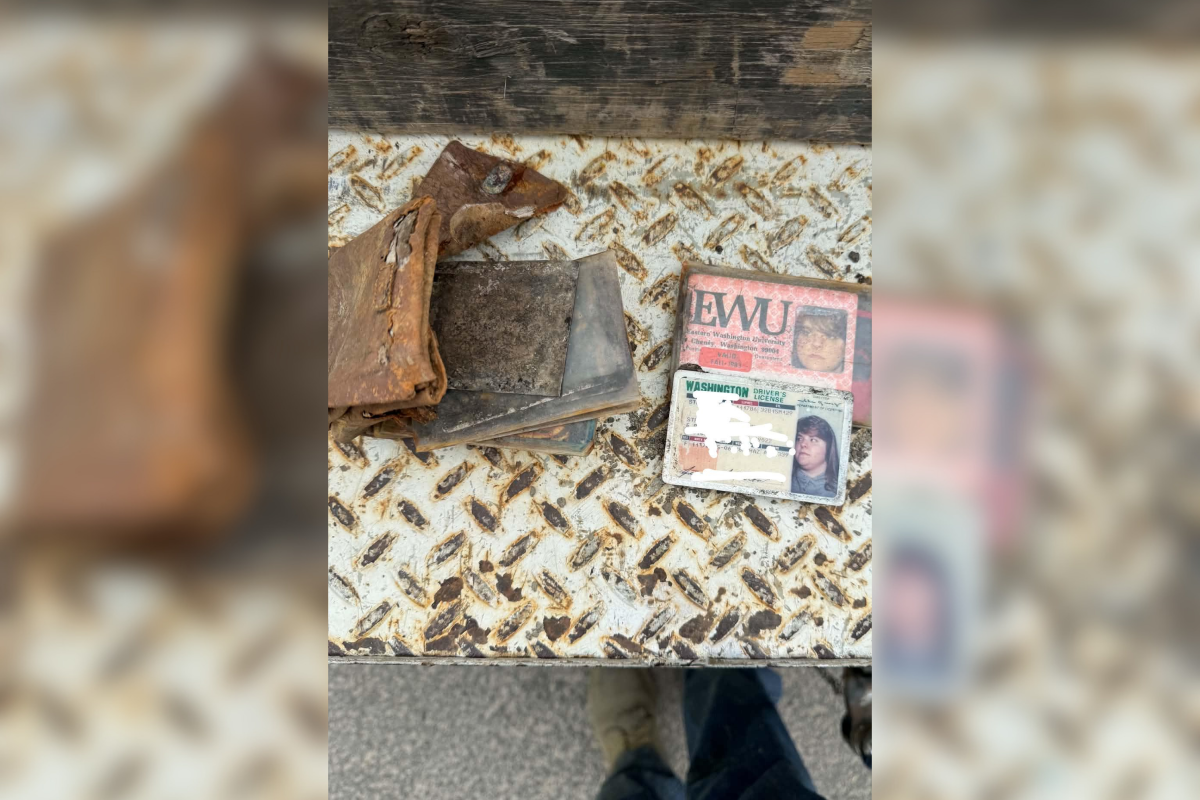
Decades rolled past like waves on a shore, witnessing the decline of analog culture, the rise of the internet, and the complete transformation of the Pacific Northwest landscape. Yet, while the world moved forward at a dizzying, high-tech pace, the discarded wallet remained quietly cradled in the Washington soil, hidden beneath generations of overgrown grass, falling leaves, and shifting dirt just beyond the campus perimeter. The mystery of its final resting place would endure until a sunny afternoon forty-three years later, when an ordinary city groundskeeper was executing his routine chores, maneuvering a heavy lawnmower across a patch of public grass. Spotting an unusual, weathered anomaly nestled in the dirt near the blades of his mower, the groundskeeper paused his machine to investigate, only to pull from the earth a decaying, mud-caked piece of leather that had miraculously survived the harsh elements of over forty changing winters and summers. Demonstrating an extraordinary sense of civic curiosity and modern resourcefulness, the finder carefully wiped away the decades of grime to discover that the plastic-encased identification cards inside were remarkably intact, preserving the youthful, smiling face of an eighteen-year-old student from 1983. Recognizing the historical gravity of his find, the groundskeeper decided to embark on a digital detective mission, utilizing the global reach of Facebook to search for the name printed on the faded, vintage driver’s license.
Meanwhile, now sixty-one years old and living a life vastly removed from her teenage years at Eastern Washington University, the woman logged into her social media account on an otherwise ordinary day, only to notice a strange notification waiting in her message requests folder. Upon opening the message, she was confronted with an image that instantly suspended the present moment and pulled her backward through time: a photograph of a heavily weathered, vintage leather wallet resting alongside her own pristine freshman student ID and a sideways-aligned, eighties-era driver’s license. The sheer absurdity of the image elicited an immediate, disbelieving laugh, as her eyes locked onto the face of her teenage self—a ghost from a lifetime ago, preserved perfectly within a time capsule that had been buried in the dirt for more than forty years. The shock was not one of grief or loss, but rather a profound, surreal amusement at the near-impossible odds of such a discovery, sparking a flood of long-dormant memories about her campus days, the layout of the science building, and the specific sting she had felt on the afternoon her trust was broken. It was a bizarre, delightful bridge between her past and her present, a tangible proof that the universe sometimes keeps receipts of our forgotten chapters only to return them when we least expect it.
When the kind-hearted groundskeeper warmly offered to mail the physically recovered wallet and its decades-old contents back to her, she paused to contemplate the true value of material possessions versus the memories they carry. Realizing the impracticality of reclaiming a crumbling piece of decayed leather and obsolete identification cards, she graciously declined the offer, recognizing that she had no functional use for a forty-three-year-old wallet in her daily life. Instead, she found that the digital image alone kept the perfect balance of nostalgia, serving as a powerful “memory nudge” that painted a vivid picture of her college years and resurrected thoughts of the friends, professors, and youthful ambitions she had long since lost touch with. She particularly found joy in the quirky layout of her old sideways driver’s license, a charming relic of a bygone era of state documentation that added an extra layer of humor to the entire ordeal. By letting go of the physical object while holding onto the digital photograph, she transformed a decades-old act of petty theft into a lighthearted, beautiful monument to her youth, proving that some objects are far more valuable for the stories they tell than for their material presence.
Unable to keep such an extraordinary coincidence to herself, she decided to share her deeply human, full-circle story with the internet, posting the photograph and a brief recount of the events on Reddit’s popular “mildly interesting” forum. The response was immediate and overwhelming, capturing the collective imagination of the online community and rapidly generating over 17,000 upvotes and hundreds of heartfelt, bewildered comments from strangers worldwide. Users were captivated not just by the survival of the plastic ID cards against the elements, but by the profound poetry of a lost piece of youth being excavated from the earth and delivered directly to its owner’s digital screen decades later. For the woman, the widespread viral reaction has been an unexpected and delightful bonus, allowing her to share a moment of pure, whimsical wonder with thousands of people who found the cosmic timing of the discovery just as magical as she did. Ultimately, the story of the stolen wallet of 1983 serves as a gentle, heartwarming reminder that nothing is ever truly lost forever, and that the passage of time has a mysterious way of healing old wounds, turning a forgotten moment of sadness into a shared, beautiful celebration of human connection.