





Paragraph 1: The Unseen Struggle at the Dinner Table
Imagine the golden years—a time for rest, for grandchildren, for looking back on a life of work with satisfaction. But for a growing number of older Americans, this vision is shadowed by a more primal, pressing anxiety: the simple, terrifying question of where the next meal will come from. It’s a question that shouldn’t haunt a seventy-year-old, yet for millions, the stark choice between filling a prescription, paying the electric bill, or putting groceries in the cart is a daily moral dilemma. A profound and deeply unsettling new study from the University of Michigan reveals that this struggle is not just a temporary hardship—it leaves a devastating, lasting scar on the brain itself. The research, published in the American Journal of Clinical Nutrition, uncovers a stark and alarming correlation: older adults who grapple with food insecurity in their later years face a dramatically elevated risk of developing dementia. This isn’t just about an empty stomach; it is about the potential erosion of memory, identity, and the very essence of who we are, decades after the hardship occurs. The study pulls back the curtain on a hidden public health crisis, suggesting that the silent, daily stress of not having enough to eat can be a prelude to a far more devastating cognitive decline, transforming the twilight years from a time of reflection into a battle for cognitive survival.
Paragraph 2: The Quantified Weight of Hunger
The statistics paint a grim and unmistakable portrait of vulnerability. Analyzing decades of data from the Panel Study of Income Dynamics—the nation’s longest-running household survey—researchers followed 2,051 adults over two distinct chapters of their lives. They tracked food insecurity during midlife (1999-2003) and again in later life (2015-2019), then examined the participants’ cognitive health in their senior years. The results are nothing short of chilling. Adults who experienced food insecurity during both midlife and later life had a staggering 40 percent estimated probability of developing probable dementia, compared to just 11 percent for those who never faced such hardship. Perhaps even more striking, the connection was most acute for those who experienced insecurity specifically in their older years—a 34 percent probability of dementia—while food insecurity in midlife alone showed no statistically significant link to cognitive decline. This temporal sensitivity suggests that the aging brain is uniquely fragile, and the stress and nutritional deficiencies of later-life deprivation act as a kind of accelerant for cognitive deterioration. As Daniel Preston, founder of LiveInCare USA, noted, the data isolates later life as the critical window of danger. It’s not simply a lifetime of cumulative wear and tear; it’s the specific, crushing vulnerability of the elderly, where the body and mind are less resilient, and the absence of a stable food supply becomes a direct assault on the neurological foundations of memory.
Paragraph 3: A Call to Reopen the Promise of SNAP
Behind these stark statistics are real faces, real kitchens, and a systemic failure to protect the most vulnerable among us. The study’s author, Noura Insolera, an assistant research scientist at the Institute for Social Research, draws a direct line between this cognitive crisis and public policy. She points, with a palpable sense of missed opportunity, to the temporary expansion of the Supplemental Nutrition Assistance Program (SNAP) during the COVID-19 pandemic. At that moment, the federal government acted with remarkable speed and generosity, dramatically boosting benefits and keeping millions of families—including seniors living on a fixed income—out of food insecurity. Insolera wistfully suggests that this model of intervention should not have been a temporary emergency measure, but a permanent bulwark against hunger. “If there is one thing I could change, it would be to go back to the generosity of benefits that SNAP was able to provide during the pandemic,” she said. “If those levels of benefit would have been kept, we might not see the increases in food insecurity we have seen since those benefits expired.” Her plea strikes at the heart of the matter: we know exactly how to fix this problem. We have the tools, the data, and the administrative capacity. The failure is one of political will, not of possibility. When we let emergency benefits lapse, we are not just cutting a check; we are implicitly making a choice to let the cognitive health of our elders hang in the balance.
Paragraph 4: The Delicate Dance of Causation and Hope
However, the researchers are careful to tread a line of scientific caution, acknowledging that this is a correlation, not a definitive proof of cause and effect. Preston is quick to point out that “reverse causation” could be at play—perhaps undiagnosed cognitive decline is the very reason individuals are struggling to manage their finances and food supply in the first place. It is a sobering, cyclical thought: the early, subtle manifestations of dementia could be what precipitates food insecurity, which then further accelerates the decline. Unmeasured factors, like social isolation, chronic physical ailments, or undiagnosed depression, could also muddy the waters. Yet, while the causation remains unclear, the implications are undeniable and deeply actionable. “The encouraging aspect is that food insecurity is potentially addressable,” Preston emphasizes. This is the crucial pivot from despair to determination. Even if we don’t fully understand the biochemical pathway that links an empty pantry to a struggling brain, we know that no one should have to experience that emptiness. Unlike so many heartbreaking diagnoses, this is one where the risk factor is a tangible, fixable problem. Meal delivery services, local food banks, and more compassionate approaches to connecting the elderly with existing assistance are not just charitable gestures—they are, based on this study, vital components of a public health strategy for preserving cognitive function.
Paragraph 5: The Memory Inside the Cart
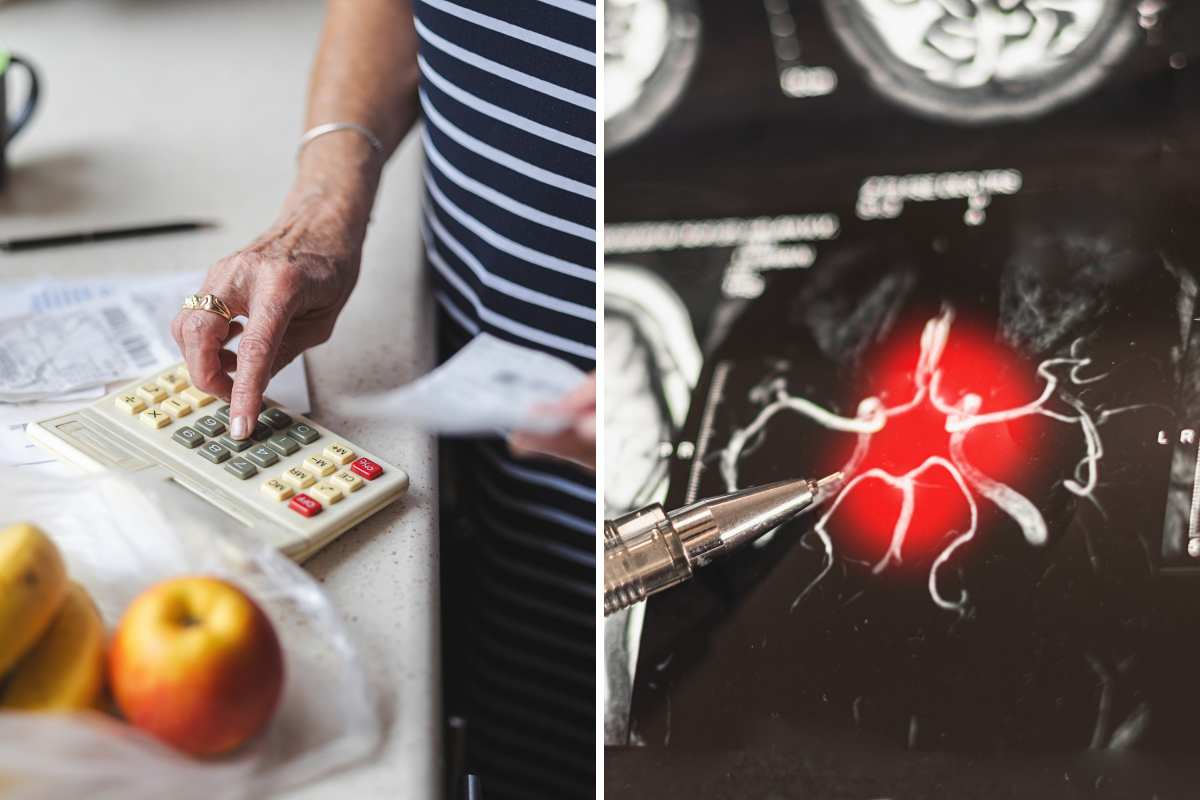
To truly humanize this data, we must move beyond percentages and odds ratios and consider the individuals living behind these numbers. Imagine a retired teacher, her hands gnarled with arthritis, standing in a grocery store aisle, carefully calculating the cost of a can of soup versus a loaf of bread. She skips the fresh fruit because it goes bad too quickly, settling for cheaper, heavily processed items that are high in sodium and low in the nutrients the aging brain desperately needs. The stress of this calculation doesn’t end at the checkout counter; it follows her home, circling her thoughts, raising her cortisol, keeping her awake at night. Now, imagine the neurons in her hippocampus, the brain’s memory center, struggling under that relentless biochemical siege. This research suggests that this daily grind of survival—this constant, gnawing insecurity—is a thief. It doesn’t just steal her shopping list; it steals the recipes her mother taught her, the smallest memories of her grandchildren’s first laughs, the knowledge of where she is supposed to be in an hour. Food is not just fuel; it is a medium for connection, for love, for routine. When we treat food as a luxury rather than a fundamental right for our elders, we are effectively dimming the lights on their minds. We are betraying the very people who built our world, leaving them to navigate their final chapters without the security that fosters dignity and mental clarity.
Paragraph 6: A Societal Reckoning and the Road Ahead
This study serves as a powerful, urgent wake-up call. It reframes hunger not merely as an issue of social justice or economic disparity, but as a direct threat to the neurological vitality of our aging population. We have built a society where retirement, for many, is not a reward but a precarious cliff-edge, where pensions are replaced by dependence on fluctuating markets, and where the cost of medication and housing squeezes out the most basic human necessity: food. As we look to the future, with the nation’s demographic shifting inexorably older, we must ask ourselves a fundamental question: what kind of society do we want to build for those who raised us? The answer lies in action—in solidifying SNAP benefits, in expanding community meal programs, in teaching doctors to screen for hunger as routinely as they check blood pressure, and in destigmatizing the shame that so often prevents seniors from asking for help. The researchers’ caution about causation should not give us license to do nothing; rather, it should ignite us to act now, erring on the side of compassion. While the scientific work continues to untangle the precise biological mechanics, the moral calculus is simple: because the risk is real, the response must be swift. We cannot afford to lose another generation to the silence of an empty pantry. We owe our elders a future where the golden years are truly golden—filled with the comfort of reliable meals, the warmth of shared stories, and the beautiful, irreplaceable clarity of a mind that is well-nourished, secure, and fully alive.