


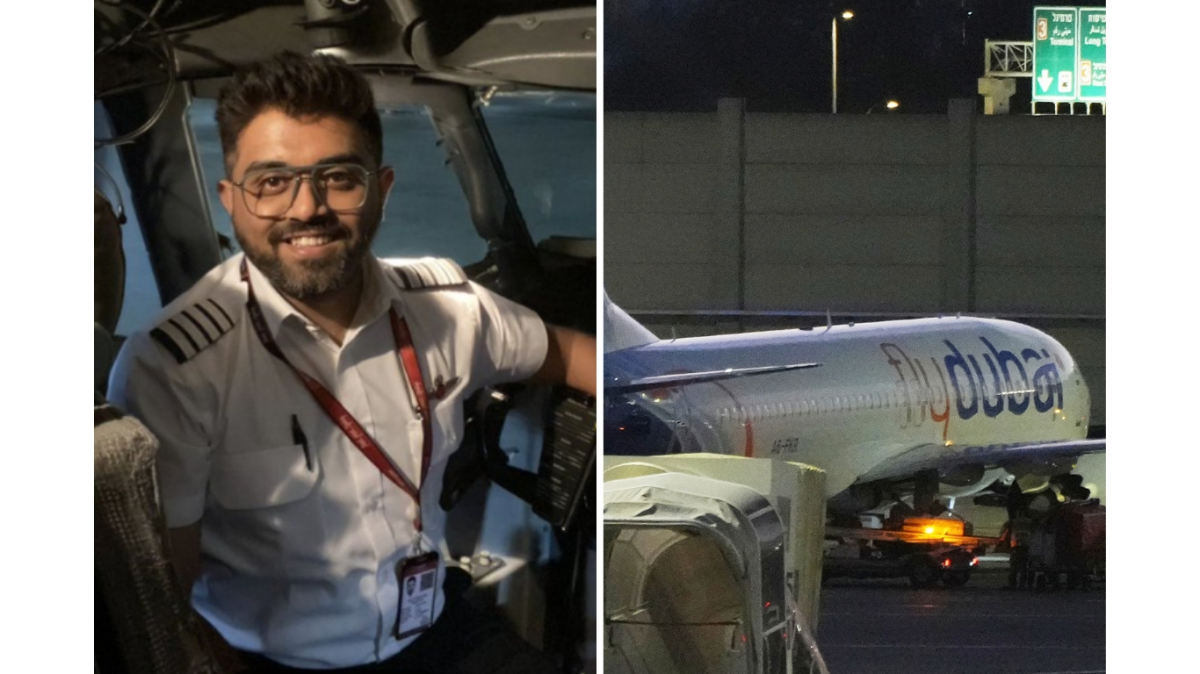
It began as an ordinary flight, the kind of routine journey that millions of passengers board every day without a second thought. But on Wednesday, a FlyDubai aircraft bound for Tel Aviv became the scene of a nightmare when, according to investigators, the co-pilot attacked the captain and tried to send the plane crashing down. The captain, Smit Machchhar, was stabbed during the struggle, and the aircraft reportedly plunged into a dive before passengers and fellow aviation professionals on board intervened, helping to regain control and guide the plane to a safe landing in Saudi Arabia. What makes the episode even more disturbing is the emerging backstory: national and international investigators are now examining how the Omani co-pilot, who had reportedly been identified as a potential security risk a year earlier, was still able to continue working in aviation, move to another airline, and eventually take his place in the cockpit of a passenger jet headed for Israel. The incident has sent shockwaves through the aviation world, not only because of how close it came to catastrophe, but because it raises uncomfortable questions about whether the systems designed to protect air travel from insider threats have serious holes.
The co-pilot’s history, as reported by ABC News and The Wall Street Journal, is deeply troubling. While training with Oman Air in 2024, the Omani national was allegedly found in possession of extremist materials. According to ABC News, which cited senior intelligence and law enforcement officials, he was suspended from flying. But the suspension did not end his career. He was reportedly permitted to continue working in an administrative role at the airline, and investigators are now trying to understand how he later made his way to FlyDubai, where he eventually became a first officer on a flight to Tel Aviv. The Wall Street Journal, citing people familiar with the matter, separately reported that the pilot had previously been banned from flying by Oman because of concerns that he had adopted radical ideological views. What remains unclear, and what investigators are desperate to determine, is whether those concerns were ever shared with foreign airlines or governments before the man was hired by FlyDubai. If they were not, the case could represent a catastrophic failure in communication between national authorities and the international aviation industry. If they were, the questions become even more uncomfortable: why would an airline place a pilot with such a background in a safety-critical role on a route to Israel?
The details of what happened in the cockpit are still emerging, and authorities have been careful not to release everything they know. Israeli Prime Minister Benjamin Netanyahu said Friday that the suspect had undergone “Islamist radicalization” and that he came to crash the plane. Netanyahu also said authorities were investigating whether the pilot acted alone or with assistance. ABC News reported that the suspect had allegedly indicated he intended to crash the aircraft in Israel, though no public evidence has yet been released to support that assertion. Both FlyDubai and Oman Air have declined to publicly confirm any allegations regarding the co-pilot’s prior security status. FlyDubai said Friday that it had temporarily suspended operations to Tel Aviv at the request of authorities and that a full investigation was underway. For the families of the passengers who were on board, and for the captain who was attacked while doing his job, the wait for answers must feel agonizing. For the broader public, the episode is a reminder that the safety of commercial aviation depends on an invisible network of background checks, medical reviews, and ongoing monitoring—and that when one part of that network fails, the consequences can be catastrophic.
Security concerns involving pilots are among the most serious issues that airlines and regulators can face. Commercial pilots are normally subjected to extensive background screening, medical evaluations, recurrent training, and continuous monitoring throughout their careers. Depending on the country, concerns about violent extremism, terrorism-related activity, radicalization, or threats of violence can lead to suspension from flight duties, revocation of certifications, or other restrictions. Cases involving pilots accused of extremist beliefs or intentions are relatively uncommon when compared with routine disciplinary, medical, or performance-related issues. But aviation security experts often regard insider threats as especially dangerous because pilots and crew members already have authorized access to secure areas and aircraft systems. They are inside the fortress, so to speak, with the keys in their hands. The thought that someone in such a position could harbor a hidden intent to harm passengers is unsettling, and it explains why the investigation into this incident is being treated with such urgency. The co-pilot’s alleged actions, if confirmed, would represent a betrayal not just of his airline, but of the trust that passengers place in every person who works in the aviation industry.
As investigators piece together the timeline, one key question is likely to dominate their work: were warning signs missed, or was information simply not shared between organizations? According to The Wall Street Journal, it is not known whether any concerns identified by Omani authorities were communicated to foreign airlines or regulators. That is a crucial detail. Aviation is a global industry, and pilots frequently move between airlines and countries. A security flag in one country may mean nothing in another if there is no mechanism for sharing that information. Investigators are also examining how the pilot progressed from a reportedly restricted status at one carrier to an operational flying role at another. Was there a gap in his employment history that should have prompted more questions? Did FlyDubai request records from Oman Air, and if so, what was provided? Did the pilot himself disclose his previous suspension when applying for his new position? The case may also prompt broader questions about how airlines evaluate employees over time. Initial background checks are only one component of aviation security. Many experts emphasize the importance of ongoing assessments and information-sharing mechanisms when credible concerns emerge. A person can pass a background check and later become radicalized. A person can show warning signs and then appear to settle down, only to become a danger years later. Without continuous evaluation and a reliable system for communicating red flags across national borders, the industry is left hoping that every potential threat will be caught in time.
For now, authorities in the United Arab Emirates, Israel, and other countries are continuing their investigations, and many of the central questions remain unanswered. How did the pilot move from a reportedly restricted status at one airline to a cockpit role at another? Why were concerns about his ideological views, if they existed, not enough to keep him out of the air permanently? And what can be done to ensure that no other airline ever unknowingly places a similar threat in the captain’s seat? This incident has also highlighted the extraordinary bravery of the people on board the flight—the passengers and aviation professionals who rushed to help regain control of the aircraft when the captain was attacked. Their actions likely saved the lives of everyone on board, and their courage deserves recognition. But their heroism should not be the only takeaway. The story of this flight is also a warning. It shows that the systems meant to protect air travel are only as strong as the information they are built on, and that trust, while essential, must be earned through vigilance. As the world waits for the investigation to conclude, the families of the passengers, the crew, and the flying public can only hope that the lessons learned from this close call will lead to real change—so that the next time a warning sign appears, it is not ignored, not lost in the gaps between countries and companies, but acted on before it is too late.