





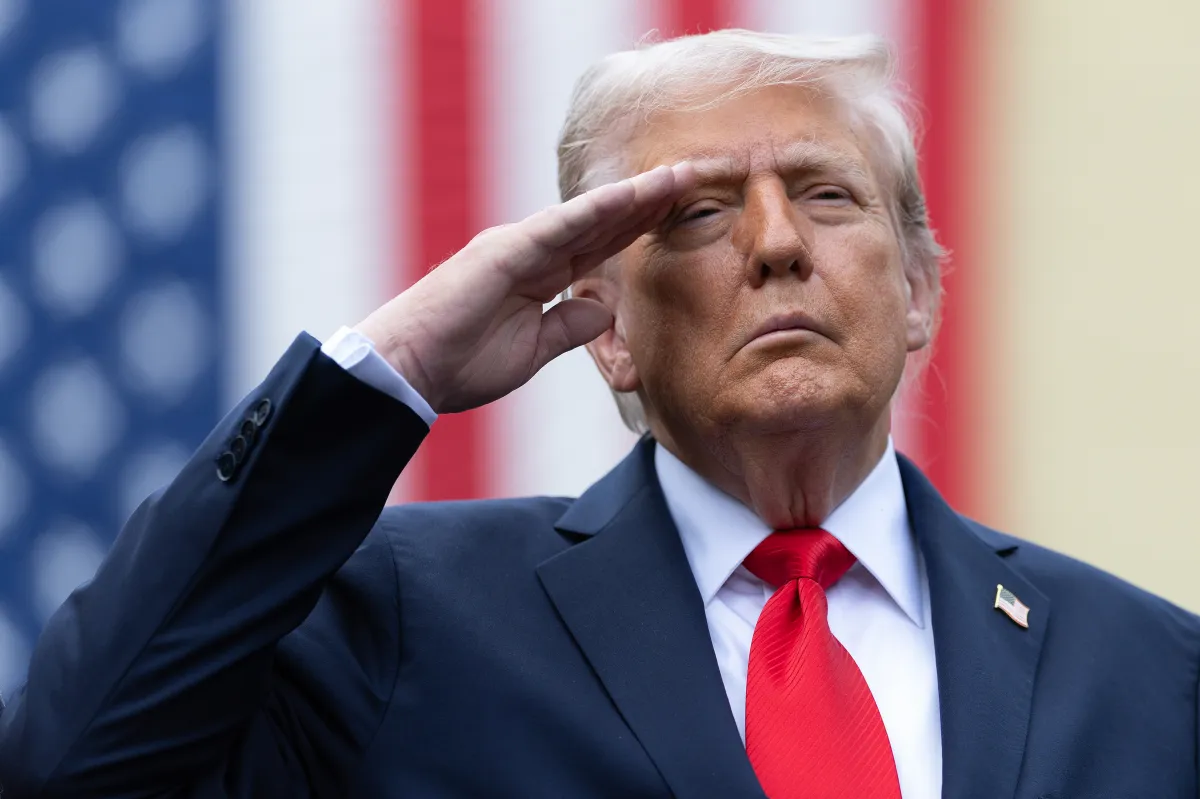
A quarter of a century has passed since the morning that forever carved itself into the American soul, and the nation once again finds itself standing at the threshold of remembrance. The September 11 attacks took nearly 3,000 lives, and for the families who lost mothers, fathers, children, and friends, the ache has not faded with time; it has only changed shape. On this anniversary, President Donald Trump stood at the Pentagon to honor those who died, his voice carrying the weight of a ritual that has become both sacred and familiar. He described the attacks as a confrontation with “pure evil,” and he spoke of the savage monsters who struck at the very symbols of civilization. Yet in the same breath, he celebrated the resilience that emerged from the smoke and wreckage—the Americans in Virginia, in New York, and in the skies over Pennsylvania who did not hesitate, who stood their ground, and who showed the world that the flag would never fail. His words were forceful, even defiant, concluding with a warning to any potential attacker that America would hunt down its enemies, crush them without mercy, and triumph without question. For many who listened, it was exactly what they needed to hear, a confirmation that the country had not forgotten, that the dead had not died in vain. But for others, the day was more complicated, because this anniversary also drew attention to Trump’s long and tangled history with the memory of 9/11—a history filled with solemn tributes, vivid personal recollections, and claims that have raised questions over the years.
The lead-up to the 25th anniversary was not without its own quiet controversy. Trump had been expected, by some reports, to attend the Pentagon ceremony rather than the commemoration at Ground Zero, and the suggestion was that he had made that choice because officials would not allow him to speak at the New York site. That report was immediately disputed by Trump himself, who took to Truth Social to push back with characteristic force. He insisted that he had been to New York many times over the years, and that no one ever speaks at the solemn ceremony. He almost seemed to welcome the silence, saying he would love not to speak, because he speaks all the time, and because this day belongs to the victims and their beautiful family members. There was something almost tender in that statement, a rare acknowledgment that some moments are too fragile for politics and speeches. Yet the very need to clarify his presence, to explain why he was where he was, revealed how much of the 9/11 commemoration has become entangled in perception and political symbolism. Even before the ceremony, Trump had spoken at a Steel Across America event near the White House, where he once again invoked the nearly three thousand precious souls stolen from the nation, and reaffirmed the sacred vow made a quarter of a century ago: we will never forget. But in those same remarks, he also told a story about the aftermath of the attacks, a story that would soon become the subject of intense scrutiny.
That story was about being in Lower Manhattan after the towers fell, and about the rescue workers he said he brought with him. Trump said he was building a big building in New York, and that he took his whole crew down to the site right after the attack. He then described an incident near the building now known as One Liberty Plaza, where two firefighters allegedly grabbed him under the arms and lifted him, running with him because they feared the structure was about to collapse. He remembered telling them he could run himself, but they kept going, carrying him like a child, because they thought it was coming down. The image was vivid, almost cinematic, and it seemed designed to place him not at the margins of the tragedy but at its very center, as someone who was so close to the danger that even firefighters had to save him. Yet within hours, Trump was forced to clarify his account in response to questions from the media. He said he was “obviously not” at the World Trade Center on the day the towers collapsed, but insisted that he went there shortly afterward with a large group of construction workers. He added that everything he said was exactly accurate. The clarification did not settle the matter in the minds of many, but it offered a revealing glimpse into the way Trump processes history—not as something remote, but as a personal drama in which he is always present, always involved, always part of the story.
On the day of the attacks, Trump had watched from his home in Trump Tower on Fifth Avenue, a vantage point that gave him a front-row seat to history. He told Howard Stern in 2002 that he had two windows focused on the World Trade Center, and that he saw the whole thing. Years later, during a campaign stop in Columbus, Ohio, he described in haunting detail what he witnessed: the beauty of downtown Manhattan framed by his apartment window, the second plane coming in, and people jumping from the burning towers. It was a grave and troubling memory, and he spoke about it with a kind of solemnity that seemed to surprise even his audience. But his very first public comments about the attacks were made hours after the hijacked planes hit, in a live phone interview with the local television station WWOR. At that moment, with the smoke still rising from Lower Manhattan, Trump was asked what he would have done if he had been president. His answer was simple: he would be taking a very, very tough line. He said the perpetrators could not be tolerated, and that this just couldn’t be allowed to happen. It was also in that interview that he mentioned his own building at 40 Wall Street, noting that it had been the second-tallest building in downtown Manhattan before the World Trade Center, and that now it was the tallest again. To some, that comment seemed tone-deaf, an attempt to promote his own interests while the city was bleeding. But Alan Marcus, who worked for WWOR that day and later became a consultant and friend of Trump, offered a more charitable interpretation. He said it was simply “Donald being Donald,” the brand manager of Trump touting his brand reflexively, even on that day. It was a human moment, in a way, a reminder that we all bring our habits and instincts into even the darkest hours.
Two days after the attacks, Trump was seen at Ground Zero, and a Washington Post reporter captured an image of him stepping into the plaza with every hair in place, impeccably dressed in a black suit and pressed white shirt, holding a cellular phone to his ear. The contrast between his polished appearance and the surrounding devastation was striking, and it seemed to capture something about the strange intersection of celebrity, wealth, and national tragedy. In an interview with a German television station on the outskirts of the site, Trump spoke with uncharacteristic humility, saying he had never seen anything like it—the devastation, the human life wasted for no reason whatsoever. He called it a terrible scene and a terrible sight, but he also insisted that New Yorkers were strong and resilient and would rebuild quickly. He then went further, claiming that he had hired a couple of hundred workers to help with the rescue efforts, and that his teams would be involved in some form in helping to reconstruct the city. He made similar comments to NBC News that same day. But investigations have not found evidence to independently support those claims, and no proof has emerged that he helped clear rubble from the site. Still, Trump has continued to repeat the story over the years, weaving himself into the narrative of recovery and heroism. At a campaign event in Buffalo in 2016, he described standing at the site, watching the workers clear the rubble and try to find additional lives, and he claimed that he helped a little bit. The phrase “I helped a little bit” was both modest and ambiguous, allowing him to be part of the story without needing to prove anything. For some, it was an endearing attempt to share in the collective grief and resolution; for others, it was an appropriation of a tragedy that belonged to the first responders and the families of the dead.
In the years that followed, 9/11 became a recurring theme in Trump’s political life, and he used it in ways that were both unifying and divisive. During the 2016 Republican primary, when Senator Ted Cruz attacked “New York values,” Trump responded with a defense of the city that was rooted in the memory of the attacks. He spoke of the smell that lingered for months, of the way the whole world loved New Yorkers, and he turned Cruz’s insult into a moment of emotional solidarity with the victims and their families. But he also blamed former President George W. Bush for the attacks, telling Jeb Bush that the World Trade Center came down during his brother’s reign, and suggesting that he would have been tougher on terrorism, that Osama bin Laden would have been caught long ago if he had been president. Perhaps the most controversial moment came during a rally in Alabama, when Trump claimed that he watched thousands and thousands of Muslims cheering as the World Trade Center came tumbling down, some of them in Jersey City, New Jersey. That claim was widely disputed and never substantiated, but it tapped into a deep well of fear and anger that was already present in the post-9/11 political landscape. Trump also had a history of more awkward, even careless references to the day—like a 2013 tweet in which he extended his best wishes to all, “even the haters and losers,” on the special date of September 11th. The tweet was deleted, but it remained part of the record, a reminder that even those who are most associated with 9/11 remembrance can struggle to find the right words. Twenty-five years later, the anniversary is not just a moment of grief; it is also a mirror reflecting how memory, politics, and personality have shaped the way we honor the dead and tell the story of that terrible Tuesday morning. For Trump, as for the nation, the day remains an open wound, a source of resolve, and a story that continues to be told, retold, and argued over, because some days are too important to let go, and too complicated to ever fully settle.