





Something significant is happening in American energy, and it’s not confined to corporate boardrooms, university labs, or the usual policy circles in Washington. It’s happening on a military installation in southern Indiana. This week, the Defense Department announced that Naval Weapons Station Crane will host the Navy’s first advanced nuclear microreactor, with a target deployment date of September 2028. The reactor is compact by design, but it is expected to deliver something enormous: reliable, always-available electricity to an installation that plays a vital role in military research, testing, and weapons support. The thinking behind the project is both simple and urgent—protect essential operations by generating power on site, independent of the commercial electric grid that can be disrupted by storms, cyberattacks, physical attacks, or simply the strain of growing demand. In Pentagon language, this is about energy resilience. But it is also part of a much larger story. The Indiana microreactor is not an isolated experiment. It is the latest and perhaps most visible sign that nuclear power is experiencing a genuine revival in the United States, a revival that reaches from the windy plains of Wyoming to the industrial corridors of Texas and from the national laboratories of Idaho to the old nuclear plants of the Midwest. After decades of stalled construction, bitter public battles, and financial disappointments, nuclear energy is being invited back into the national conversation—not just as a carbon-free power source, but as a strategic asset for national security, economic competitiveness, and grid reliability. And this time, the military is helping lead the way.
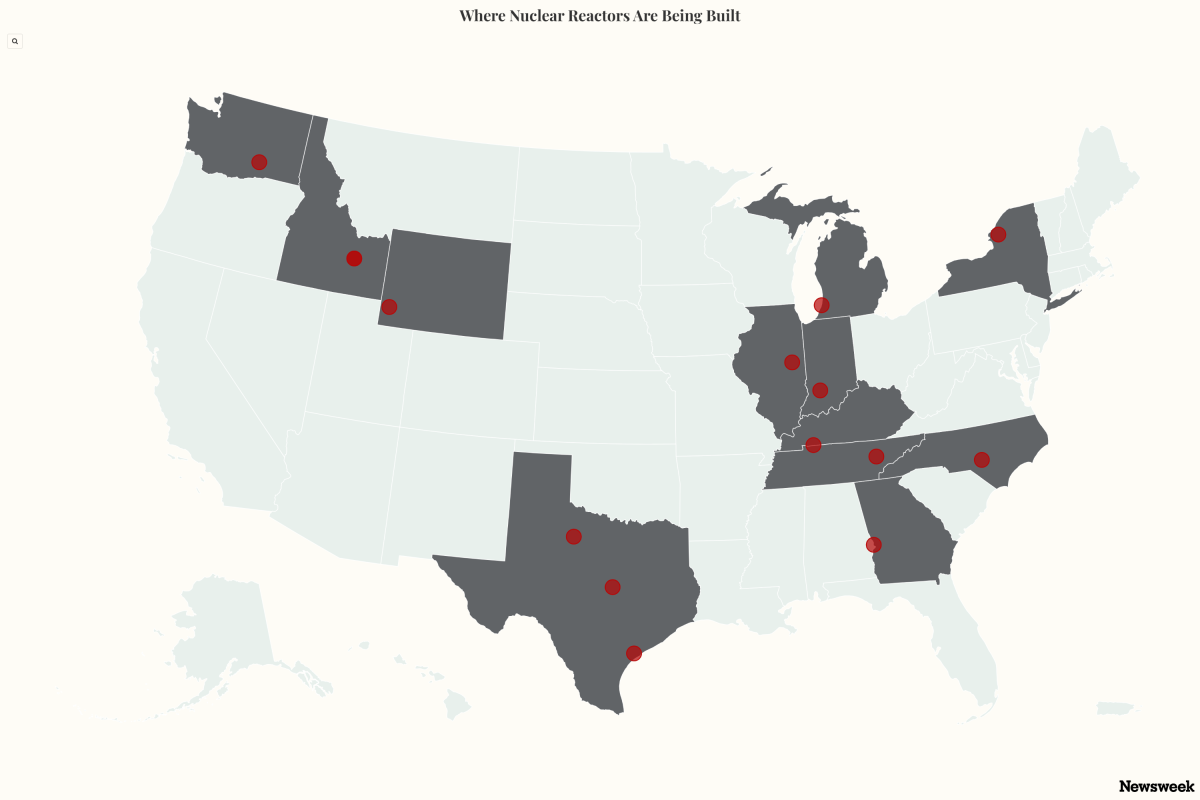
The announcement from the Pentagon was framed in unmistakably ambitious terms. Officials said the project would help “unleash the American nuclear industrial base” and give military installations the kind of independent, resilient power that modern operations require. But Crane is only one piece of a rapidly expanding national mosaic. Across the country, a wave of advanced nuclear projects is moving forward at different stages of development. In Wyoming, TerraPower is pushing ahead with the Natrium reactor, a next-generation design intended to be safer and more flexible than traditional plants. In Tennessee, Kairos is testing its Hermes reactor, another advanced design that uses molten salt cooling. In Washington State and Texas, X-energy is developing its Xe-100 reactor, a small modular unit that can be built in factories and assembled on site. In Michigan, the Palisades nuclear plant is being revived, an effort to restart an existing facility rather than build from scratch. In Illinois, the KRONOS microreactor project is in the works, and at Idaho National Laboratory, both Oklo’s Aurora and the Department of Defense’s Project Pele are taking shape. The Army, meanwhile, has its own program, known as Project Janus, which aims to place microreactors at installations including Fort Bragg, Fort Campbell, Fort Hood, Fort Benning, and Fort Drum. All of these efforts are being watched closely by experts at the Center for Strategic and International Studies, which maintains a public dashboard tracking nuclear deployment across the country. Interestingly, the Indiana microreactor is so new that it does not yet appear on that dashboard—but CSIS officials say it will be added soon. That small detail says a lot: the pace of announced projects is now moving faster than the organizations that track them.
To understand why this moment matters, it helps to remember how far nuclear power fell. For decades, new reactors in the United States were rare, expensive, and politically difficult. Three major accidents—Three Mile Island in 1979, Chernobyl in 1986, and Fukushima in 2011—left deep scars on public confidence. Utilities that once planned fleets of reactors quietly canceled them. Construction costs ballooned, timelines stretched, and the industry seemed to be shrinking into a relic of the atomic age. But the energy world has changed. Climate change has made the need for low-carbon electricity more urgent than ever. Electricity demand is surging due to data centers, electric vehicles, manufacturing reshoring, artificial intelligence, and the broader electrification of the economy. Solar and wind power have grown dramatically, but they are not always available when needed; the sun sets, the wind stops blowing. Batteries help, but they are still limited and expensive for long-duration needs. Nuclear energy offers something that few other clean sources can: a steady, concentrated, around-the-clock supply of electricity that is almost carbon-free. Advanced reactors and small modular reactors, known as SMRs, are designed to address many of the old problems. They are smaller, factory-built, and in some cases can be deployed more quickly. They use passive safety systems, meaning they can shut down safely without human intervention or external power. They can be placed closer to where energy is needed, including remote military bases or industrial sites. That is why utilities, technology companies, and defense planners are all looking at nuclear again. It is not a nostalgic return to the past; it is a forward-looking response to the pressures of the present.
Policy has followed necessity. In May 2025, President Trump signed a series of executive orders designed to accelerate nuclear reactor construction, streamline licensing, strengthen domestic fuel production, and expand American generating capacity. The orders signaled a clear federal commitment to making nuclear energy a pillar of the country’s energy strategy. But the military has its own reasons for embracing this technology, and they go beyond climate policy. The Department of Defense is one of the largest energy consumers in the world. Its installations need power for critical missions, communications, training, and weapons systems. Yet many bases depend on the commercial grid, which is increasingly vulnerable to extreme weather, cyberattacks, and potential adversaries. A microreactor on site provides a measure of energy independence that can keep operations running even when the grid cannot. For Naval Weapons Station Crane, the reactor is intended to serve exactly that purpose: reliable power independent of the outside system, protecting critical defense operations from interruption. The Army’s Project Janus reflects the same logic, with planned microreactor deployments at bases across the country. These are not small symbolic gestures. They are practical investments in resilience, designed to ensure that military capabilities do not depend on fragile civilian infrastructure. They also create a market for advanced nuclear technology, which can help drive down costs and accelerate commercialization for civilian use. In that sense, the military is not just a customer; it is a catalyst for an entire industry.
Despite the enthusiasm, nuclear energy still faces serious opposition, and it would be dishonest to pretend otherwise. Many Americans remain worried about radioactive waste, which can remain dangerous for thousands of years and still has no permanent disposal site in the United States. They worry about the possibility of accidents, even if newer designs are safer. They worry about security risks, both in terms of terrorism and the spread of nuclear materials. And they worry about cost. The history of nuclear power in America is full of projects that ran years behind schedule and billions over budget. The same problems could plague the current wave of advanced reactors. Critics point out that many of the designs are unproven, that the supply chain for specialized fuel and components is still immature, and that regulatory hurdles remain significant. Supporters respond that advanced reactors are fundamentally different from their predecessors: they are smaller, simpler, safer, and designed for mass production. They argue that the cost problems of the past came from building enormous custom plants, not from nuclear technology itself. Public opinion may be shifting in subtle ways. A June 2026 survey by Echelon Insights found that voters opposed building an AI data center in their community by a wide margin—62 percent to 27 percent. In the same poll, more respondents said they would support building a nuclear power plant in their community than an AI data center, with nuclear attracting 34 percent support compared to 27 percent for data centers. That is not a ringing endorsement of nuclear power, but it is a telling sign: in a world of booming electricity demand, people may be more willing to accept nuclear facilities than they are to accept the infrastructure of the digital age that demands so much power.
So what happens next? The honest answer is that no one knows for certain which of these projects will succeed. Some will face local opposition, financing problems, licensing delays, or technical setbacks. The road from announcement to operation is long, and in nuclear power it is rarely smooth. But the sheer number of reactors now being planned, licensed, built, or demonstrated marks a dramatic reversal from the decades-long slowdown that followed America’s last great wave of nuclear construction. The Indiana microreactor is a small piece of that larger shift, but it may turn out to be an important one. It brings together two powerful forces: the military’s need for resilience and the country’s need for clean, reliable power. It also reflects a broader recognition that energy is national security, that economic growth depends on electricity, and that the tools we use to keep the lights on must evolve. Nuclear power may not be a perfect answer, and it certainly is not the only one. But after years of being written off as too dangerous, too expensive, and too difficult, it is coming back—one project, one base, one reactor at a time. Whether the promise lives up to the hype will depend on execution, innovation, and public trust. But the direction is clear. Nuclear energy is once again becoming part of America’s plans for the future, and the announcement in Indiana is a reminder that sometimes revolutions start quietly, in unexpected places.