





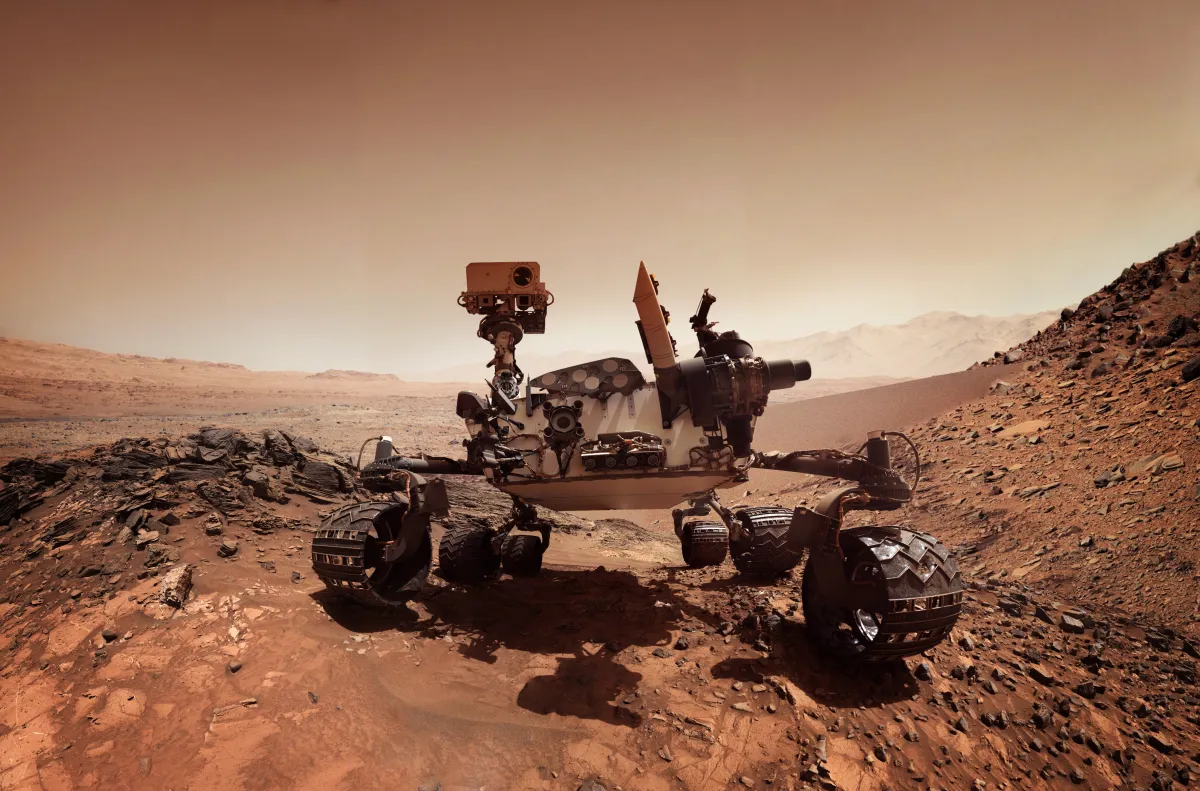
Imagine opening a small metal tube on Earth and holding a piece of another planet in your hand—a piece that might prove we are not alone in the universe. That is the tantalizing possibility NASA is currently facing, yet the actual retrieval of that evidence remains one of the hardest problems in space exploration. In July 2024, NASA’s Perseverance rover, which landed on Mars in 2021, discovered a strange, arrow-shaped rock in an ancient dry riverbed inside the 28-mile-wide Jezero Crater. The rock, nicknamed Cheyava Falls, was found in a region known as Bright Angel, along the edge of an old river channel called Neretva Vallis where water flowed more than 3.5 billion years ago. When NASA announced the discovery in September of that year, the agency’s then-acting administrator, Sean Duffy, called it “the closest we have ever come to discovering life on Mars.” The rover had detected intriguing chemical and mineral patterns, organic material, and small features that resemble textures created by microbial life on Earth. It was not proof, but it was a whisper—a possible sign that something once lived on the Red Planet. For scientists, the only way to find out for sure is to bring that rock home. But that mission, known as Mars Sample Return, is currently in limbo. In January, Congress cut broad federal funding, and the joint NASA-European Space Agency campaign was shelved. Today, NASA’s website describes sample return as a “future mission” with no firm dates, despite the fact that the space agency had already spent billions of dollars planning it. So the rock that could rewrite history is sitting on another planet, waiting, while we argue over budgets and priorities.
What exactly did Perseverance see that got scientists so excited? Dr. Lindsay Hays, NASA’s senior scientist for Mars Exploration, was part of the team that presented the discovery. In a recent interview, she tried to explain what made Cheyava Falls stand out from the rocky terrain around it. The rover identified “textures” in the rock—visible features, layered patterns, and chemical clues that are hard to describe without falling into geological jargon. There were also mineral characteristics and organic signatures that caught the team’s attention. On their own, none of these observations would be definitive. But taken together, at the tiny scale that a rover can measure, they looked exactly like the kind of chemical fingerprints that microbial life might leave behind when it eats minerals and turns them into energy. Hays put it more simply: the evidence suggests that “something was there and ate there.” The rock is made of clay and silt, sedimentary materials that, on Earth, are excellent at preserving traces of ancient life. It also contains organic carbon, sulfur, oxidized iron, and phosphorus—ingredients that form the basic building blocks known to support microbiology. If Earth is any guide, these are the sorts of rocks that would hold fossils of tiny organisms, if fossils could be found. But Mars is a different world, with a different history, and the chemistry could also be explained by natural processes that have nothing to do with biology. There is simply no way to know from photographs and rover instruments alone. That is why scientists are so desperate to get these samples into laboratories on Earth, where they can be sliced, scanned, and analyzed molecule by molecule. As Hays acknowledged, there is absolutely a chance that when the broader scientific community studies the samples, other explanations will emerge that better fit the data—explanations that do not require life. That is the nature of science, and that is why this is so exciting.
But the value of returning Martian rocks goes far beyond the question of ancient biology. Hays says the samples would help researchers understand the age of the Red Planet in a much richer way. Currently, scientists estimate the timing of Martian geological events by counting craters and observing which rocks sit above others. That is a bit like knowing that one page of a book came before another, without being able to tell the actual date. With a sample safely in a lab, scientists could perform what is called absolute dating, measuring the precise age of a rock and then using that anchor to sort out the entire timeline of Martian history. This would give scientists a more accurate picture of when volcanoes erupted, when rivers flowed, and when the climate changed. The samples could also solve a practical, urgent problem for future human explorers: dust. Mars is covered in fine, powdery dust that gets everywhere. It ruined solar panels on the Insight lander, it sticks to spacesuits, and it can damage both machinery and human lungs. Hays pointed out that the dust at Jezero Crater is remarkably similar to the dust at Gale Crater, which Curiosity has explored since 2012. That discovery goes all the way back to the Viking landers of 1976, which showed that dust from two very different locations on Mars looked nearly identical under microscopic analysis. But the exact composition and size distribution of that dust remains a mystery when studied from a distance. In a lab on Earth, researchers could answer those questions. They could figure out what compounds are in the dust, how sharp or reactive the grains are, and how dangerous they might be for astronauts who spend months or years on the surface. None of that can be accomplished with robotic instruments alone. As Hays said, “We can’t really do that remotely.”
The problem is money. Mars Sample Return has been described as one of the most scientifically desirable and technically challenging missions ever planned. Chris Impey, an astronomy professor at the University of Arizona, explained that Congress balked after independent reviews estimated the total cost would exceed eleven billion dollars and that samples might not return before 2040. The biggest hurdle is not collecting the samples; it is launching them off Mars. “No one has ever launched a rocket from the surface of another planet,” Impey noted. That requires building a lightweight rocket that can survive on another world, ignite perfectly, and meet an orbiter in Martian orbit—a complex choreography that has never been attempted. The technical requirements are steep, and the bill is staggering. Impey suggests that NASA could still achieve the science by scaling back the mission. Perseverance has already collected 33 sample tubes, each containing about ten grams of rock. But returning every single tube is expensive. A smaller capsule, carrying just a few of the most promising samples, could dramatically reduce the cost. “Leaving 150 grams behind could save billions of dollars,” he said. Even so, losing the mission altogether would be a devastating waste. Every sample collected by Perseverance represents years of careful exploration and scientific investigation of the Jezero Crater region. As Impey put it, rovers alone can never return the same amount of science that lab analysis on Earth can. A rover can tell you that a rock is interesting; a laboratory can tell you what it is made of, where it came from, and whether it contains the faint chemical remnants of life. NASA’s budget has already felt the pain. The agency spent 2.5 billion dollars on sample return before the program was shelved, according to spokeswoman Alana Johnson. She added that the agency is trying to apply the lessons learned from the project to new missions, including SkyFall, a planned 2028 mission that would send three helicopters to explore Mars from the air. But that is cold comfort to the scientists who know that the answer to one of humanity’s oldest questions is waiting in a sample tube just a few feet away from an idling rover.
For Dr. Hays, the dream is still alive. She told Newsweek that NASA remains “agnostic” about exactly how Perseverance’s samples will be returned, but the importance of the samples to the global scientific community remains front and center. She said she is “hopeful” the agency will find a way. Derrick Pitts, the chief astronomer at Philadelphia’s Franklin Institute, is less optimistic about the current political path. He believes the mission will eventually happen, but only after the debate over funding shifts. “Greenlight the funding, rebuild an engineering team, design, build, test a system, fly it out there, retrieve the samples, return to Earth, collect successfully,” he said. “That’s if the current administration does an immediate about-face. Not likely.” Pitts points to the role of politics in NASA’s difficulties. It is not that the agency lacks money in a national sense, he argues; it is that partisan fights over spending priorities have hobbled one of the most ambitious scientific projects in history. He suggests that NASA could partner with commercial companies such as SpaceX or Blue Origin, which are developing their own heavy-lift rockets and spacecraft without the same political baggage. A private partnership might be able to do what NASA cannot, especially as a stepping stone to a human mission to Mars. For Pitts, the cost of curiosity is exactly what we should be willing to pay. “Knowledge is priceless,” he said. “We can do anything we want to regardless of price. It’s always just a question of what we value. Not going through with MSR just tells you what our values are.” His words carry an uncomfortable sting, especially when other nations are racing to achieve what the United States and Europe have put on hold.
China has already announced plans to complete the world’s first Mars sample return mission. Its Tianwen-3 spacecraft is scheduled to launch in 2028, collect roughly 500 grams of Martian material, and return to Earth by 2031. The mission’s chief scientist, Zengqian Hou, told reporters at an international conference in Hefei that “ample evidence” shows early Mars had liquid water, a denser atmosphere, and a global magnetic field—the conditions needed for a habitable environment. That is why Tianwen-3 will make the search for signs of past life its primary objective. “Through detailed analysis of returned samples, scientists hope to find reliable biosignatures,” Hou said. The Chinese mission is ambitious, and it may fail, but its existence is a powerful reminder that space exploration is not just a matter of budget spreadsheets. It is an expression of human curiosity, a way of asking who we are and whether we are alone. The Jezero Crater samples are already inside their tubes, sealed like messages in bottles left on a distant shore. They contain the record of a world that was not always a frozen desert. They might contain answers to questions people have been asking for centuries. The story of Mars Sample Return is not over; it is still being written. It will take political will, international cooperation, and a boldness to risk failure. But if humanity can find the courage to go get those rocks, we may finally discover that the darkness above us is not so empty after all. The Red Planet, so silent and dry, may turn out to have a story that includes breath, water, and life—and that story is waiting just beyond our reach.