





In the high-stakes, pressure-cooker environment of the modern National Football League, there is an enduring and almost sacred philosophy held in the city of Philadelphia: football games are fundamentally won and lost in the cold, unforgiving trenches of the line of scrimmage. For years, the Philadelphia Eagles have built their competitive identity around a relentless, suffocating defensive front that terrorizes opposing quarterbacks and halts running backs completely in their tracks, asserting absolute physical dominance over anyone who dares to cross their path. However, this off-season presented a profound existential challenge to that very identity when the franchise experienced a devastating mass exodus of defensive talent. The most glaring wound came with the departure of former first-round draft pick Jaelan Phillips in free agency, a disruptive force whose exit left an immediate and gaping vacuum on the edge of the defensive line. Compounding this loss was the departure of longtime locker room anchor and fan-favorite Brandon Graham, whose legendary locker room leadership had defined the culture of the franchise for over a decade, alongside energetic linebacker Nakobe Dean. Together, this departed trio represented a massive chunk of Philadelphia’s defensive production from the previous season, leaving behind a statistical black hole that included 67 quarterback pressures, 49 hurries, nine critical quarterback hits, and nine sacks. For a team that had finished a somewhat disappointing twelfth in the league with 42 total sacks, losing such foundational pieces felt like a recipe for a disastrous defensive decline that could derail their championship aspirations. The front office, led by a characteristically aggressive management team, recognized that they could not afford to sit idly by while their chief rivals in the NFC East fortified their rosters. They understood that to maintain their status as legitimate Super Bowl contenders, they needed to execute a swift, decisive, and highly strategic overhaul of their pass-rush unit, transforming a moment of vulnerability into an opportunity to build a much younger, significantly faster, and more versatile defensive monster that could consistently dominate their opponents.
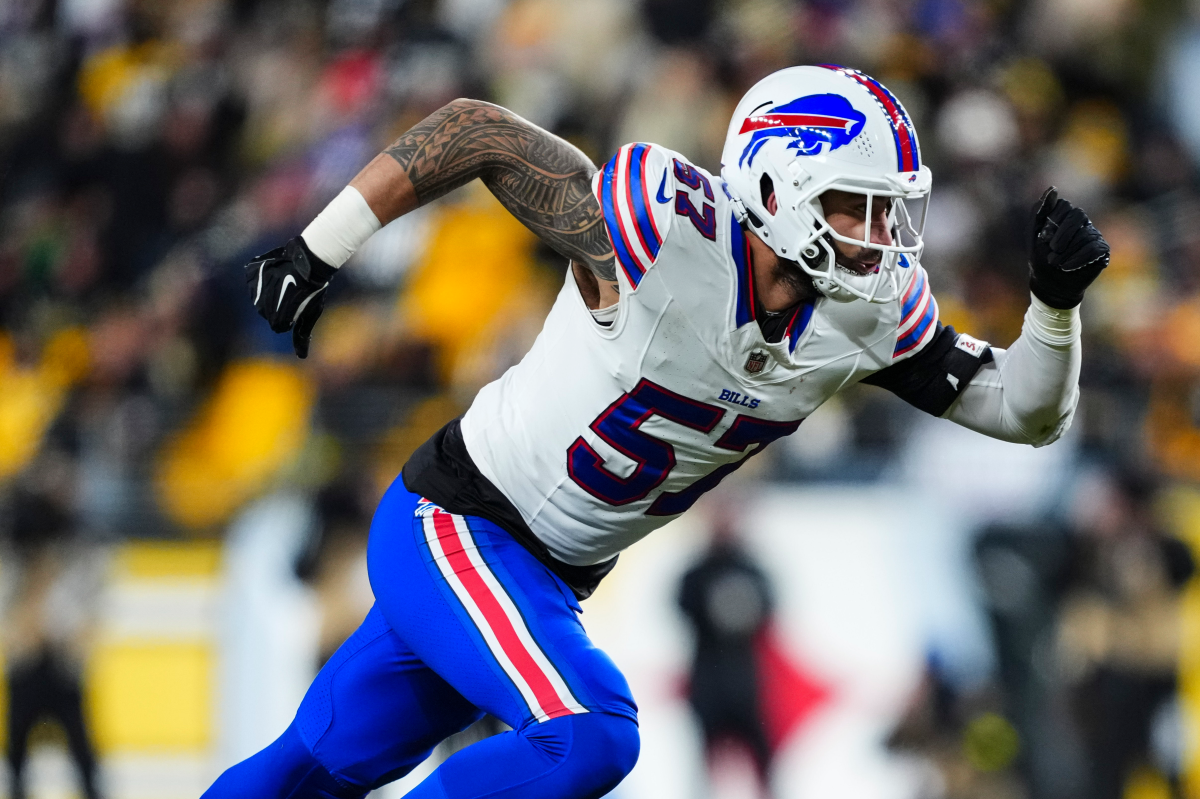
Enter A.J. Epenesa, the latest and perhaps most intriguing chess piece in this massive defensive reconstruction project. The breaking news of his signing hit the sports world on a quiet Wednesday when ESPN’s premier NFL insider, Adam Schefter, took to social media to announce that the Eagles had officially signed the former Buffalo Bills defensive end. Yet, behind this straightforward transaction lies a fascinating and deeply human story of resilience, professional heartbreak, and the fickle nature of NFL contract negotiations. Epenesa, a highly touted second-round draft selection out of Iowa back in 2020, had seemingly found a new home earlier in the spring when he agreed to a lucrative one-year, five-million-dollar contract with the Cleveland Browns. For a player entering the prime of his athletic career at twenty-seven years old, the deal represented security, validation, and a clear path to showcase his skills on a rising AFC defense. However, the business of professional football can be incredibly cruel, and Epenesa’s excitement was abruptly shattered during what should have been a routine physical examination. The Browns’ medical staff flagged undisclosed concerns, prompting the Cleveland front office to abruptly back out of the agreement and leaving Epenesa in a state of professional limbo. To go from the high of signing a multi-million-dollar contract to the low of being publicly rejected due to physical concerns is a psychological hurdle that can break lesser athletes. It forced Epenesa to spend the subsequent months working in silence, rehabilitating his body, and waiting for an organization that was willing to look past the medical red flags and trust in his proven tape. When the Eagles finally called, it felt less like a simple signing and more like a hard-earned redemption story, giving a tremendously hungry, motivated defender a clean slate in a city that embraces players who fight through adversity.
The saga of Epenesa’s failed physical in Cleveland is far from an isolated incident in today’s highly reactive, hyper-vigilant NFL, where teams must balance the desire for elite talent with the immense financial risks of injury. This fragility was illustrated on an even larger scale during the very same offseason in a blockbuster scenario involving the Baltimore Ravens and the Las Vegas Raiders. The Baltimore Ravens had reportedly put together a monumental, landscape-shifting trade package, agreeing to send two highly coveted first-round draft selections to Las Vegas in exchange for their superstar edge-rusher, Maxx Crosby. It was a trade that would have sent shockwaves through the entire league and immediately shifted the balance of power in the AFC. Yet, in another dramatic twist of fate that stunned sports fanbases nationwide, the entire blockbuster transaction totally collapsed at the finish line when Crosby reportedly failed his intense, exhaustive physical examination with Baltimore’s ultra-cautious medical staff. These high-stakes medical dramas serve as a stark reminder of the fragile, human reality that underpins the entire high-stakes, multi-billion-dollar business of professional sports. Behind the glamorous headlines, the highlight reels, and the eye-popping financial figures are human bodies pushed to their absolute physical limits, functioning on the razor’s edge of structural integrity. A single lingering shoulder injury, an undetected joint issue, or an overly cautious team doctor can instantaneously alter the structural trajectory of entire franchises and individual player careers alike. For players like Crosby and Epenesa, these physical examinations are not merely bureaucratic boxes to check; they are highly stressful gatekeepers that stand between their physical sacrifices and their financial security. By bravely stepping up to sign the veteran Epenesa after his disappointing medical setback, the Philadelphia Eagles front office has not only successfully secured a highly capable defensive contributor, but they have also gambled on the raw, unyielding human drive of a proud athlete who now has absolutely everything to prove to the vocal doubters who so quickly wrote him off just a few incredibly short months prior.
To understand what Epenesa brings to Philadelphia, one must examine the remarkably consistent resume he built over his tenure with the Buffalo Bills. Drafted into a culture of defensive excellence in Buffalo, Epenesa quietly developed into one of the most reliable and versatile complementary pass-rushers in the entire league. According to detailed analytical metrics from Pro Football Focus, his tenure with the Bills yielded a highly respectable defensive portfolio: 158 total quarterback pressures, 98 hurries, 33 quarterback hits, and 24 sacks, to go along with 135 total tackles and five forced fumbles. But Epenesa’s true value extends far beyond these traditional pass-rushing statistics; he is a uniquely well-rounded defender who possesses an exceptional football IQ and a rare knack for disrupting passing lanes. This is vividly illustrated by his 21 passes defended, three fumble recoveries, and four career interceptions, one of which he dramatically returned for a defensive touchdown. At six-foot-five and nearly two hundred and seventy pounds, Epenesa possesses the physical frame and length to clog up running lanes, set a firm edge against physical rushing attacks, and use his massive wingspan to swat down passes at the line of scrimmage when he cannot quite reach the quarterback. This incredible combination of length and leverage allows him to manipulate offensive tackles, setting up counter-moves that keep blockers off-balance throughout an entire sequence. On the field, he plays with a relentless, blue-collar motor that endears him to coaches and teammates alike, never giving up on a play and routinely making high-effort tackles down the field. This gritty, lunch-pail work ethic is a perfect match for the demanding Philadelphia fan base, which historically embraces players who display tireless effort and absolute physical commitment over flashy, inconsistent playmaking. In Philadelphia, where the fans demand excellence and possess a deeply analytical understanding of the game’s brutal nuances, Epenesa’s blue-collar style will likely turn him into an instant favorite, earning him the kind of passionate respect that is reserved only for those who leave everything on the grass.
Fortunately for Philadelphia sports fans, Epenesa will not be expected to shoulder the immense burden of reviving the team’s pass-rush entirely on his own. His quiet signing represents just one piece of an incredibly ambitious off-season masterclass in defensive asset acquisition executed by the Eagles’ front office. Earlier in the spring, the Philadelphia organization made major headlines across the league by signing former Atlanta Falcons linebacker Arnold Ebiketie, an incredibly talented young defender with a high ceiling and a stellar reputation for explosive speed and athleticism off the edge. Not content to stop there, the Eagles pulled off another major coup during the 2026 NFL draft, trading with the Minnesota Vikings to acquire Pro Bowl edge-rusher Jonathan Greenard. Greenard is a proven difference-maker in the prime of his career, possessing a devastating combination of strength, technique, and sudden acceleration that commands constant double-teams from opposing offensive coordinators. By integrating Epenesa, Greenard, and Ebiketie into a single, cohesive defensive unit, the Eagles’ coaching staff has constructed a highly versatile, multi-faceted defensive front designed to keep opposing quarterbacks in a constant state of duress. This impressive, new-look veteran trio brings a diverse array of complementary skill sets to the defensive meeting room. While Greenard provides the elite, game-wrecking star power and Ebiketie brings raw, unbridled speed around the high side of the pocket, Epenesa offers the veteran stability, physical power, and intelligent run-defense that holds the entire system together. He acts as a physical anchor on early downs, eating up double-teams and plugging the half-spaces that running backs love to exploit. This structural versatility means that defensive play-callers don’t have to telegraph their intentions based on who is on the field, as all three of these players can line up in multiple alignments to confuse opposing quarterbacks. This collaborative approach allows the defensive coordinator to deploy creative, exotic blitz packages, rotating fresh pass-rushers into the game to relentlessly wear down opposing offensive lines over the course of four grueling quarters.
Perhaps the most exciting aspect of this defensive transformation is how these new veteran acquisitions will synergize with the incredibly talented young core that the Eagles have meticulously drafted and nurtured. Despite the highly publicized, high-profile departures of veteran defensive leaders like Brandon Graham and Jaelan Phillips, Philadelphia’s younger defenders proved last season that they are ready for the spotlight. The defense returns rising star Jalyx Hunt, who turned heads last year with an impressive 60 pressures, 36 hurries, and six and a half sacks, alongside sophomore standout Moro Ojomo, who contributed 54 pressures, 44 hurries, and six sacks of his own. Adding to this youthful fire is the immensely powerful interior defender Jalen Carter, who notched 46 pressures and three sacks, and the lightning-quick Nolan Smith, who recorded 36 pressures and three sacks in a rotational role. The presence of established, professional veterans like Epenesa, Greenard, and Ebiketie creates a highly supportive, perfect ecosystem for these young players to truly thrive. This veteran buffer effectively removes the crushing, unrealistic pressure of being the sole source of defensive pressure on crucial third downs, while simultaneously providing these rising stars with elite, daily, on-field mentors who can help them refine their hand-fighting techniques, film-study routines, and strategic approaches to blocking schemes. When you combine the veteran savvy of the new additions with the explosive athletic potential of Hunt, Ojomo, Carter, and Smith, you get a defensive line that is not only deeper than last year’s squad, but immensely more dynamic, versatile, and unpredictable. Ultimately, the strategic signing of veteran A.J. Epenesa is far more than a simple depth move; it is a calculated, high-reward gamble that symbolizes the Eagles’ relentless pursuit of championship glory. By masterfully transforming their biggest potential off-season weakness into what might now be their greatest overall strength, the front office of the Philadelphia Eagles has sent a clear, unmistakable, and highly aggressive warning shot to the rest of the competitive National Football League: their historical reign over the trenches is far from over.