






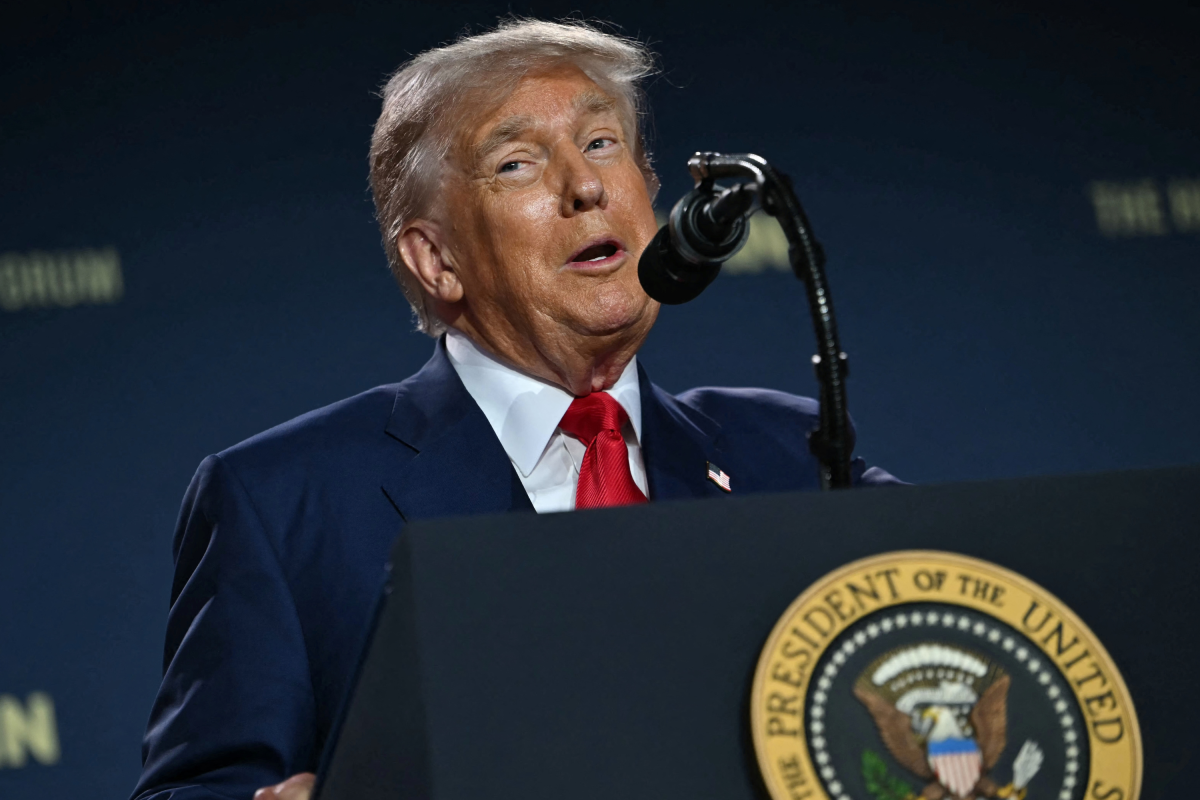
Politics often makes for strange bedfellows, but there may be no stranger pairing in American public life right now than Donald Trump and the people who talk to chatbots every day. A new poll from the Rainey Center has found that the only group of Americans giving President Trump a net positive job approval rating is the one that uses artificial intelligence tools daily. According to the survey, 54 percent of daily AI users approved of the president’s performance, while 45 percent disapproved, leaving him nine points above water with that group. That may not sound overwhelming, but in a deeply divided political moment, it is a striking outlier. Every other segment of the electorate, from weekly users to those who have never touched the technology, rated Trump more negatively than positively. For a president whose political identity is so often tied to the past, to manufacturing, to rallies in small towns and to a nostalgic vision of American greatness, it is the most future-facing, tech-immersed voters who are giving him his clearest sign of support. The finding is all the more surprising because it cuts against the usual assumptions about who supports Trump. The data offers a fresh glimpse into the political attitudes of one of the fastest-growing technology user groups in the country, and it hints that AI adoption may already be reshaping the contours of American politics in ways that traditional demographic models do not capture.
The full breakdown of the survey numbers tells a story of sharp polarization based on how often people interact with AI. Among weekly AI users, Trump’s approval fell to 32 percent, while disapproval soared to 67 percent, producing a net rating of minus 35 points. Monthly users were even more hostile, with just 24 percent approving and 74 percent disapproving, for a net score of minus 50 points, the weakest result of any group in the poll. Respondents who said they rarely use AI tools gave Trump 43 percent approval and 54 percent disapproval, a net of minus 11, while those who never use AI tools recorded 45 percent approval and 54 percent disapproval, for a net of minus 9. In other words, the more frequently people engage with AI, the more sharply their opinions of Trump diverge, but not in a straight line. The biggest gap is not between users and nonusers but between daily devotees and everyone else. Weekly and monthly users are far more negative than people who never touch AI, a pattern that suggests something specific about the daily AI experience. The Rainey Center survey, which was conducted among 1,004 registered voters using an online panel between September 10 and September 14, 2026, also found that 52 percent of voters use AI tools at least monthly. That means AI has moved from a niche curiosity to a mainstream part of everyday life for tens of millions of Americans, and those users are not a single political bloc. The divide between daily users and less frequent users is not just about technology; it may reflect different relationships with work, information, and authority.
From a traditional electoral perspective, the poll’s result is genuinely unexpected. Trump’s strongest support has historically come from older voters, rural communities, and Americans who feel left behind by rapid social and economic change. Those same groups are usually the least likely to embrace emerging technologies. Yet the Rainey Center data suggests that the president’s most enthusiastic approvers are the people who are most deeply embedded in the new world of generative AI. This does not necessarily mean that using AI causes someone to support Trump. Daily AI users are likely to be employed in certain kinds of jobs, to have certain levels of income and education, and to hold certain attitudes about innovation and risk. The correlation could be driven by any number of underlying factors. But the scale of the difference is hard to ignore. Daily users gave Trump a positive approval rating at a time when his overall approval rating has remained stuck underwater in most national polls. They may be a small slice of the electorate, but they are a growing one. The finding also points to the possible emergence of a distinct voter segment defined not by age, gender, race, or region, but by technological behavior. This is a new kind of political identity, one that could become more important as AI tools continue to spread into every corner of work, school, and daily life. People who use AI all day may see the technology as empowering, creative, and productive, not threatening. They may be more willing to trust a leader who promises to get out of the way.
One of the most likely explanations for the divide is the ongoing national battle over AI regulation. Trump has repeatedly voiced opposition to additional AI restrictions, arguing that heavy-handed government oversight would slow innovation and hand an advantage to foreign competitors. That message is likely to resonate with people who use AI every day and have experienced its practical benefits firsthand. For a teacher using AI to write lesson plans or a programmer using it to review code, the abstract fears of AI doom can feel disconnected from their daily experience. They have seen the technology make them faster, smarter, and more productive, and they may be suspicious of politicians who talk about banning it or shackling it with rules. At the same time, some of the most prominent voices in the technology world have issued dire warnings about the future of AI. Jacob Coxon, a former researcher at Anthropic, resigned this month and warned that people developing advanced AI believe it “could kill us all by the end of the decade.” Evan Hubinger, the company’s alignment science lead, publicly backed that concern and said he believed there was a greater than 10 percent chance that advanced AI could cause human extinction within the next decade, though he stressed that his concern was about future superintelligence rather than current models. These warnings have added urgency to the debate, but they may not move daily AI users, who tend to see AI in terms of concrete tasks and tangible results rather than hypothetical threats.
The broader public, however, is not uniformly opposed to oversight. The same Rainey Center survey found widespread support for some forms of AI regulation. Sixty-one percent of respondents said AI should be regulated primarily at the federal level, and 78 percent supported watermarking requirements for AI-generated content, a modest transparency measure designed to help people know when they are looking at synthetic media. Those numbers suggest that even as Americans embrace AI, they want guardrails. The challenge for policymakers is that the political landscape is not simply split between AI supporters and AI opponents. Daily users may support watermarks and basic safety standards while also opposing stricter controls that they see as bureaucratic overreach. Weekly and monthly users, who are more negative toward Trump, may be more open to an aggressive regulatory agenda. The result is a complicated map of competing instincts: excitement about innovation, anxiety about misinformation, fear of extinction, and suspicion of government intervention. Trump’s hands-off approach appears to align with the preferences of the most frequent users, but the same poll shows that most Americans want the government to play a significant role. This is not a simple culture war issue. It is a policy debate that cuts through the usual political coalitions and creates strange alliances. What makes it especially volatile is that the technology itself is changing at a pace that often outstrips the ability of lawmakers to understand it, let alone regulate it.
For now, the White House is not worried about the poll’s implications. Davis Ingle, a White House spokesman, responded to the findings by pointing to the 2024 election as the only poll that matters. “The ultimate poll was November 5th, 2024, when nearly 80 million Americans overwhelmingly elected President Trump to deliver on his popular and commonsense agenda,” Ingle said in prepared comments. “No other President in history has accomplished more for the American people than President Trump, who is working tirelessly to create jobs, cool inflation, increase housing affordability, and more. The President has already made historic progress not only in America but around the world, and this is just the beginning as his agenda continues taking effect.” The quote reflects an administration that prefers to measure public approval by election results rather than daily tracking polls. But the Rainey Center data offers a more subtle and perhaps more important insight: the American electorate is beginning to divide along lines that have nothing to do with traditional geography or class. The people who have fully integrated AI into their lives are developing a distinct political outlook, one that may reward leaders who promise to let the technology run free. As AI continues to spread, the number of daily users will almost certainly grow, and so will their political influence. The September survey is a snapshot, but it hints at a future in which how Americans live with technology could matter as much as where they live, how much they earn, or how they identify politically. The coalition of the future may be built not around left and right, but around those who embrace change and those who want to slow it down.