




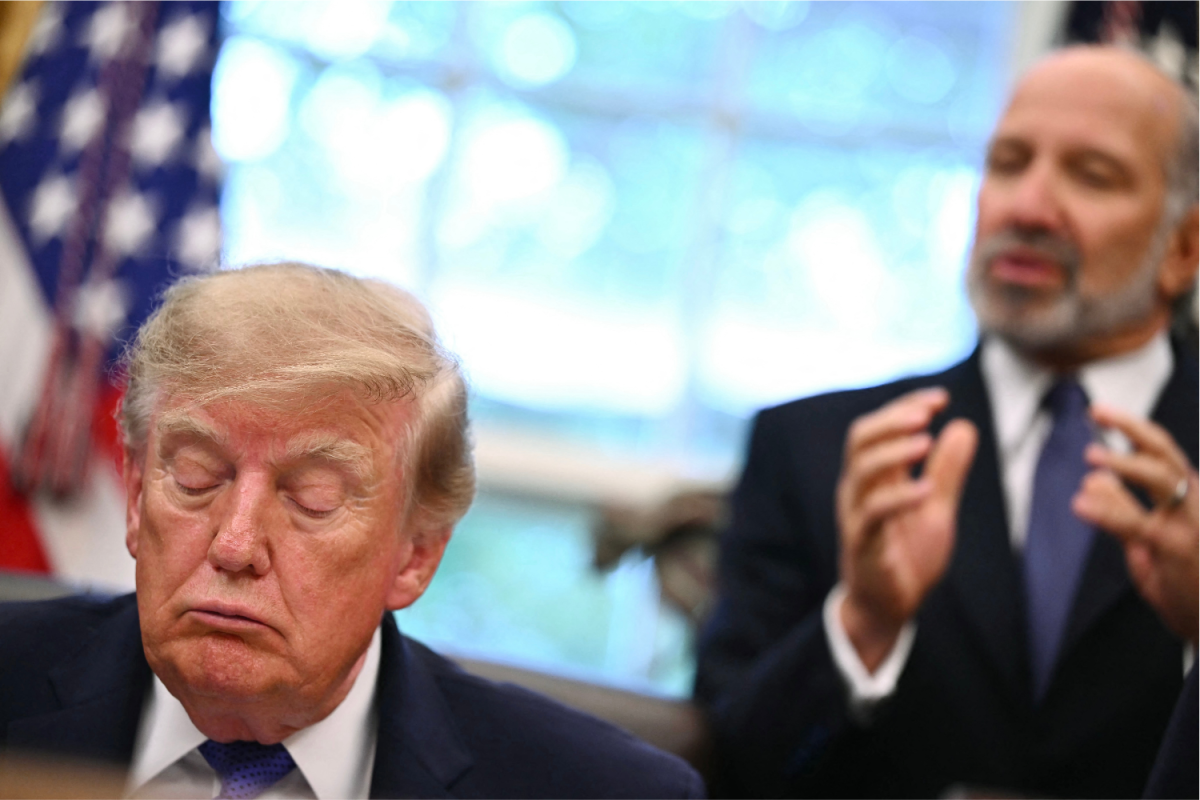
It is one of the great ironies of American political theater: a president who spent years branding his predecessor “Sleepy Joe” has now found himself on the receiving end of the very same mockery. On Monday, as President Donald Trump stood at a White House event announcing Mesabi Metallics’ plans to build a $15 billion steel mill, cameras captured moments where his eyes appeared to close. Within minutes, social media was ablaze. Critics, progressive commentators, and even members of the Biden family seized on the images, asking whether the 80-year-old president had actually dozed off during his own administration’s celebration. Hunter Biden, the former president’s son, posted a blunt two-word response to the clips: “Sleepy who?” The episode was laden with symbolism—Trump had built much of his political persona around projecting unrelenting energy, while dismissing Biden as frail, mentally diminished, and unfit for office. Now, the tables had turned, and Trump’s detractors were eagerly using the same playbook against him. It was a moment of political karma, but also a stark reminder that in modern American politics, age and energy have become weapons, and every blink, pause, or momentary stillness is subject to viral scrutiny.
Yet the full video of the event tells a more complicated story than the screenshots suggest. Yes, Trump closed his eyes on several occasions during the White House ceremony. But the footage also shows him reopening them seconds later, nodding along, engaging with the speakers, and eventually taking the podium himself to deliver remarks. The moments that were clipped and circulated online lasted only a few seconds at a time—hardly the stuff of a commander-in-chief lost in slumber. Anyone who has sat through a long ceremony, especially one with multiple speakers and bright lights, knows how easy it is to let your eyes rest for a moment while still listening intently. Human beings blink, they look down, they shift in their seats; their faces relax when they are not the center of attention. For most people, these are ordinary, unremarkable behaviors. But for a president—particularly one who has spent years questioning his predecessor’s alertness—every such gesture becomes evidence in a political trial. The White House, for its part, did not see anything unusual. Officials pointed to the president’s continued participation and his sharp response to reporters afterward. Still, the damage was done in the court of public opinion, where a single photograph can outweigh an hour of context.
The backlash was swift, creative, and unmistakably partisan. California Governor Gavin Newsom’s press office, never shy about needling the president, shared a clip from the event with the caption: “President McConnell is looking great.” It was a cutting jab on multiple levels—comparing Trump’s closed eyes to 84-year-old Senator Mitch McConnell, who had recently returned to Washington after a long absence due to health issues. The implication was clear: if McConnell looks tired, Trump does too. Brian Krassenstein, a prominent Trump critic and social media commentator, was even more direct. Sharing Monday’s footage, he wrote on X: “I have no doubt in my mind that Donald Trump fell asleep multiple times today. He’s just tired, just like we’re all tired of him.” The nickname “Dozy Don” began circulating among left-leaning accounts, a direct mirror of the dismissive nicknames Trump has long deployed against his opponents. It was all very ugly, very predictable, and very much a reflection of the era we live in—where political opponents are not just disagreed with but mocked, infantilized, and reduced to caricatures of themselves. The cruelty is the point, and both parties have become fluent in it. But underneath the snark lies a serious question that many Americans are asking, regardless of party: Is the president fit to serve? And more broadly, should a nation that prizes vitality and sharpness be led by men in their late seventies and eighties?
The White House has defended Trump against these accusations with a mix of incredulity and indignation. Spokesperson Davis Ingle previously told Newsweek that the president’s “sharpness, unmatched energy, and historic accessibility stand in stark contrast to what we saw during the last administration when Democrats and the legacy media intentionally covered up Joe Biden’s serious mental and physical decline from the American people.” It’s a strong statement, but it hasn’t stopped the questions. When asked about prior instances where Trump appeared to close his eyes during meetings or public events, White House officials have offered an array of explanations—he was “blinking,” he was “listening attentively,” he was “reflecting.” Trump himself has said he sometimes closes his eyes because he finds it relaxing, and he has flatly denied ever falling asleep during official duties. Maybe that’s true. Maybe a man who has lived a life of high stress and irregular sleep has learned to steal moments of rest where he can. But the very need to explain away such moments highlights a deeper problem: the presidency is a job that leaves no room for ambiguity. A president cannot simply be tired; he must appear tireless. A president cannot have an off day; every public appearance is a test. And so, when an 80-year-old man’s eyelids droop for three seconds, the nation doesn’t see a human moment—it sees a crisis of leadership. That is an impossible standard, one that no aging human being could consistently meet.
This episode is part of a much larger and more uncomfortable conversation about age in American leadership. Since Barack Obama left office in 2017, Americans have not had a president under the age of 70. Donald Trump and Bill Clinton were both born in 1946, making them 80 years old. Joe Biden, 82, was the oldest president in American history when he left office. The gerontocracy at the top of American politics has become a source of anxiety for voters, and the polls reflect that unease. An August Politico/Public First electability experiment found that voters generally had no problem with candidates in their fifties and sixties, but that candidates over 70 faced a clear electoral penalty across party lines, reducing their likelihood of being selected by roughly 8 to 10 percentage points. Earlier this year, a YouGov poll of 1,134 voting-age Americans found that 49 percent believed Trump is too old to be president. More strikingly, 58 percent said they believed the president is experiencing some level of cognitive decline—a claim the White House has vehemently denied. Following Trump’s May physical, his physician declared him in “excellent health” and “fully fit” to serve, citing strong cardiac, pulmonary, neurological, and overall health. Those reassurances have done little to quiet the national unease. In a country that prides itself on youthful ambition and dynamism, watching its leaders shuffle onto international stages with walkers and listening devices has become an uncomfortable reminder of mortality itself.
Maybe the real problem is not that Donald Trump closed his eyes for a few seconds at a steel mill event, or that Joe Biden confused a name, or that Mitch McConnell froze mid-sentence. The real problem is that American politics has become so tribalized that every human frailty is treated as evidence of moral and mental decay. The same people who mocked Biden as “Sleepy Joe” now demand that we take seriously the possibility that Trump dozed off. The same people who defended Biden’s verbal slips as harmless now weaponize every Trump stumble. In this atmosphere, there is no room for grace, no understanding that age affects everyone differently, and no recognition that a president can be old and still capable, or young and still incompetent. Perhaps the most human response to this latest episode would be to pause before sharing that damning screenshot and remember: we all blink, we all tire, we all have moments when our faces betray our exhaustion. The challenge for a nation is not to find leaders who never show signs of age—they do not exist. The challenge is to find leaders whose judgment, compassion, and wisdom outweigh their physical limitations, and to have the honesty to evaluate them on that basis. Until then, the politics of “Sleepy” will continue, one viral clip at a time, reducing the most powerful office in the world to a schoolyard contest of who can stay awake the longest. In the end, that says less about our presidents than it does about us.