


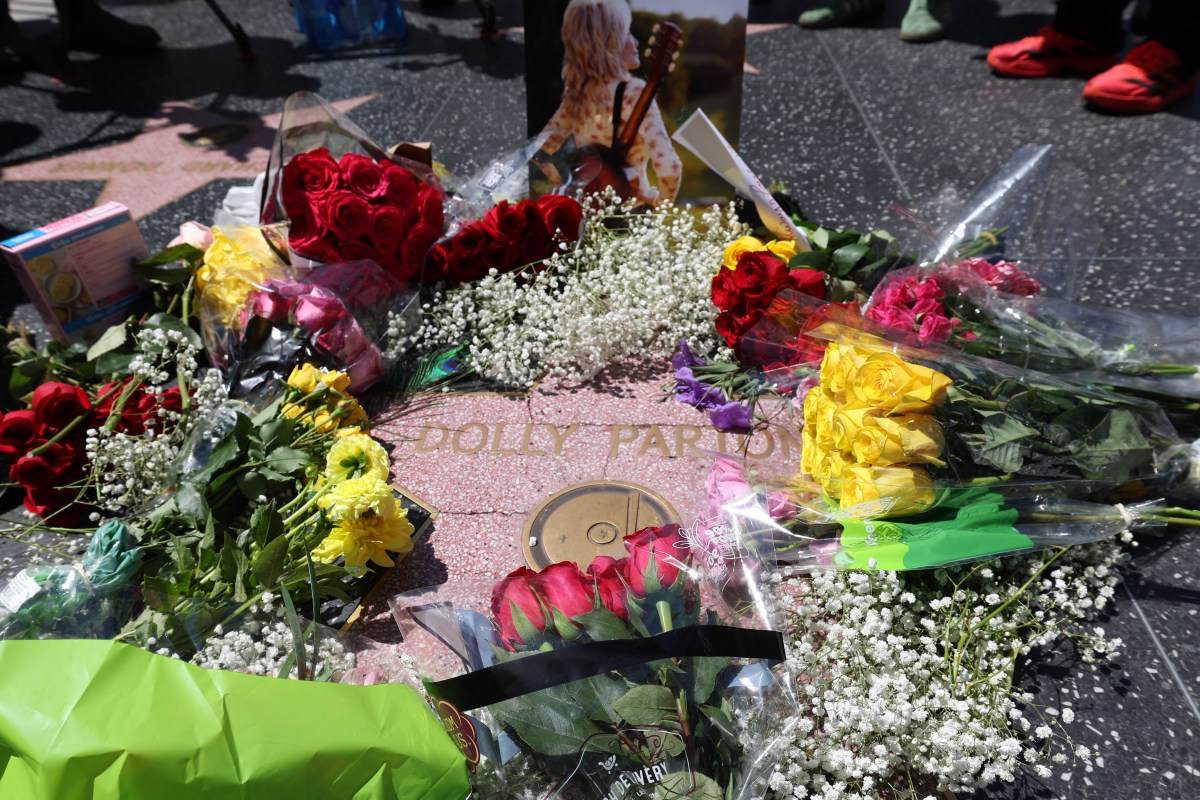
Some sorrows need a place to sit. In the week after Dolly Parton died, her Hollywood Walk of Fame star became exactly that: a flat, worn patch at the center of a busy city where strangers could gather and cry over a polished piece of pavement as if it were a church. They came with bouquets, cards, cowboy hats, photographs, and sometimes just their own quiet hesitation. They knelt beside the star that had carried her name since 1984, pressed their palms against the metal, took pictures, sang softly, and left offerings in the same way people leave notes on a grave. It was not a planned memorial, but grief finds its own geography, and that star became sacred ground. Then, just a week after her death, the ground was broken. According to TMZ, someone scratched Parton’s name on the star, scraping across the surface as if trying to erase it, and flowers left by mourners were stolen. Videos posted on social media showed crews working near the star on Tuesday, trying to repair what had been damaged, but the image stuck in the mind like a splinter. It felt so unnecessary, so petty, so impossible to understand. Here was a woman who had spent decades giving people songs to laugh, cry, and recover; the least the street could do was hold her name in safety. Instead, a fresh scar had been added to a memorial that was already meant for love. There is no clear reason, and maybe no reason ever will be found, but the act leaves a strange, hollow feeling in anyone who has ever loved Dolly Parton’s voice. It hurts because the flowers did not belong to the person who stole them. They were part of something larger: a public goodbye, a messy moment in human history, where fans were trying to make sense of an 80-year-old woman’s death. To scratch her name like that after everything is not just bodily arrogance; it is a little cut in the gentle space that grief had made.
The official response came quickly, or at least as quickly as official responses can. Ana Martinez, a spokesperson for the Hollywood Chamber of Commerce, confirmed to TMZ that the star had been damaged and that a fan reported Monday night that flowers had been stolen. She also explained that Parton’s star already had cracks from time and heavy foot traffic, so the star was actually scheduled for repairs on Tuesday before the vandalism happened. That small detail helped make sense of the crews on the sidewalk; some of the work was routine maintenance, the kind of care that any old star needs after years of tourists standing on it, touching it, and sometimes living on it. But now repair work felt different. Instead of simply fixing old edges, they had to respond to an insult to someone’s memory. The Hollywood Walk of Fame is not a museum, after all. It is a living part of the street in a city where people step on fame daily. It is worn by weather, by fancy, by celebration, by loss, and by life. Yet every star is a little promise: that a person, or a person’s craft, has earned a lasting place in the city’s architecture. Parton’s name was already part of that promise. It had survived decades of smog, sun, rain, and millions of feet. It did not deserve to be scraped by someone’s hand, especially not just a week after the entire world was still mourning her. The crews who knelt there on Tuesday must have felt the strangeness of their task. They were fixing more than bronze and materials; they were trying to steady a small part of the brokenness that followed a great American artist’s death.
To understand why people cared so much, it helps to remember what that star meant when it was placed there. In 1984, Dolly Parton had already built a career that did not need an award to monument, but the Hollywood Chamber honored her for her recording work. She had already given the world songs like “Jolene,” “I Will Always Love You,” and “Coat of Many Colors,” songs that had not only climbed in the world, they had become the measure of private lives. With a voice that was warm and bright, with a personality that could make a room feel small and safe, she shifted from Tennessee to worldwide fame without losing the way she spoke. The Walk of Fame was perhaps not a natural home for her; it was in Los Angeles, far from the Smoky Mountains, but the city recognized a kind of long-distance magic. Her name in the sidewalk meant that a girl who grew up in the Tennessee hills without modern plumbing? The country girl, the storyteller, the woman in rhinestones, could enter the same fabric that symbolically cloaked every icon of Hollywood. People who cherished the star often did not stop to look at the bronze pattern. They came because it was a thread linking them to her. It was proof that no matter how many glittering performers passed through, this particular song could stay. That she had the star for all those years meant she was no temporary star; she was one of the constellation. And when the world learned that she had left us, that spot on the street became the most natural place to load the emotion. It was not so much that the star was Dolly; it was that Dolly had always been the star. Someone who had mined meaning from their own life to give to everyone. You cannot scratch that out of sidewalk.
It was only a week before the expensive vandalism that Parton had eventually died. She was 80 years old, and she had been in Vanderbilt-Ingram Cancer Center in Nashville, a hospital that carries some of her threads and pains, and she had been surrounded by people who loved her. The announcement of her death shook more than Nashville; it shook the world. The phrase “brief bout with cancer” held precious little, but cancer more than enough; it was a cloud that changed the horizon once the public learned. People felt the loss like the end of a relationship they had never realized gave so much. The Walk of Fame star became a shining place to remember her, with fans gathering from everywhere to leave bouquets, notes, and keepsakes. It turned into one of those strange informal memorials that get created when people in a city suddenly realize they are part of a family. But when someone stole the flowers, that same spot became evidence that grief does not always bring the best out of people. Sometimes grief or just meanness comes disguised as a snatch on the edge. It is tempting to imagine that the person who stole the flowers wanted a memento, or was an unruly souvenir hunter, or was otherwise detached from the meaning of the flowers. What they did was more than a petty incident; it was the kind of act that would make a mourner mistrust everything private. Yet out of many evil moments, there is good to remember; the flowers were the original story. People kept placing them, and even after the theft, people will come again to that star. The act of a thief did not empty the memory, though it certainly made the mourning feel a little more hard.
The national and international stricken with Parton’s death was a reminder of how far she reached. She was not just a country star; she was someone who had crossed from music into films, philanthropy, and daily honesty in a way that escaped no one. Public figures, actors, musicians, and presidents issued statements that spoke of her talent and her warmth. Fans swapped videos of her stage and shared stories of her kindness. The outpouring was measured in more than just theatrical words; it was felt in kitchens where people played her albums, in bedrooms where a song had once had held the beating heart of a long night, and now on the Hollywood Walk where she died. The scratch on her star, small as it was, seemed so out of place next to the love. It was as if someone had tried to shout over a silent prayer. In moments of great loss, the human imagination searches for something to hold, and a star’s name is a thin piece of bronze to hold all of that. But Dolly Parton is not actually there; she was always more alive in a recording or a story than in a marker. The scratch could not hurt Dolly, and it could not be hurt by the true architecture of her legacy. It only hurts the mourners, and even then, only as much as a scratch can hurt living people. Really, her work will outlast every Walk of Fame star, every sidewalk, every person who takes flowers. “I Will Always Love You” continues to hang in the air long after the last flower has rotted. What is a scuff across a star compared with a song is that it has prepared millions of people? The act of vandalism is not meaningless, but it is powerless in the long story of what she did and who she was.
The restoration will probably happen soon, and the star will be grounded once again. The crews are already there, chipping old filler, comparing the letters, making the damaged surface smooth enough to walk over. It will never be same exactly as the original; but hardly anything is, and that is perhaps the lesson in this whole strange moment. People will continue to walk past it, and some will pause and remember. Some will notice a faint line from the repaired name and be angry all over again. Others will simply shake their heads and lay another flower, another bouquet, another small token. The city may decide to replace the star entirely, or not; it could be sealed and polished and closed, but the dark marks may not go away. And maybe that is not entirely bad. The crack, though ugly, can be part of its story because no good story is without damage; Dolly herself knew that. She sang about broken lives and old clothes and making beauty out of nothing. The scratch is an ugly add, but it will not be the final word. The final word belongs to the vernacular of people who still hear her music and feel softer. If she could return for a second, she would probably not linger on the vandalism. She might instead make a joke, smile, and remind us that fame is only a sidewalk but kindness is forever. That would be the Dolly Parton way: not to scrub away evidence of the cruelty, but to turn it into another coat of many colors. Her name remains exactly where it was, in the ground as in the collective, in a space that has been touched by grief, anger, but also love. The damaged star will be mended, the flowers will return again, and the name Parton? It will not stay scratched because the world will not let it stay scratched.