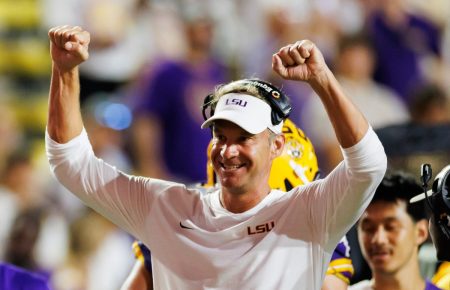




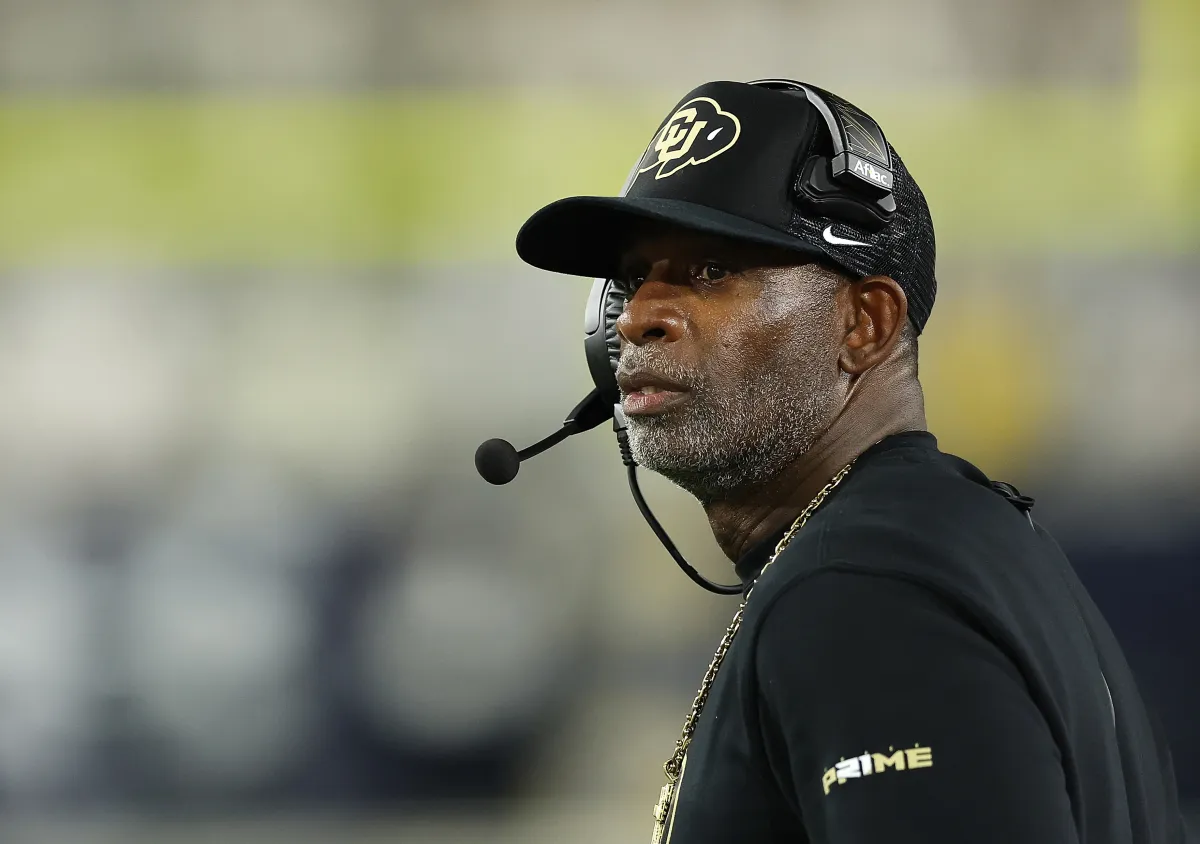
Saturday night belonged to Oxford, Mississippi, where the college football world stared at the scoreboard in disbelief as Ole Miss knocked off LSU and the former Rebels coach Lane Kiffin watched from the visiting sideline. It was the kind of chaotic, electric atmosphere that defines college football at its most intoxicating. But while the cameras and the crowds were focused on the SEC West, something more quietly painful was unfolding in Evanston, Illinois. There, on a cool night at Northwestern’s Ryan Field, Deion Sanders and his Colorado Buffaloes were being dismantled, embarrassed, and ultimately humbled in a 41-7 loss that felt less like a bad game and more like a sudden collision with reality. The Buffaloes had entered the night as one of the sport’s early feel-good stories, undefeated through two weeks and coming off a thrilling upset of Georgia Tech. They left with their egos bruised, their flaws exposed, and their head coach visibly angry in a way that had nothing to do with the scoreboard itself. Football is a game of emotional whiplash, of soaring highs and crushing lows, and Colorado experienced both in the span of just a few hours. But the most revealing moment of the night did not happen in the end zone or on the line of scrimmage. It happened after the game, in the quiet of the locker room, where Sanders saw something he simply could not tolerate: joy in the aftermath of a loss.
The game itself was never close in the way the final score suggests. Northwestern entered the matchup as modest 3.5-point favorites, a number that seemed almost insulting to a Colorado team that had just beaten Georgia Tech on the road and then demolished Weber State at home. The Buffaloes were riding a wave of momentum, fueled by a young and confident quarterback in Julian Lewis and a receiver corps that seemed capable of scoring on any given snap. But from the moment the Wildcats took the field, they looked like the more prepared, more physical, and more disciplined team. Northwestern stacked the box, pressured Lewis into hurried throws, and turned Colorado’s offense into a shadow of the unit that had lit up the scoreboard only a week earlier. Lewis finished the night completing 19 of 29 passes for just 168 yards, with one touchdown and two interceptions. The Buffaloes turned the ball over four times in total, a reckless cascade of mistakes that made any hope of a comeback impossible. Meanwhile, Northwestern churned out 423 total yards to Colorado’s 348, controlling the clock and the tempo. It was not just that Colorado lost; it was that they lost in a way that revealed a deep gap between their self-image and their actual consistency. They looked like a team that believed its own hype, and the Wildcats were more than happy to punish that naïveté.
But the most memorable part of the evening came after the final whistle, when Sanders addressed the media with the raw, unfiltered frustration of a competitor who refuses to accept losing as part of the process. He spoke about walking into the locker room and seeing players laughing, smiling, and carrying on as if the 41-7 beating had not happened. It was, to him, an unacceptable betrayal of the standard he has tried to instill in the program. “I saw some guys fight and fighting through it, offensively and defensively,” Sanders said. “Now, you did see a couple of guys that I just got on because I don’t understand how you can have joy in a loss, especially when I’m upset, and I’m walking right behind you.” There was something almost personal in his voice, a sense of disbelief that a player could treat a loss so casually. He continued, “I don’t understand that. I can’t never understand that because I want to win every darn thing. And I can’t understand how in the world do you find joy, or you can find a laughing manner, when I’m right behind you walking in. I don’t understand that. And I addressed it, and I’m gonna put my foot in it, not on it.” That final phrase — “put my foot in it, not on it” — was a subtle but important distinction. He is not looking to crush these young men or publicly humiliate them. He is looking to step directly into the middle of the problem, to be present, to demand more, and to make it clear that complacency will not be tolerated.
To understand why Sanders was so upset, you have to understand just how high Colorado had climbed in the previous two weeks. The season opener against Georgia Tech was supposed to be a litmus test, a road game against a solid opponent that would tell the country whether this new-look Colorado roster was for real. The Buffaloes passed with flying colors, grinding out a 14-13 victory that was gritty, defensive, and far from pretty. It was the kind of win that builds character and belief. Then came Weber State, where the offense exploded in every possible way. Julian Lewis looked like a future superstar, completing 17 of 23 passes for 366 yards and four touchdowns with no interceptions, adding a rushing score for good measure. Junior running back Micah Welch rumbled for 106 yards and a touchdown on just 11 carries, and wide receivers Joseph Williams and DeAndre Moore both topped 100 yards through the air. It was a performance that made Colorado look not just good, but dangerous. The kind of team that could outscore anyone on a given Saturday. And so the loss to Northwestern was not just a setback; it was a psychological shock. The same offense that had thrown for 366 yards and four touchdowns could only manage 168 yards and two interceptions. The same defense that had choked the life out of Georgia Tech’s offense looked slow and confused against a Northwestern team that simply wanted it more. The joy that Sanders saw in the locker room was likely not malicious or disrespectful; it may have been the nervous laughter of young men who did not know how to process failure. But for a coach who treats every game like a matter of personal honor, that kind of reaction is unforgivable.
What makes this loss even more troubling for Colorado is that the schedule is about to get significantly harder. There will be no soft landing, no easy rebound game to regain confidence and fix mistakes. Next week, the Buffaloes travel to Waco to take on Baylor, a team that is desperate for a win and will not be intimidated by a Colorado program still searching for an identity. After that come back-to-back matchups against No. 11 Texas Tech and No. 15 Utah, two teams with the kind of physicality and quarterback play that can expose every weakness a defense has. This is the heart of the Big 12 schedule, and Colorado will have to navigate it with a young quarterback still learning how to handle adversity, an offensive line that struggled against Northwestern’s pressure, and a locker room culture that is now being tested in a way it has not been tested all season. The loss to Northwestern was brutal, but it may also be a necessary one. It revealed that the Buffaloes cannot simply rely on talent and momentum. They have to develop habits of focus, preparation, and composure that carry them through the difficult moments. Sanders has always been a coach who believes that adversity reveals character, and now his team will have to prove that they have it. The next few weeks will tell the real story of this Colorado team, not the early season highlights.
In many ways, what happened in Evanston was a perfect snapshot of the Deion Sanders experience. He is not a coach who accepts moral victories, nor is he interested in building a program on excuses. He demands excellence, and he expects his players to feel the same sting he feels when they fall short. The image of him walking into the locker room, already upset about the loss, and then seeing players laughing, is a reminder that the challenge of coaching is not just about drawing up plays or recruiting talent. It is about changing a culture, shifting a mentality, and teaching young men that losing should never become comfortable. Sanders’ postgame comments were blunt, but they were also caring in a way that can be easy to miss. He was not just angry; he was disappointed in the lack of urgency, the lack of emotional investment. He has said repeatedly that he wants to win at the highest level, and he knows that starts with how players react in the quiet moments after a defeat. The Buffaloes are not a finished product, and this loss does not define them. But how they respond to it will. Do they have the maturity to turn this pain into growth, or will they let the season spiral into mediocrity? That is the question hanging over Boulder this week. For now, Sanders has made one thing clear: he is not going anywhere, and he is not lowering his standard. He said he is going to put his foot in it, not on it. That means he will be right there in the middle of the struggle, demanding more, pushing harder, and refusing to let joy ever again become the response to a loss. The road ahead is difficult, but for Colorado, there is still time to turn this humbling night into the turning point of their season.