


For a quarter and a half of Saturday’s ACC showdown between North Carolina and Clemson, the sport looked as if it had entered a strange new era. Bill Belichick, the legendary NFL coach who had spent decades as the face of cold genius on the sideline, was on the verge of making Clemson look ordinary. His Tar Heels came out with energy and precision, moving the ball against a Tigers defense that seemed unable to stop anything. By halftime, UNC led 17-6, and the contrast in body language was unmistakable. Belichick stood apart, stone-faced, while his players celebrated. On the other sideline, Dabo Swinney paced and gestured, helplessly watching his team fall apart. Clemson’s offense, led by Tait Reynolds in his first start of the season, had no rhythm. Drives stalled before they could gain any momentum. The passing game was off, the running game was stuck, and the Tigers looked like a team already sliding toward a disastrous 1-2 record. For anyone watching, it was hard not to feel the enormity of the moment. Here was Belichick, only weeks into his first college job, doing what no one had expected so quickly. He had won his first two games against TCU and East Tennessee State, but those were tune-ups. This was a referendum on whether his experiment could work at the highest level of college football. And in the first thirty minutes, the answer seemed to be a resounding yes. The Tar Heels were faster, sharper, and more confident. They were playing with the discipline that has always been Belichick’s hallmark, but also with the joy that comes from being underestimated. The fans in Chapel Hill had not felt this kind of hope in years, and you could hear it in the stadium. But football has a brutal way of rewriting narratives, and before the afternoon was over, the story would change completely.
In the second half, everything flipped. The Clemson team that stumbled through the opening two quarters suddenly looked like the Tigers of old, and the shift was almost dizzying. Tait Reynolds, the same quarterback who had struggled to move the chains in his first start, began to find his footing with every possession. It wasn’t just that he made a few good throws; he seemed to grow into the game, reading the defense, scrambling for extra yards, and giving his teammates a reason to believe. Clemson put together scoring drives of 92, 68, and 44 yards, each one more methodical than the last. The offensive line opened holes, the receivers made contested catches, and Reynolds showed the kind of composure that could become the foundation of a season. North Carolina, meanwhile, could not sustain its early momentum. The defense that had flustered Reynolds in the first half suddenly looked tired and reactive. The sideline that had been so confident grew quiet. And on the field, the Tar Heels began to make the kinds of mistakes that have haunted Belichick teams when things go wrong: missed assignments, dropped passes, and the subtle body language of a team that knows it is losing control. When the final whistle blew, Clemson had saved itself from the nightmare of an 0-2 start in conference play. For Swinney, it was a deep breath after weeks of mounting pressure. For Belichick, it was the first loss of his college season, a bitter pill after the euphoria of opening wins against TCU and East Tennessee State. More than anything, the game became a reminder that in football, momentum is a living thing. It can disappear in a single play, and it can return just as quickly. The final score mattered, but the most talked-about moment of the day was yet to come.
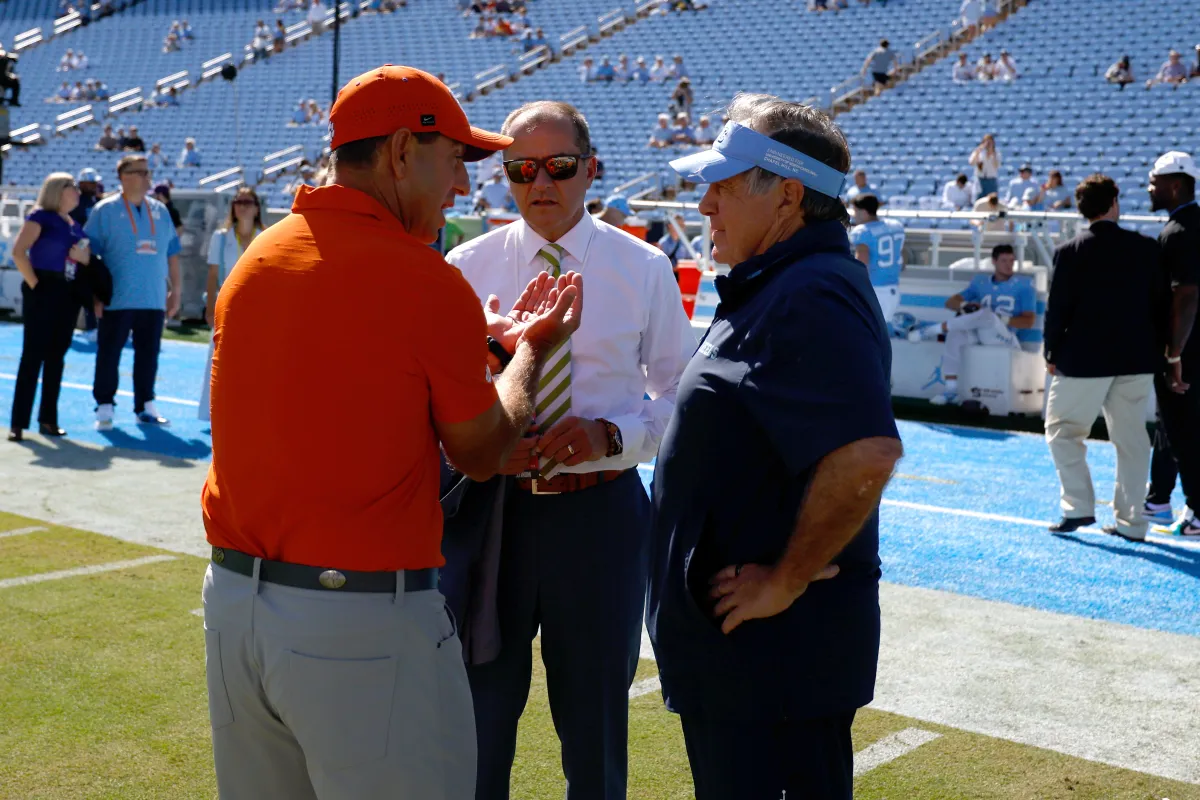
After the game, Swinney and Belichick met at midfield for the traditional postgame handshake, and the exchange lasted barely two seconds. What should have been a moment of mutual respect, however grudging, became something far more awkward. Swinney, who had just guided his team back from a double-digit deficit, clearly expected more than a quick clasp. He took his hat off, a gesture of courtesy and humility, and moved toward Belichick with the openness of a coach who wanted to acknowledge the battle. Belichick, as he has done so many times in his career, gave the briefest possible handshake and immediately turned away. There was no pat on the back, no brief exchange, no recognition of the drama that had just unfolded. Just a cold, mechanical movement that seemed to dismiss Swinney as if he were an inconvenience. The video of the interaction went viral almost immediately, racking up nearly a million views in less than seven hours. It was the kind of clip that feeds the endless debate about Belichick’s personality, a man who has never been interested in performing warmth for the cameras. But to many viewers, this was more than just a gruff coach being introverted. It looked like disrespect, a sore loser refusing to give credit where credit was due. The scene was especially striking because Swinney had just won a game that might have saved his season. He had outcoached a legend in the second half, and yet the response he received was the emotional equivalent of a slammed door.
Social media was quick to react, and the responses ranged from amused to angry. One fan wrote, “ngl that handshake was over before it started,” capturing the way the moment seemed to end as soon as it began. Another said, “I didn’t expect anything different from Belichick,” suggesting that this is simply who he is after all these years. A third fan was far less forgiving, writing, “@Belichick_B is an [expletive] & when he loses you can absolutely add the -hole- to it. He will be an ex football coach starting 2027.” That comment tapped into a broader sentiment that Belichick’s coldness is acceptable when he is winning, but becomes impossible to stomach when he loses. Another user echoed that idea, remarking, “Belichek is an amazing coach and a classless loser when he doesn’t win. Sour puss sore loser. Humility would tell him it wasn’t just him.” Still others pointed out the visual irony of the moment, with one noting, “Dabo even took his hat off to show respect, and yet look at Bill.” Even people who admitted they do not like Swinney found Belichick’s behavior unacceptable. As one comment put it, “I don’t like Dabo either but Bill is such a [expletive] lol.” The comments were not just idle chatter; they reflected a deeper cultural expectation that coaches, especially older legends, should model sportsmanship. The handshake is one of the few rituals that connects football to honor and mutual respect. When it is reduced to a transactional glance, it leaves people unsettled.
The awkward handshake also highlighted how much pressure both coaches are carrying this season, and how different their paths have been in recent years. Swinney, a two-time national champion, has spent the last few seasons on a hot seat that grows warmer every time Clemson falls short of its own enormous standards. Heading into this game, his record since 2023 was just 26-14, a mark that would be celebrated at most programs but feels like failure at a place that once thought of itself as Alabama’s equal. Saturday’s comeback was, in many ways, a survival moment. It quieted the noise, at least for now, and gave Swinney proof that his locker room still believes in him. Belichick’s situation is even more complicated. After a 4-8 debut season in Chapel Hill, the expectation was that he would show steady improvement, and a 2-1 start did offer some hope. But the pressure around him has intensified for reasons beyond the win-loss record. The resignations of general manager Michael Lombardi and defensive coordinator Steve Belichick, his own son, raised questions about dysfunction behind the scenes. Some observers believe Belichick is already on thin ice, and that another losing season could end his college experiment almost as quickly as it began. Those stakes made the postgame handshake feel even more striking. Here were two men who understand that every game is a referendum on their futures, and yet one of them could still find it within himself to show respect while the other could not. It was not just a moment of bad manners; it was a window into the psychology of two coaches fighting for survival.
In the end, the game itself was a classic college football story of redemption, resilience, and the unpredictable swing of emotion. Clemson walked off the field with renewed purpose, while North Carolina walked off with a bitter reminder that nothing in this sport is guaranteed. But the image that lingers is the handshake, because it revealed something uncomfortable about the human side of competition. Belichick has built his entire career on the idea that results matter more than relationships, that feelings are a distraction, and that the only thing worth respecting is victory. When he wins, his coldness is often framed as genius, a refusal to waste energy on frivolities. When he loses, the same behavior looks petty and small. Swinney, for all his critics, carried himself with grace in that moment, and the contrast was impossible to ignore. The handshake was not just about two coaches after a game. It was about pride, insecurity, and the difficulty of acknowledging someone else’s success when you are still hurting from your own failure. In that sense, Belichick’s two-second dismissal of Swinney was not a moment of strength but of vulnerability. It showed that even the greatest coaches are not always great at being human. And as both teams move forward into the rest of the season, the play that defined Saturday may not be a touchdown at all. It may be the brief, cold clasp of two hands, a moment that lasted less than three seconds but said more about the nature of competition than any quarterback could have said in a hundred interviews.