



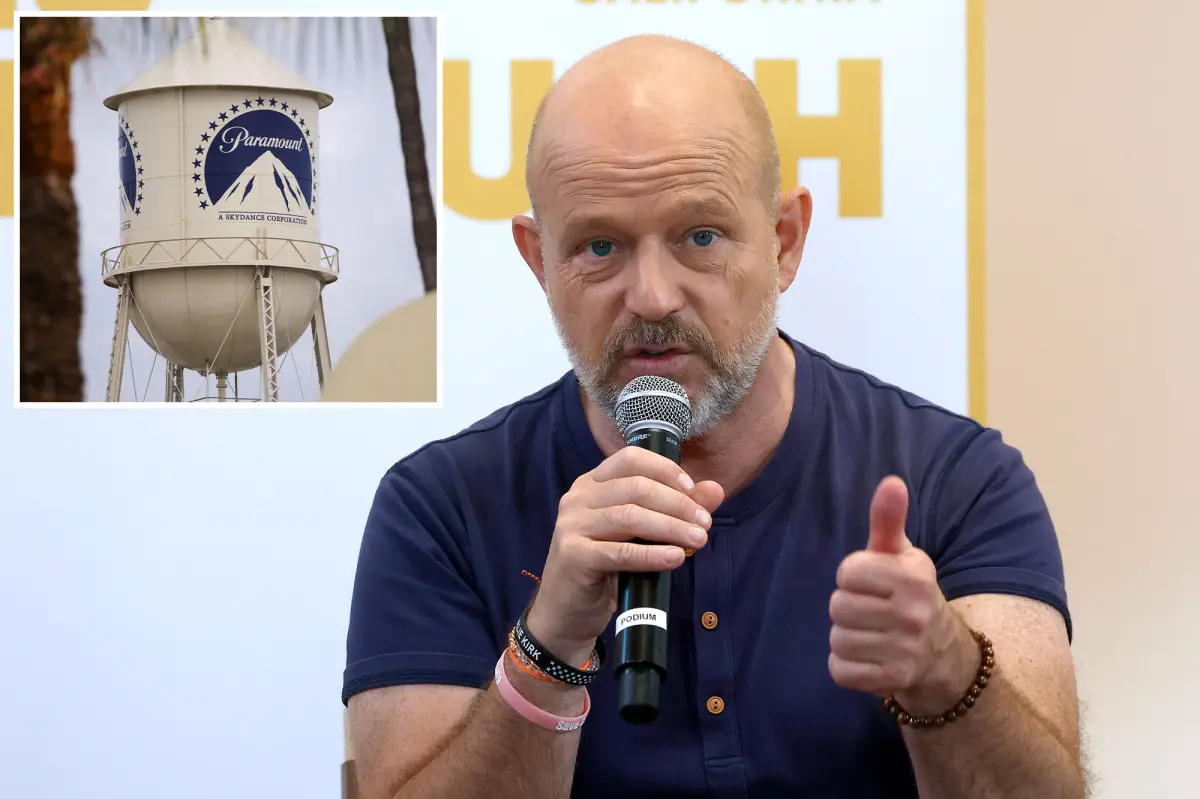
For more than a century, Hollywood has been more than just a place on a map—it has been the beating heart of American imagination, a dream factory where struggling actors, writers, and technicians come to turn ambition into art. But that dream is fraying, and in California’s political arena, it has become a battleground. Steve Hilton, a Republican candidate for governor, is using the entertainment industry’s mounting troubles as a fiery campaign issue, accusing state leaders of driving away the very economic engine that made California world-famous. His outrage has a tangible target: Paramount, one of the most iconic studios in Hollywood history, is now threatening to leave the state entirely. Paramount Skydance CEO David Ellison is embroiled in a bitter legal fight with California Attorney General Rob Bonta over the proposed $110 billion takeover of Warner Bros. Discovery, and he has made no secret of his willingness to relocate the company if the political climate doesn’t change. For Hilton, this is not just a corporate dispute—it is evidence that California’s leadership has abandoned an entire industry. He points to a sobering statistic: 51,000 film jobs have vanished from California in just three years. He blames exorbitant production costs, heavy taxation, and an unforgiving regulatory environment for pushing productions to cheaper states like Georgia and Texas, where studios can save millions and face fewer hurdles. In Hilton’s view, the studios aren’t leaving because they want to; they’re leaving because California made it impossible for them to stay. His message is deliberately visceral, aimed at the grips, electricians, coordinators, stunt performers, and crew members who rarely see their names in lights but are the backbone of every movie and television show. “Paramount’s eyeing the exit and our stuntmen, coordinators, and crews are already packing for Texas and Atlanta,” he wrote on social media, alongside a video meant to show the human cost of the exodus. “I’m going to Bring Hollywood Home with real incentives and less red tape. ENOUGH IS ENOUGH.”
Hilton’s post was not a policy white paper; it was a gut-level appeal from a politician who understands that Hollywood’s decline is personal for tens of thousands of California families. The video he shared, titled “POV: You’re a Hollywood stuntman struggling to find work,” features veteran stuntman Sam Maloof describing a world turned upside down. Maloof, whose career spans blockbusters like “Mission: Impossible,” “The Fast and the Furious,” “Three Kings,” “The Hitcher,” and “Transporter 2,” says he knows countless industry professionals who have already packed up and moved to Texas or Atlanta. These are not executives making deals from corner offices; they are the men and women who throw themselves off buildings, choreograph car chases, and make the impossible look effortless on screen. For them, the decision to leave California isn’t about politics—it’s about survival. When productions increasingly hire local crews in cheaper states, even experienced Hollywood professionals find themselves shut out. Maloof’s own family stars in the Netflix reality series “Drive Hard: The Maloof Way,” a show about their shared love of cars, racing, and stunt driving. But even that success story is now in jeopardy. “We want another season out of that, but it’s slim pickings now because they’re moving out of the state,” Maloof says in the video. His question is simple and heartbreaking: “So what can we do to try to bring Hollywood back?” Hilton used the moment to frame the entire crisis as a moral failure, not just an economic one. For him, the loss of entertainment jobs from Los Angeles is nothing less than a crime. “This is a passion for me with this industry. It’s so important in this region in LA, the movie industry, television industry,” he said. “It’s a crime what they’ve let happen to let all those jobs go to other states and other countries. It’s an absolute crime.” The word “crime” is carefully chosen—it suggests not just negligence, but deliberate harm, and it gives frustrated workers a villain to blame.
The story of Sam Maloof is the human face behind the statistics, and it illustrates why this issue resonates so deeply in Los Angeles and beyond. Maloof has spent decades performing death-defying stunts for some of the biggest franchises in cinema history. He has worked alongside A-list stars, traveled to exotic locations, and built a career that many would envy. But now, he finds himself in the strange position of being a legend in his field with nowhere local to work. When he looks around his industry, he sees friends—stunt performers, assistant directors, coordinators—moving their families to Texas or Georgia, where the studios are booming and the cost of living is manageable. The glamour of Hollywood, he suggests, has been outsourced to places that once seemed like unlikely contenders for the entertainment crown. And it’s not just Hollywood’s traditional workforce that is suffering; it’s the entire ecosystem of small businesses, equipment rental houses, catering companies, and local unions that depend on a steady stream of productions. When a film shoots in Atlanta, the catering contracts go to Atlanta companies; when it shoots in Austin, the local stunt teams get hired. The money that once flowed through California’s economy now flows elsewhere. For Hilton, this is a betrayal of the state’s identity. He casts himself as the defender of a blue-collar Hollywood, the working-class professionals who are often invisible in the glitz of red carpets and award shows. His meeting with Maloof was designed to show that he isn’t just talking to studio bosses; he’s listening to the people on the ground who are struggling to find their next paycheck. The video is raw, understated, and more powerful than any campaign ad could be because it centers on a real person with a real fear: that the industry he loves and helped build no longer wants him.
California’s leaders are not ignoring the problem entirely, but their response may be too little, too late. Last July, the state increased its annual film and television tax credit fund from $330 million to $750 million, a significant infusion aimed at keeping productions in-state. More recently, Governor Gavin Newsom signed legislation designed to capture the work that happens after the cameras stop rolling—editing, sound mixing, visual effects, and other post-production jobs. Starting next year, studios will be able to claim tax credits covering between 35% and 50% of qualifying post-production spending in California. Perhaps most notably, this incentive can also be claimed by productions that shoot in other states, as long as they do their post-production work in California. This is a pragmatic acknowledgment that California may not always win the primary filming battle, but it can still compete for the higher-paying, high-skilled jobs that come in the aftermath. It’s a clever strategy, but it also reveals how far the state’s dominance has slipped. There was a time when California didn’t need incentives to attract productions; it had Hollywood, the weather, the talent pool, the studios, and the infrastructure. Now, it has to fight for scraps alongside New Mexico, Louisiana, and other states eager to offer generous subsidies. The new law is an attempt to adapt to a world where filming can happen anywhere, but critics argue it treats the symptom rather than the disease. The root problem, they say, is not a lack of incentives—it’s the overall cost and complexity of doing business in California, from permitting to insurance to labor rules. Hilton and his supporters would argue that no amount of tax credits can offset the damage caused by endless red tape and an anti-business environment. To them, the state is applying Band-Aids to a wound that needs surgery.
Meanwhile, the Paramount drama adds a bizarre and high-stakes backdrop to the political debate. The proposed merger between Paramount Skydance and Warner Bros. Discovery would create one of the largest entertainment conglomerates in the world, with enormous power over television networks, streaming services, film studios, and intellectual property. But California Attorney General Rob Bonta, joined by eleven other state attorneys general, filed a lawsuit in July arguing that the merger would stifle competition and harm consumers and workers. The legal challenge is rooted in antitrust concerns: with fewer major studios controlling more content, the argument goes, workers have fewer options, wages stagnate, and independent voices get squeezed out. David Ellison, the Paramount CEO, has pushed back hard, even suggesting that the company might leave California altogether if the legal pressure continues. No official move has been announced, and Paramount remains a towering presence in Los Angeles, but the very threat is enough to send shivers through an industry already experiencing massive disruption. The irony is unmistakable: the same state that nurtured Paramount into a global powerhouse is now suing to block its expansion and potentially pushing it out the door. For Hilton and his supporters, this is the perfect example of California’s self-destructive tendencies. How can a state claim to support good jobs and economic growth while its attorney general wages war on one of its most iconic companies? Bonta and his allies would counter that the lawsuit is about protecting competition and preventing media consolidation, not about destroying jobs. But in the court of public opinion, the nuance often gets lost. What people see is another California politician picking a fight with the entertainment industry instead of working to keep it in the state. That perception, fair or not, is politically potent, and Hilton is tapping into it with the confidence of someone who knows he has found a winning issue.
In the end, the fight over Hollywood is about more than tax credits and merger approvals; it is about whether California still has a place for the industries and workers that built its identity. The loss of 51,000 film jobs in three years is not just a statistic—it is a community scattered across the country, a generation of young people wondering if a career in the movies requires leaving their home state, and a legacy of production expertise that could vanish if the exodus continues. Hilton’s language is provocative, but it resonates because it gives voice to a genuine sense of loss. The entertainment industry is woven into the fabric of Los Angeles; it is the region’s signature industry, its biggest cultural export, and a source of pride for millions. Watching it slip away to other states feels like watching a piece of the California dream die. California’s policymakers, meanwhile, are scrambling to adapt, offering bigger incentives and new tax breaks, but every response seems like rearguard action against an inevitable tide. The settlement talks between Paramount and the state suggest that cooler heads may prevail on the merger issue, but the underlying economic pressures remain. As for Hilton, his campaign may not succeed—he faces long odds in a deeply Democratic state—but he has tapped into a vein of frustration that transcends party lines. Democrats in Los Angeles are just as worried about the loss of entertainment jobs as Republicans in Orange County, and everyone can understand a stuntman who just wants to work close to home. Whether Hollywood stays or goes will be determined by more than politicians’ promises; it will be determined by a complicated mix of economics, law, culture, and luck. But for now, the world is watching to see whether the industry that once made California the golden land of dreams can survive in the state that gave it birth. The story is still being written, and its next scene may decide the future of American filmmaking for generations to come.