


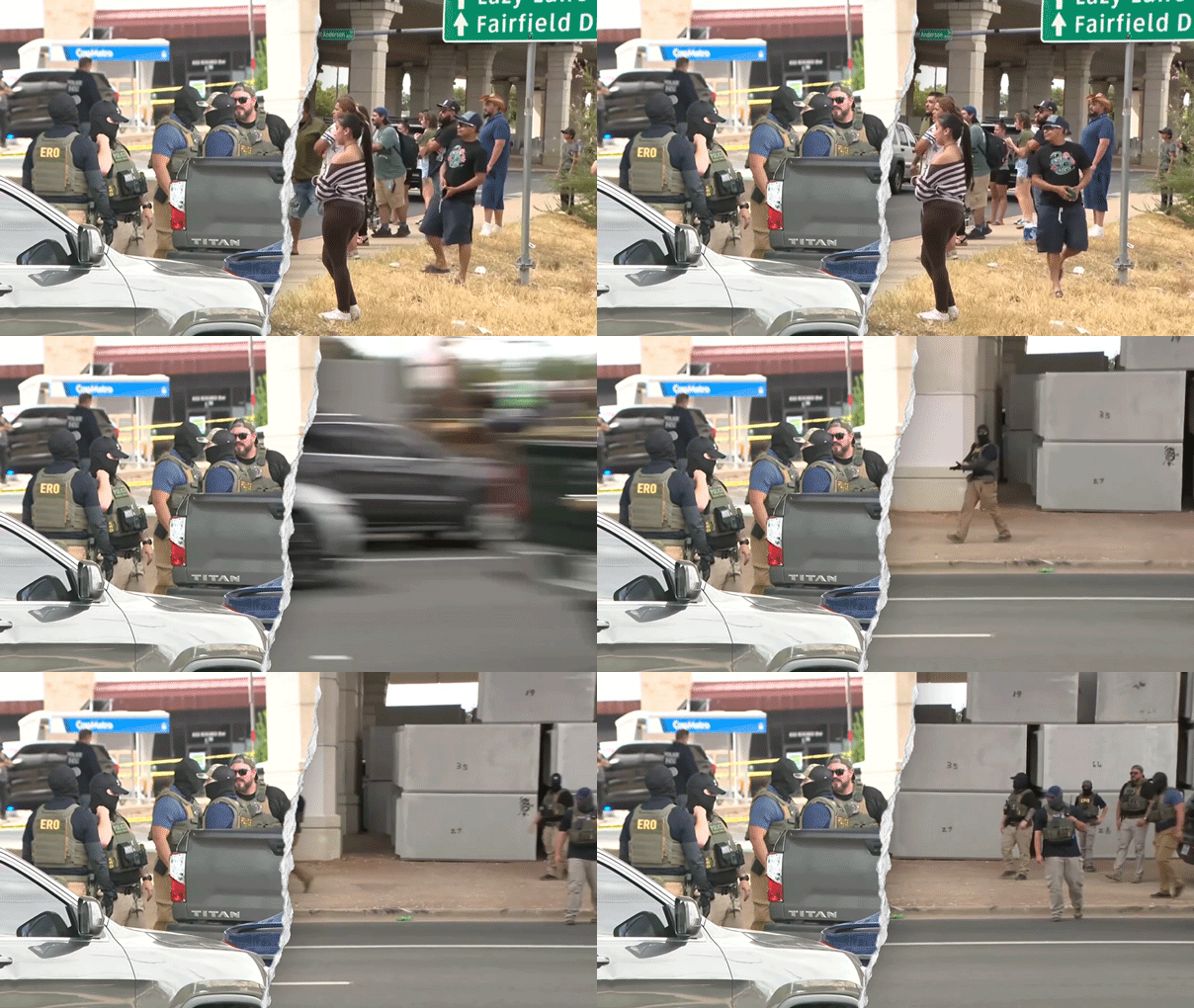
A gray cloud of uncertainty settled over Austin, Texas, this past Sunday as the city braced for a development that once again placed federal immigration enforcement under a harsh national spotlight. What began as what many assumed would be a quiet morning in the 7000 block of West Anderson Lane slowly turned into a scene of tension and unanswered questions after Rep. Greg Casar, a Democrat who represents parts of Austin, stated publicly that an agent with U.S. Immigration and Customs Enforcement had shot a person during an operation in the city. The allegation, shared on X in a terse post, hit the community with the force of a siren. By mid-afternoon, Austin city leaders had scheduled a 4 p.m. news conference at Austin City Hall, and the official announcement described the matter, with unnerving brevity, as an “Immigration and Customs Enforcement shooting.” Mayor Kirk Watson, Austin Police Chief Lisa Davis, and Austin-Travis County EMS Chief Robert Luckritz were all listed as speakers, a lineup that suggested the city understood how seriously the public would take the matter. The Texas Department of Public Safety confirmed to FOX 7 Austin that ICE was handling an investigation in that area, but offered not a single additional word about whether anyone had been shot or injured. That silence, which stretched through the morning and into the afternoon, created a vacuum of information that was immediately filled with worry, anger, and suspicion. It was a familiar feeling for immigrant communities and advocacy groups in Texas, where federal enforcement actions have long been a source of fear and where the phrase “ICE is here” can empty a parking lot or close a school.
Casar did not wait for official confirmation before demanding answers. In his post on X, he wrote that “ICE has shot a person in Austin this morning,” and in the same breath called for a full, independent investigation and the immediate release of body-camera footage. His words were blunt, and they were meant to be. “Over and over, ICE has shot people and then lied about what happened,” he continued. “We will demand truth, transparency and accountability.” There was no mistaking the congressman’s tone: he was not asking questions, he was issuing a challenge. Casar has long been one of the most outspoken critics of federal immigration enforcement in Congress, a member of the progressive alliance often referred to as the “Squad.” He has repeatedly accused the Department of Homeland Security of operating with impunity, and his recent remark calling DHS “the greatest threat to our safety” was a crystallization of a worldview shaped by countless documented cases of excessive force, questionable raids, and what critics describe as a culture of secrecy within the agency. For Casar, the Austin shooting was not an isolated incident but the latest chapter in a story he has been telling for years. His demand for body-camera footage was especially pointed, because the absence of such footage has been a recurring problem in ICE-involved shootings. In Houston, for example, federal agents involved in a fatal shooting were not wearing body cameras, according to sources. That means there is no visual record of one of the most consequential moments in a person’s life, no way for investigators to assess the agent’s perception of threat, and no way for the public to know whether the shooting was justified. Casar wants Austin to be different, which is why he is pressing so hard for the footage to be released before official narratives have time to harden.
For hours, the only official word came from a state agency with limited involvement. The Texas Department of Public Safety confirmed to FOX 7 Austin that ICE was handling an investigation in the 7000 block of West Anderson Lane, but provided no additional details. The brief confirmation did little to answer the questions that families and community members were asking. Who was the person who was shot? Did they survive? Were they an adult, a teenager, a resident of the neighborhood? What led an ICE agent to fire a weapon on a Sunday morning in a busy commercial area? Was there a confrontation, an accident, a misunderstanding? The Austin Police Department, for its part, referred Fox News Digital to ICE for more information, a procedural response that highlighted the difficulty of obtaining clarity in federal matters. ICE did not immediately respond to requests for comment, leaving local leaders to address the public with incomplete information. That dynamic, in which local officials are expected to speak to events shaped by federal actors who remain silent, has become painfully familiar to cities across the country. It is a dynamic that breeds rumor, conspiracy, and fear, especially in places where immigrants live in the shadows. In a city like Austin, which has worked hard to position itself as a welcoming community, the scene on West Anderson Lane represented a form of cognitive dissonance. Here is a city that prides itself on inclusivity, that has passed measures to limit local cooperation with immigration enforcement, and that has elected representatives who are openly critical of federal policy. Yet the federal government can still bring its enforcement machinery into those streets, with all its firepower, and the people of Austin are left to pick up the pieces and wait for explanations.
The situation in Austin did not arise in a vacuum, and the city’s residents were reminded of that by a wave of recent news reports that have generated intense national attention. In May, clashes erupted outside New Jersey’s Delaney Hall immigration detention center after protesters defied a state police order to relocate to a designated demonstration area. Video of the confrontation showed chaotic scenes of shouting, pushing, and arrests, and the altercation quickly became a symbol of how inflamed the immigration debate has become. Newark Mayor Ras Baraka later criticized the tactics used by state troopers sent to secure the facility, which had turned into a regular site of demonstrations. The mayor’s criticism reflected a broader pattern, as local and state officials across the country have found themselves at odds with federal enforcement operations that sweep through their jurisdictions without advance notice. In Minnesota, the tension turned fatal. Renee Good was killed by an ICE agent in early January after authorities said she tried to use her vehicle to run over federal officers. Just over two weeks later, on January 24, Alex Pretti was fatally shot by agents as he recorded federal officers in Minneapolis. In both cases, the families of the deceased, as well as community activists, demanded the release of recordings and independent investigations. The official accounts of each shooting did little to quell the outrage, and the incidents became rallying cries for those who argue that federal immigration agents are too quick to use lethal force and too slow to explain themselves. The federal officers involved, as is often true in such cases, made the case that they acted in self-defense or in defense of others, and they pointed to the inherent dangers of enforcement operations. But in a country where large numbers of people have little faith in the institutions that are supposed to protect them, every new shooting is scrutinized through a lens of accumulated grievance. The deaths of Good and Pretti, along with the clashes in New Jersey, created a backdrop of national tension, and the shooting in Austin seemed to be the next entry in that list of troubling incidents.
Against that backdrop, the news conference at Austin City Hall took on an outsized importance. Mayor Kirk Watson, a seasoned political figure, was expected to strike a tone of cautious concern, acknowledging the gravity of the incident while avoiding any direct condemnation of federal authorities. Police Chief Lisa Davis, who oversees a force that has its own complicated history with accountability, would be in the difficult position of explaining the relationship between local law enforcement and ICE. EMS Chief Robert Luckritz, meanwhile, could offer only the clinical details of any medical response, if he was willing to share them. The presence of these three leaders demonstrated that the city was treating the matter seriously, but it could not change the fact that the most important information still resided with ICE. Casar’s call for an independent investigation—one that would not be conducted by the same agency whose officers fired the shots—was a direct challenge to the standard practice of self-review. Critics of that practice argue that federal agencies are too often judges in their own cases, falling back on legal justifications that are difficult to challenge from the outside. Body-camera footage, if it exists, could change that dynamic. It could show whether the person who was shot posed an immediate threat, whether de-escalation was attempted, and whether the use of force was proportionate. But body cameras have not been universally adopted in ICE operations, and in Houston, the lack of cameras in a fatal shooting made it impossible to provide that kind of evidence. Austin, like many cities, has learned from painful experience that the release of video footage is key to restoring trust, even when the footage shows something uncomfortable. Without it, the public is left with official narratives that may be self-serving, incomplete, or outright false. Casar knows this, which is why he demanded the footage immediately. He also knows that the longer the footage is withheld, the more the public will assume that it contains something damaging. In the struggle to define what really happened on West Anderson Lane, the video—if any exists—is likely to be the difference between a community that eventually accepts an explanation and a community that never lets go of its suspicion.
The shooting on West Anderson Lane, with all its unanswered questions, has become a test of what accountability means in a nation that cannot agree on the most basic aspects of immigration policy. For Casar, the moment affirmed his belief in the danger that federal enforcement poses to communities, a belief he has expressed in increasingly stark terms. His call to treat the Department of Homeland Security as a threat to public safety might sound extreme to some, but to many of his constituents, it is a natural response to years of watching federal agents operate with limited transparency and little apparent consequence. For local officials, the shooting was a reminder that immigration policy is not an abstract debate. It is a matter that decides whether a family holds on to its father, whether a child sees their mother again, and whether a person gets to walk away from an encounter with a federal officer. As Fox News Digital reached out to ICE and the Texas Department of Public Safety for additional information, the silence from Washington could be felt in Austin. No name, no medical update, no body-camera footage, no explanation of why a federal agent fired a weapon on a residential street. The news conference scheduled for 4 p.m. would provide some measure of reassurance, if only because it showed that local leaders were willing to stand before the public. But no press conference can substitute for real answers, and no statement of concern can repair the trust that is broken every time a shooting remains unexplained. The people of Austin, many of whom have already lived through years of anxiety over federal raids and detentions, will continue to watch, wait, and wonder. They will ask whether their city is still the refuge it claims to be, and whether the institutions that are supposed to protect them are actually acting in good faith. Casar promised that he and others would not stop demanding truth, transparency, and accountability. It is a promise that will be tested in the coming weeks, as the investigation unfolds and as the federal government decides whether to open its doors or pull them tighter. What happened on West Anderson Lane is more than a single incident; it is a measure of the distance between the country’s stated ideals and its daily realities. The answer to that question will be written not in press releases, but in the lives of the people touched by that Sunday-morning moment, and in the willingness of those in power to finally show their work.