


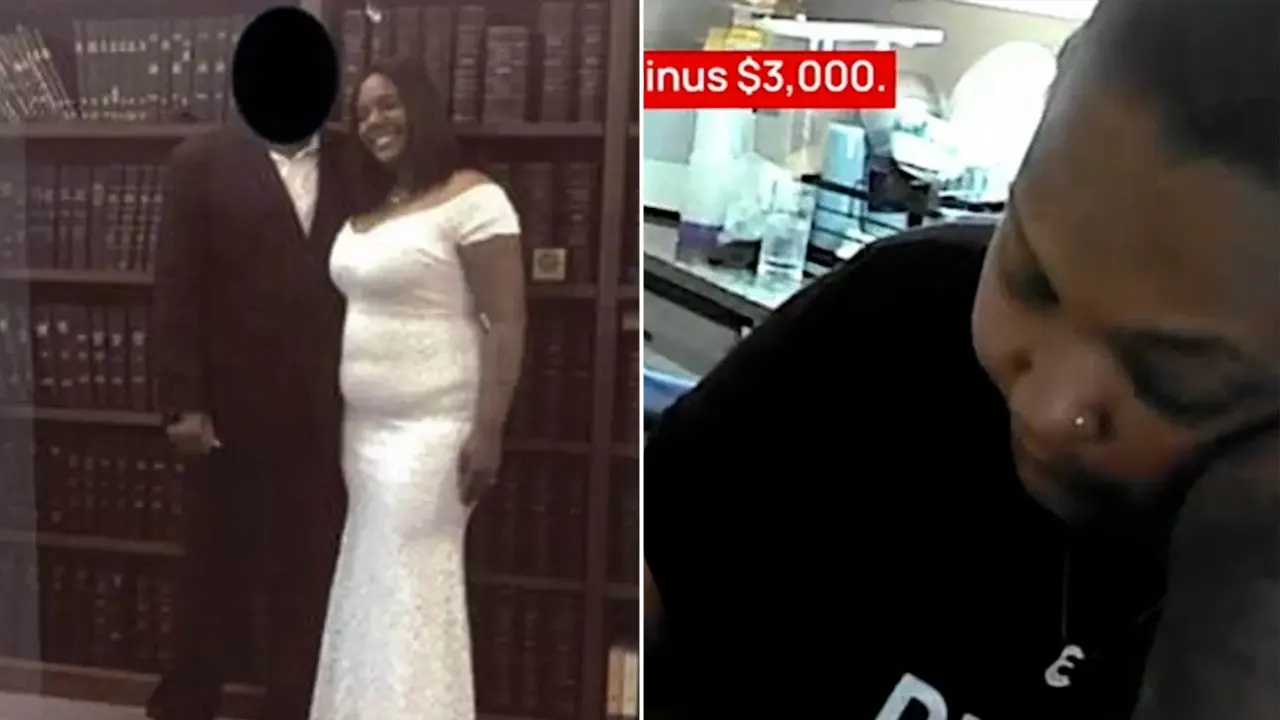
Federal prosecutors in Massachusetts have released a video that offers a rare, unfiltered look inside an alleged scheme to sell the American dream through sham marriages. The woman at the center of the case, Jennifer Gonzalez, is accused of orchestrating fake weddings between U.S. citizens and immigrants who needed legal status, charging immigrants up to $40,000 per marriage. The U.S. Attorney’s Office for the District of Massachusetts says the operation netted more than $6 million, and it has now made public a video recorded by a cooperating witness in which Gonzalez calmly explains how the fraud worked. In the footage, she does not come across as a hardened criminal in handcuffs. Instead, she appears as a confident businesswoman, walking a prospective client through the details of a contract, calculating payments on a calculator, and advising him on how to avoid leaving a paper trail. It is a startling look at a world where love and commitment are counterfeited, and where someone else’s desperation becomes an investor’s profit. For the immigrants involved, the arrangement was less a romantic wedding than a transaction—a high-stakes gamble with their futures. For Gonzalez, it was apparently a lucrative enterprise, one that allegedly allowed her to buy properties in other countries while selling a false promise of stability in the United States. As authorities describe it, Gonzalez was not an accidental participant or a low-level document broker. She was the ringleader, the person who connected citizens willing to marry for money with immigrants who had far more to lose. The video was recorded by a witness cooperating with federal law enforcement, which means that Gonzalez thought she was speaking to a potential customer. Instead, she was speaking to someone who was helping build the case against her. That makes the footage all the more revealing: it is not a confession made under oath, but a business meeting captured in real time. It shows how brazen the operation had become, and how comfortable Gonzalez was explaining the details of her illegal scheme to a complete stranger.
At one point in the video, Gonzalez describes what happens when a potential client arrives. She does not talk about helping people start a new chapter; she talks about supply and demand. “They will come, I will present them to the wife, they’re like, ‘yes, I want them, not a problem, I’ll be back in, I don’t know, three weeks.’ And they would leave and make me hold these girls for months,” she explained. The words are jarring. The women waiting to be chosen are not brides in any real sense; they are inventory, held for men who might or might not return. Gonzalez then turns to the money, moving through the numbers with the ease of someone who has done this countless times. “The payment, it’s agreed by both parties, OK? This is the first initial payment for the total amount of $38,000. Now, let me calculate that real quick. So $38,000 minus $3,000… That’s going to give us $35,000. And then the day of the wedding, you have to bring me, what? $12,000.” She is not nervous. She is not whispering. She is explaining terms with the confidence of a salesperson, as if she were selling a car or a vacation package rather than a marriage. The video is all the more disturbing because it is so ordinary. There is no melodrama, no hint of guilt, no acknowledgment that the arrangements she is describing could ruin lives. The witness who recorded the exchange was posing as an immigrant seeking a green card through marriage, so every sentence out of Gonzalez’s mouth became evidence. In her mind, she was managing risk, not committing a crime. But the calmness in her voice is perhaps the most disturbing part. For Gonzalez, the people involved were customers and commodities, not human beings making life-altering decisions under tremendous pressure.
Perhaps the most revealing part of the video is what Gonzalez says about contracts. She makes clear that the client—the immigrant—is the one she is working with, and that the American citizen involved in the marriage should stay out of the paperwork. “You and I are the ones in this contract, not nobody else. Because we don’t want to get your wife and yourself into a…putting in paper about a fake marriage. You know what I mean? Does that make sense to you? Because if anything happened, we don’t want them to have any proof that this was fake,” she said. In other words, she was building a structure designed to protect herself and her operation. If the marriage was exposed, the immigrant and the citizen spouse would be the ones holding the evidence, while Gonzalez could step back and claim she had simply introduced two people. It is a cynical way to run a business, and it speaks to the broader cruelty of fraud: the people who pay the most are often the ones least able to defend themselves. She also made it clear that the payments were structured to give her maximum control. The initial payment came before the paperwork began. The second payment came at the wedding. Any additional fees were negotiated along the way. By insisting that only she and the immigrant were parties to the contract, she was creating a situation where the immigrant had no legal protection if the marriage fell apart or if the citizen spouse backed out. There would be no written agreement to take to a lawyer, no receipt to prove what was paid, and no one to call but the woman who had promised to deliver a future and then vanished. For the immigrant, the contract meant handing over tens of thousands of dollars to someone who would never appear in any official record. For the citizen spouse, it meant participating in a lie that could lead to criminal charges, deportation proceedings, and the permanent destruction of a reputation. Gonzalez, meanwhile, was allegedly collecting payments at every stage while making sure that her own name stayed off the documents that could incriminate her. It was fraud with a legal strategy, and it treated human lives as liabilities.
Gonzalez also knew how to use the politics of immigration to her advantage. In the video, she tells the witness that Massachusetts is the best place for an immigrant to be. “Massachusetts is best place for you to be. That is a fact,” she said. “You get health insurance. You get a lot of help as an immigrant here,” she explained, adding, “Trump doesn’t like this state because…the state defends us very much.” Her remarks are a window into how criminal facilitators think. Sanctuary policies were not, for her, a matter of principle or compassion. They were selling points. She could promise clients access to health care, social services, and a state government that would not ask too many questions. That made her fake-marriage packages more attractive and more expensive. Her choice of Massachusetts was no accident. As a sanctuary state, it has policies that limit cooperation between local law enforcement and federal immigration authorities. That made it a safer environment for people living in the country without papers. But it also made it a fertile ground for fraud, because there were fewer checks on the documents and relationships that Gonzalez was creating. For her, sanctuary was not a moral stance; it was a market condition. She saw a state that was willing to protect immigrants and turned it into a place where she could charge them thousands of dollars for a fake wedding, knowing the local system would not scrutinize their status too closely. At the same time, she was paying attention to the political climate. She revealed that she stopped arranging marriages around 2025 because of increased federal immigration enforcement. In her own words, the crackdown made the business too risky. That detail is important because it shows that she was not just following the law—she was calculating when to get out. It also suggests that her operation was flexible enough to adapt to changing times, and that she may have moved on before authorities caught up with her. For the immigrants who trusted her, the timing was less convenient. They were left with marriages built on lies, payments they could never recover, and legal exposure that did not disappear simply because their broker decided to retire.
Gonzalez, according to the video, did not just make money from immigrant fees. She also told the witness that she owned multiple properties in the Dominican Republic, which she called “my country,” and in Puerto Rico. That detail caught the attention of U.S. Attorney Leah Foley, who framed it as the defining irony of the case. “Miss Gonzalez got rich off selling the American dream, all the while investing her money in another country,” Foley said. The line captures the essence of the alleged scheme: the American dream was not something Gonzalez believed in—it was something she packaged, marketed, and sold to people who were willing to risk everything to obtain it. She reportedly took their payments and used the profits to build a life somewhere else, far from the consequences of her actions. The video also shows Gonzalez explaining her personal connection to the countries where she invested her earnings. When she called the Dominican Republic “my country,” she revealed something important: she considered herself an outsider to the United States in some way, even as she was helping others enter it. Her loyalty was not to the nation whose legal system she was violating. It was to the wealth she was accumulating, and to the places where that wealth could be hidden from the consequences of her actions. That is a particularly cynical form of exploitation: she used the opportunities of the United States to earn millions, then transferred the money to places where she believed she would be safe from federal investigators. There is something heartbreaking in that image. The immigrants who paid her were not looking for luxury. They were looking for safety, family, work, and the chance to be recognized as the people they already were. Gonzalez was offering them a shortcut, but it was a shortcut that led to a dead end. By making her clients sign contracts with her directly and by keeping the citizen spouses off the paperwork, she made sure that if the scheme collapsed, the blame would fall on the people who were already the most vulnerable. The prosecutor’s words also serve as a reminder that immigration fraud is never just a violation of administrative rules. It is a money-making enterprise that feeds on the hopes of people who have been told, often by the very world around them, that they are not enough.
While prosecutors described Gonzalez as the ringleader of the operation, she was not alone. Authorities arrested four other co-conspirators who were allegedly involved in the scheme, and the investigation is likely not over. The case will now move through the courts, where Gonzalez and her codefendants will have the opportunity to respond to the charges. But regardless of how the legal process unfolds, the video has already had an impact. It shows, in vivid and human terms, how immigration fraud can become a business—and how easily that business can corrupt something as personal as marriage. It also reveals the broader stakes in the national debate over immigration. Some will view this case as proof that the system is vulnerable to bad actors. Others will see it as evidence that immigrants are often preyed upon by criminals who exploit their fears. Both views contain a measure of truth. The real lesson may be that fraud does not happen in a vacuum. It happens when people with money see people in need, and when the law becomes a maze that some find impossible to navigate. For immigration enforcement agencies, the case is a warning to unscrupulous brokers that they will be held accountable. For the immigrants who may have been involved, it is a reminder that a fake marriage can be a trap. Many people who enter into such arrangements do not fully understand the danger until it is too late. The government has a responsibility to investigate fraud, but it also has a responsibility to acknowledge that people who are exploited by brokers like Gonzalez are often victims themselves, even if they also broke the law. The line between victim and perpetrator is not always clear, and the video captures that complexity in a single, unforgettable image: a woman in a simple room, using a calculator to put a price on a marriage, while a desperate man sits across from her, hoping that this time, somebody will actually keep their promise. The video is not simply evidence against Jennifer Gonzalez; it is a reminder that behind every criminal case there are human stories—of love that was never love, of money that was never returned, and of dreams that were sold to the highest bidder. The American dream should not be a product. But in the world Gonzalez allegedly built, it was exactly that.